Case Study: Algebra (Part 2): Applying Learning Strategies to Intermediate Algebra

Case Study
Algebra (Part 2): Applying Learning Strategies to Intermediate Algebra
Introduction
 Algebra is a branch of mathematics that uses symbols and operations to solve problems. As they solve these problems, students are required to think abstractly and use multiple representations (e.g., symbols, equations, graphs, diagrams) to represent the math concepts. They are also required to generalize mathematical concepts that they previously learned, using those concepts as they transition from completing problems with numbers to solving problems with symbols (e.g., 6 + 3x + x2). However, many students have not obtained a strong foundation in these mathematical concepts. For this reason, these students are unprepared for algebra.
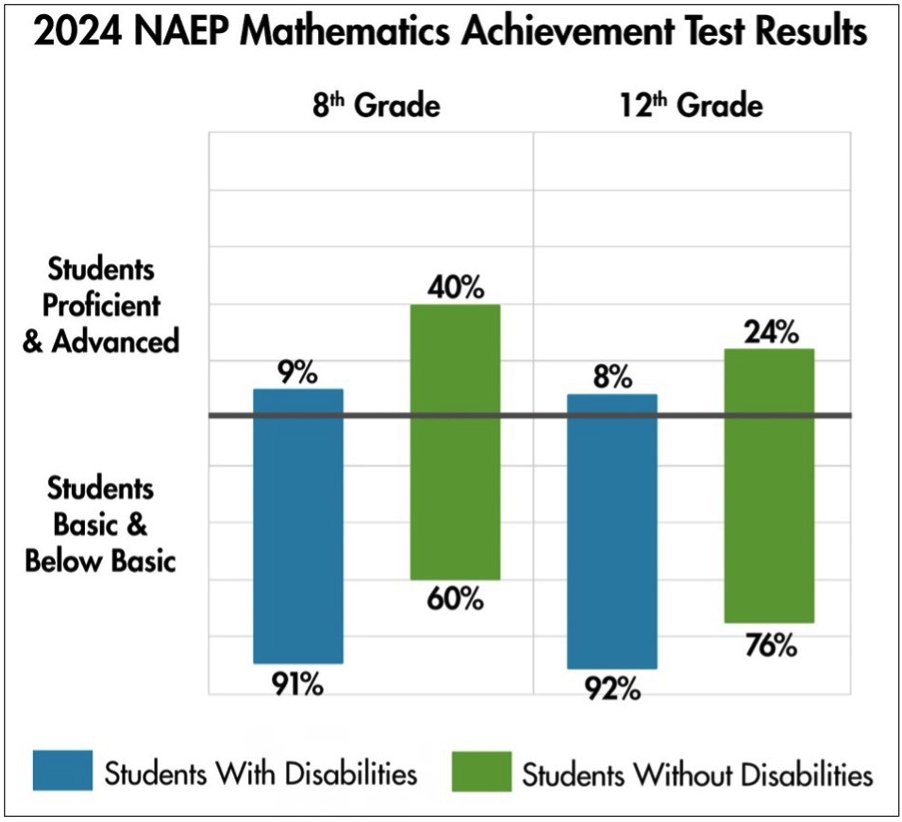
The National Assessment of Education Progress (NAEP) administers mathematics achievement assessments to fourth- and eighth-grade students each year and to 12th-grade students every four years. Student performance indicates the degree to which they have acquired the knowledge and skills expected at their grade level. The results are categorized into one of four levels: Below Basic (little mastery), Basic (partial mastery), Proficient (mastery), and Advanced (beyond mastery). NAEP data indicate the following for different student groups:
- Students with disabilities
- 9% of eighth graders are Proficient and Advanced
- 8% of 12th graders are Proficient and Advanced
- Students without disabilities
- 40% of eighth graders are Proficient and Advanced
- 24% of 12th graders are Proficient and Advanced
Source: National Assessment of Education Progress. (2024). NAEP mathematics achievement test results. The Nation’s Report Card. https://www.nationsreportcard.gov/ndecore/xplore/NDE
The National Mathematics Advisory Panel (NMAP) identified three mathematical concepts needed for students to be successful in algebra.
For Your Information
NMAP (2008) states that six major topics should be covered in algebra:
- Symbols and Expressions
- Linear Equations
- Quadratic Equations
- Functions
- Algebra of Polynomials
- Combinatorics and Finite Probability
This case study unit describes strategies applicable for polynomials. Strategies applicable to the first four topics are covered in Algebra (Part 1): Applying Learning Strategies to Beginning Algebra.*
- Fluent with whole numbers—In addition to having a strong number sense, students must understand and be able to use place value and properties, compose and decompose numbers, and estimate. They must also be fluent in basic operations (i.e., addition, subtraction, multiplication, division) and be able to apply those operations to problem-solving.
- Fluent with rational numbers—Students must understand and be able to compute positive and negative fractions and understand the relationships among fractions, decimals, and percents. They should also understand rates, proportionality, and probability.
- Understanding of geometrical measurement—To solve algebra problems, students should understand similar triangles and be able to analyze two- and three-dimensional shapes. In addition, students are required to identify and use formulas (e.g., perimeter, area, volume) as well as identify unknown lengths, angles, and areas.
Students who have difficulties in any of these three concepts— as well as deficits in long-term memory, working memory, and organizational skills—will struggle with algebra due to the high cognitive load (i.e., the amount of working memory resources being used for a task) needed to solve problems.
*Note: As students graduate to more complex algebraic procedures, such as solving problems containing exponents and factoring polynomials, they can still use the same learning strategies that they used to understand the basics of algebra. This case study unit contains three of the four strategies introduced in Algebra (Part 1): Applying Learning Strategies to Beginning Algebra—using precise mathematical language, the Concrete-Representational-Abstract (CRA) method, and metacognitive strategies. As such, the basic information on the STAR sheets is the same. However, this case study unit shows how to apply them to more advanced algebraic concepts and offers examples of more advanced problems.
NMAP also states that the curriculum must concurrently develop their conceptual understanding, computational fluency, and problem-solving skills for them to be successful in algebra. Six essential instructional strategies, five of which will be discussed in one or more STAR Sheets, have been identified to assist students in developing their knowledge and skills in algebra:
- Explicit instruction—Using a structured instructional method, educators first provide students a rationale and clear expectations for learning skills or concepts, then model, scaffold, provide opportunities for practice and engagement, and offer feedback until students have independently mastered the skill or concept.
- Multiple representations—Educators use manipulatives, as well as pictorial and symbolic representations, to demonstrate concepts; students use multiple representations to organize their thinking to demonstrate conceptual understanding.
- Sequence or range of examples—Educators specify a sequence or pattern of examples or a variation in the range of examples.
- Visual representations—Students use visuals such as diagrams or charts to organize their work, reflect their understanding of a problem, and correctly solve it.
- Student verbalization—Students verbalize self-instructions or solution steps, and teachers encourage students to think aloud when solving problems.
- Use of metacognitive strategies—Students use these strategies for organizing information and for solving problems with self-reflection and self-questioning.
Gersten, R., Chard, D. J., Jayanthi, M., Baker, S. K., Morphy, P., & Flojo, J. (2009). Mathematics instruction for students with learning disabilities: A meta-analysis of instructional components. Review of Educational Research, 79, 1202–1242. https://doi.org/10.3102/0034654309334431
Lee, J., Bryant, D. P., Ok, M. W., & Shin, M. (2020). A systematic review of interventions for algebraic concepts and skills of secondary students with learning disabilities. Learning Disabilities Research & Practice, 35(2), 89–99. https://doi.org/10.1111/ldrp.12217
National Assessment of Education Progress. (2024). NAEP mathematics achievement test results. The Nation’s Report Card. https://www.nationsreportcard.gov/ndecore/xplore/NDE
National Mathematics Advisory Panel. (2008). Reports of the task groups and subcommittees. U.S. Department of Education. http://files.eric.ed.gov/fulltext/ED502980.pdf
Watt, S. J., Watkins, J. R., & Abbitt, J. (2016). Teaching algebra to students with learning disabilities: Where have we come and where should we go? Journal of Learning Disabilities, 49, 437–447. https://doi.org/10.1177/0022219414564220
Overview of Basic Algebra Skills
- Add, subtract, multiply, and divide integers
- Add, subtract, multiply, and divide algebraic expressions
- Solve expressions with variables
- Solve two-step equations
- Solve multistep equations
- Solve real-world algebra problems
- Understand the algebraic order of operations
- Graph coordinates
- Understand functions
Each case study includes multiple STAR Sheets and cases.

STAR (STrategies And Resources) Sheets—These provide a description of a well-researched strategy that can help you solve the case studies in this unit.

Cases—These present a problem-based classroom issue or challenge and an assignment, which can be completed using one or more of the STAR Sheets. There are three progressive levels of cases: Level A (gathering information), Level B (analyzing information), and Level C (synthesizing information).
STAR Sheet
Using Precise Mathematical Language
About the Strategy
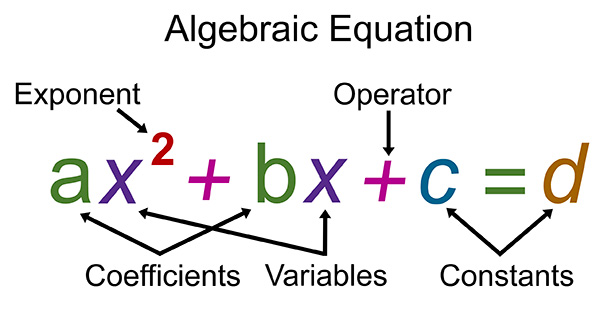 Using precise mathematical language requires the use of formal math terms (e.g., negative five rather than minus five for –5). For algebra, mathematical language includes both mathematical vocabulary terms and symbols. Using precise mathematical language:
- Helps to ensure clear communication among educators and students
- Facilitates better understanding of concepts for students
- Allows students to explain their mathematical reasoning
What the Research and Resources Say
- Mathematics vocabulary is necessary for the demonstration of mathematics proficiency (Hughes et al., 2016; Powell et al., 2018).
- Mathematical language should be consistently taught during mathematical instruction (Peeples et al., 2023; Hughes et al., 2016; Powell et al., 2018).
- Teachers must model clear and concise mathematical language through lessons, and they should expect students to use clear and concise mathematical language when explaining their solutions, providing support as needed (Hughes et al., 2016; Powell et al., 2018).
- The ability to solve word problems is dependent on understanding the language in the problems (Hughes et al., 2016; Powell et al., 2018).
Types of Activities to Implement
Educators should teach students to use precise mathematical language and provide good models when presenting content and providing feedback. Following are several instructional practices that educators can use to help students learn mathematical language.
Explicit Instruction for Pre-Teaching Mathematical Language
Educators can increase students’ mathematical language by explicitly pre-teaching novel terms and symbols to students before they encounter them in their work. When using explicit instruction to pre-teach mathematical language, educators should:
- Select language needed to understand the concept
- Provide a clear and precise definition
- Provide examples and non-examples
- Check for understanding
- Provide feedback
- Review
- Provide opportunities for independent practice
The examples below demonstrate how to implement the seven steps of explicit instruction. The first is an example of how to pre-teach a vocabulary term and the second is an example of how to introduce a symbol.
| Vocabulary Term: Base Number and Exponent | |
| Clear and precise definition |
|
| Examples |
|
| Non-examples |
|
| Check for understanding and feedback |
Teacher: Let’s look at this number 34. [Teacher says “three to the fourth power” while writing on the board.] The number three is the base number, the number that will be multiplied, and the number four is the exponent, the number of times we will multiply the base number. What number is the base number? |
| Independent practice |
Provide the students with an independent activity that allows them to demonstrate their understanding of base numbers and exponents. |
| Symbol: ≠ | |
| Clear and precise definition | The not-equal-to symbol ≠ means that two values or expressions are not equal. It is written as an equal sign with a diagonal line through it. |
| Examples |
|
| Non-examples |
|
| Check for understanding and provide feedback |
Teacher: Who can describe what the not-equal-to sign looks like? |
| Independent practice |
Provide the students with an activity they can complete independently that allows them to demonstrate their understanding of the not-equal-to symbol. |
Frayer Model
The Frayer Model is a graphic organizer used to build students’ understanding of key vocabulary terms across all subject areas. In mathematics, it also can be used to increase students’ understanding of symbols. This type of graphic organizer includes:
- The term—The vocabulary term or symbol is placed in the center circle.
- The definition—A clear and precise definition is provided in the upper-left quadrant and, if applicable, it can include an algebraic formula.
- Characteristics—Features that help the student recognize, identify, or distinguish the term or symbol are recorded in the upper-right quadrant.
- Examples—Synonyms, concrete applications, or relevant illustrations of the characteristics of the term or symbol are placed in the bottom-left quadrant. In mathematics, this might include tables, graphs, or diagrams.
- Non-examples—Antonyms, inappropriate applications, or relevant illustrations that do not fit the characteristics of the term or symbol are recorded in the bottom-right quadrant and might include tables, graphs, or diagrams.
Educators should provide explicit instruction on how to develop and use the Frayer Model. After asking students to create a Frayer Model on their own, teachers should review the completed models to ensure the information is correct. Below are two examples of a Frayer Model, the first for the term equation and the next for the absolute value symbol.
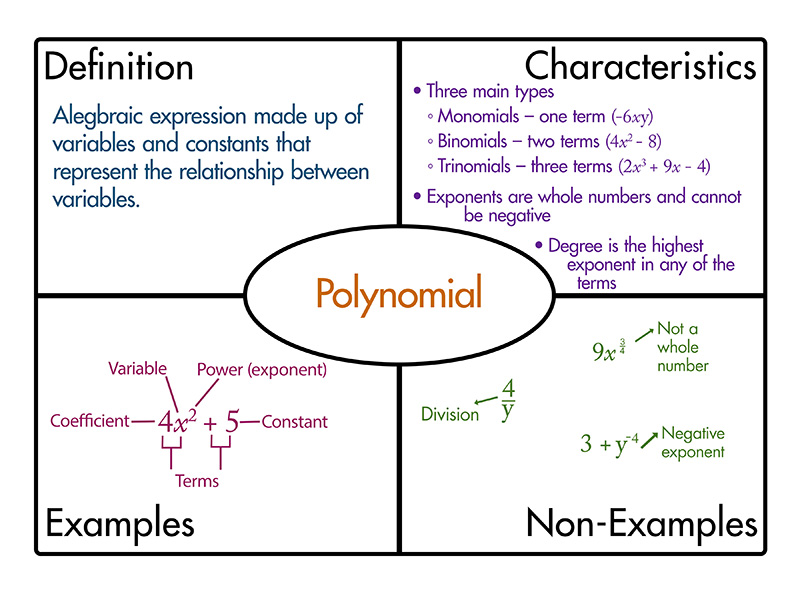
Description: A Frayer Model with four quadrants and a center circle that says Polynomial. The upper-left Definition quadrant says, “Algebraic expression made up of variables and constants that represent the relationship between variables.” The upper-right Characteristics quadrant says, “Three main types: monomials – one term (–6xy); binomials – two terms (4x 2 – 8); and trinomials – three terms (2x3 + 9x – 4). Exponents are whole numbers and cannot be negative. Degree is the highest exponent in any of the terms.” The lower-left Example quadrant shows 4x 2 + 5 and identifies the terms (4x 2, +5), coefficient (4), variable (x), power/exponent (2), and constant (5). The lower-right Non-Examples quadrant provides three non-examples of polynomials: 9x3/4, with the exponent labeled as “not a whole number”; 4/y, which is labeled as division; and 3 + y–4, with –4 labeled as a negative exponent.
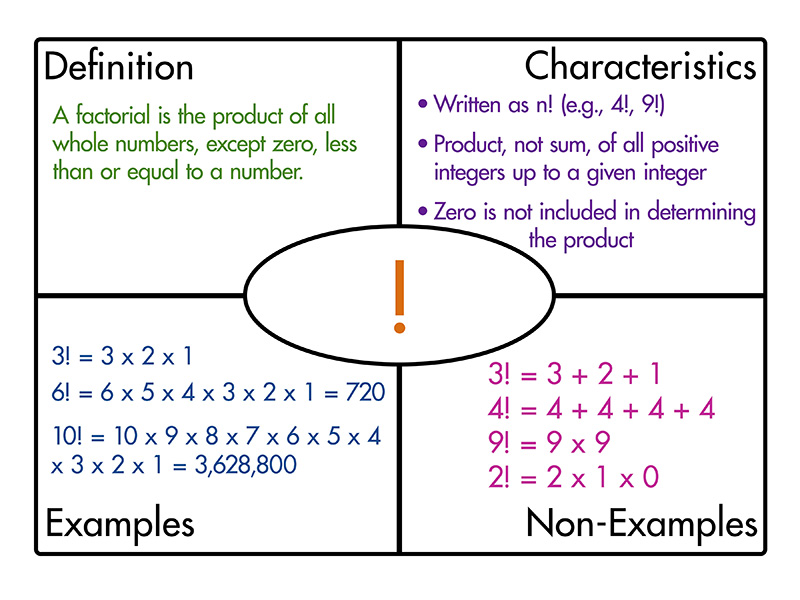
Description: A Frayer Model with four quadrants and a center circle that features the symbol for factorial. The upper-left Definition quadrant says, “A factorial is the product of all whole numbers, except zero, less than or equal to a number.” The upper-right Characteristics quadrant says, “Written as n! (e.g., 4!, 9!); product, not sum, of all positive integers up to a given integer; and zero is not included in determining the product.” The lower-left Examples quadrant provides three examples of factorials: 3! = 3 x 2 x 1, 6! = 6 x 5 x 4 x 3 x 2 x 1 = 720, and 10! = 10 x 9 x 8 x 7 x 6 x 5 x 4 x 3 x 2 x 1 = 3,628,800. The lower-right Non-Examples quadrant provides four non-examples of factorials: 3! = 3 + 2 + 1, 4! = 4 + 4 + 4 + 4, 9! = 9 x 9, 2! = 2 x 1 x 0.
Self-Correcting Activities
After students have been explicitly taught new vocabulary terms, they can use self-correcting word cards to continue practicing the words. This consists of two sets of cards: one set contains the vocabulary terms, and the other set contains the definitions. Each matching term and definition has the same symbol in the upper-right corner. After students match the term with the correct definition, they can check their work by making sure the word and the definition have the same symbol. This activity can be completed independently, with a peer, or in small groups.
The number that is multiplied by the variable in an algebraic expression.
Example: 5b
The product of all whole numbers that are greater than zero but less than or equal to a number.
Example: (5! = 5 × 4 × 3 × 2 × 1 = 120)
A single term that consists of a number, a variable, or the product of a number and one or more variables.
Examples: Examples: 7, a, 7b, ab
Keep in Mind
- When teaching mathematical terms, it is important to provide an example of the definition that students can relate to.
- Precise mathematical language must be used consistently in context for students to fully understand the meaning of mathematical terms and symbols and when to use them.
- Students should be expected to use precise mathematical language, and they should be given proper feedback when not using precise terms.
- Students must be taught vocabulary terms before working on self-correcting activities. Although these activities might seem juvenile, students will appreciate having the vocabulary cards for reference as needed.
Students in intermediate algebra courses should be familiar with common algebra terms and symbols. Below are lists of the most common.
| Term | Meaning |
| absolute value | The distance from a point on a number line to zero |
| algebraic equations | An equation that contains one or more variables |
| algebraic expression | An expression that is written using one or more variables |
| base number | A number that is to be multiplied by itself a specified number of times |
| binomial | A polynomial with two unlike terms, such as (2x + 3y), (3x + 7), (6x – 18), (6 × 10 – 8 × 4), or (4ab – 6a3b4) |
| coefficient | The number that is multiplied by the variable in an algebraic expression, such as the 5 in 5b |
| equivalent | Having the same value |
| exponent | The number that indicates how many times the base is used as a factor |
| exponential function | A function where the base is a known value and the exponent is a variable (e.g., y = 3x) |
| factorial | The product of all whole numbers that are greater than zero but less than or equal to a number (5! = 5 × 4 × 3 × 2 × 1 = 120) |
| formula | A rule that is expressed with symbols |
| inequality | A mathematical sentence showing quantities are not equal, using <, >, ≤, ≥, or ≠ (e.g., 14 < x + 5) |
| integers | The set of whole numbers and their opposites |
| like terms | Expressions that have the same variables and same powers of the variable |
| monomial | A single term that consists of a number, a variable, or the product of a number and one or more variables (e.g., 7, a, 7b, ab) |
| polynomial | A mathematical expression made up of variables, coefficients, and non-negative exponents, which are combined using addition, subtraction, and multiplication, but not division (e.g., 4×2 – 2x +7) |
| scientific notation | A number expressed as a decimal number between one and 10 that is then multiplied by a power of 10; used to write extremely large and small numbers (e.g., 6 × 10⁸) |
| trinomial | A polynomial with three unlike terms, such as (x2 + x + 1), (3 × 5 – 8 × 4 + x3), or (a2b + 12x + y) |
| variable | A letter used to represent one or more numbers in an expression, equation, or inequality |
| Symbol | Meaning | Example |
| + | add | 6 + 8 = 14 |
| − | subtract | 15 – 9 = 6 |
| × or • | multiply | 4 × 3 = 12 9 • 5 = 45 |
| ÷ or / | divide | 64 ÷ 8 = 8 42/7 = 6 |
| n | variable (unknown quantity) | 15 – n = 7 |
| = | equals | c + d = d + c |
| ≠ | not equal to | 7 × 8 ≠ 9 × 6 |
| ≈ | approximately equal to | 36 + 62 ≈ 100 |
| < | less than | 3 + 8 < 6 + 2 |
| ≤ | less than or equal to | b ≤ 81/9 |
| > | greater than | 36 > 3 × 9 |
| ≥ | greater than or equal to | a ≥ 8 + 7 |
| ( ) | parentheses (grouping) | 3(2 + 8) |
| [ ] | brackets (grouping) | 3 + [ 4(5 – 12)] |
| { } | braces (sets) | 5 {3 + [3 – (4 – 12) + 1]} |
| ∝ | proportional to | x∝y |
| Δ | delta (change or difference) | Δx = 8 – 4 = 4 |
| ⇒ | if…then (implies) | a is even and b is odd⇒a + b is odd |
| ⇔ | if and only if | x = y + 3⇔y = x – 3 |
| ∴ | therefore | c = d∴d = c |
| √ | radical (square root) | √16 = 4 |
| ∛ | cube root | ∛= 2 (23 = 8) |
| ! | factorial | 6! = 6 × 5 × 4 × 3 × 2 × 1 = 720 |
| |x| | absolute value | |–4| = 4 |
| ∑ | sigma (summation) | 5 + 6 + 7 + 8 = 26 |
| ∞ | infinity | –∞ < x < ∞ |
| E | Euler’s number | e = 2.718… |
| π | pi | 3.14159… |
| f(x) | function of x | f(4) = 2x + 4 2 • 4 + 4 = 12 |
| f∘g | function composition | (f∘g) (x) |
| ∫ | integral | ∫ 1dx = x + c |
| ∈ | element of | A = {2, 4, 6} |
Hughes, E. M., Powell, S. R., & Stevens, E. A. (2016). Supporting clear and concise mathematics language: Instead of that, say this. TEACHING Exceptional Children, 49(1), 7–17. https://doi.org/10.1177/0040059916654901
Peeples, K. N., Kroesch, A. M., & VanUitert, V. J. (2023). Math is not a universal language: Supporting middle school students with learning disabilities using explicit vocabulary instruction in mathematics classrooms. Learning Disabilities Research & Practice, 38(2), 129–143. https://doi.org/10.1111/ldrp.12303
Powell, S. R., Stevens, E. A., & Hughes, E. M. (2019). Math language in middle school: Be more specific. TEACHING Exceptional Children, 51(4), 286–295. https://doi.org/10.1177/0040059918808762
STAR Sheet
Concrete-Representational-Abstract (CRA) Approach
About the Strategy
 The Concrete-Representational-Abstract (CRA) approach is a strategy for teaching mathematical concepts by systematically connecting concrete objects or student-drawn representations to the abstract equation. It allows students to understand a concept before memorizing the algorithms. The components of the framework are:
- Concrete—Students interact and manipulate three-dimensional objects (e.g., algebra tiles, integer chips). This interaction helps students understand the concept, instead of simply having them solve the algorithm.
- Representational—Students use two-dimensional drawings to represent problems. These pictures may be presented to them by the teacher, through the curriculum used in class, or students may draw their own representation of the problem.
- Abstract—Students complete the algorithm without any concrete or representational assistance.
For Your Information
Two alternatives to the CRA model have emerged. The CRA Integration (CRA-I) strategy requires students to use all three stages simultaneously. When using the Virtual-Abstract (VA) method, students move directly from interacting with virtual manipulatives (as opposed to concrete manipulatives) to the abstract stage, skipping the representational stage.
What the Research and Resources Say
- CRA is effective for all age levels and can assist students in learning basic concepts, operations, and applications (Bundock et al., 2021; Flores et al., 2024).
- By using CRA, students gain a conceptual understanding of the problem and process instead of completing the problem using a memorized algorithm (Bouck et al., 2019; Bone et al., 2023; Namkung & Bricko, 2021).
- Virtual manipulatives are effective in helping students understand algebra concepts, and students prefer them over traditional concrete manipulatives (Bone et al., 2022; Bouck et al., 2018; Satsangi et al., 2018).
Virtual Manipulatives
When using CRA, educators can use virtual manipulatives in place of concrete manipulatives. Virtual manipulatives are displayed on electronic devices (e.g., computers, tablets, smartphones). Using virtual manipulatives allows educators to adjust support for students who are struggling and provide immediate feedback without the student feeling singled out. There are a variety of apps that educators can use; however, most must be purchased (typically at a low cost). And unlike software programs, connectivity issues or Internet speed are not an issue.
Educators should remain up to date on these apps and ask the following questions when selecting them to ensure they are appropriate and meet the instructional needs of their students.
- Is the content taught correctly?
- Are the skills aligned with state or district mathematics standards?
- Can students easily navigate the app?
- Can the settings and content be customized for individual students?
- Are there different modes of presentation?
- What physical movements are required (e.g., swiping, pinching)?
- What level of feedback does a student receive? And is it timely?
- What data are provided that allow teachers to monitor student progress?
- What attributes will motivate or engage students?
After selecting an app, the educators should use explicit instruction to teach students how to use them.
Types of Activities to Implement
Below, you will learn about each stage of CRA. When using this strategy, educators should:
- Be very familiar with the concrete objects prior to teaching and having students interact with them
- Provide modeling at all three stages of the CRA approach
- Continuously monitor student work during the concrete and representational levels, asking them questions about their thinking and providing clarification as needed
Examples
Below are multiple examples of how educators can use CRA to teach students to multiply and factor polynomials. For the concrete stage, the concrete manipulatives are represented as follows.
Note: Other manipulatives can be used to represent y, y2, y3, x2 and x3.
Multiplying Polynomials
| Concrete | |
| Step 1: Write out the problem. | (x + 4) (x – 2) |
| Step 2: Using algebra manipulatives, show (x + 4) (x – 2). | 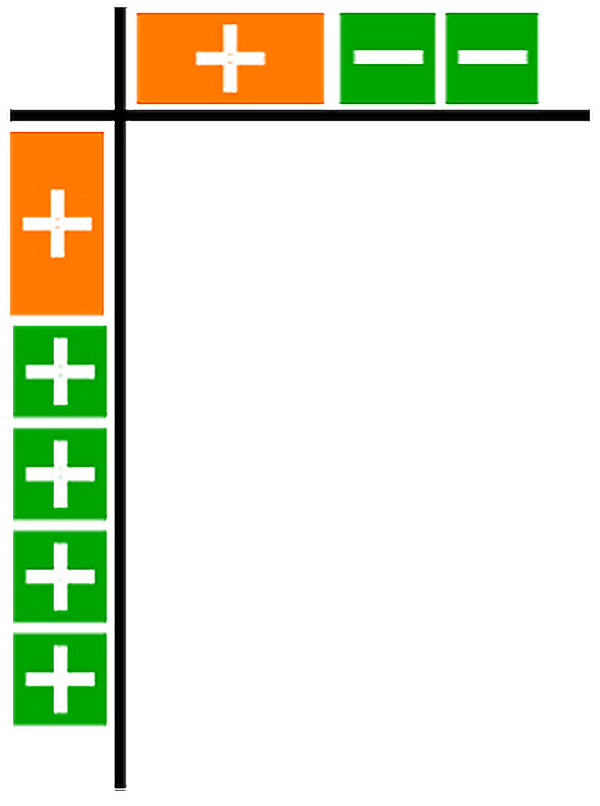 |
| Step 3: Multiply all factors and fill in the grid. | 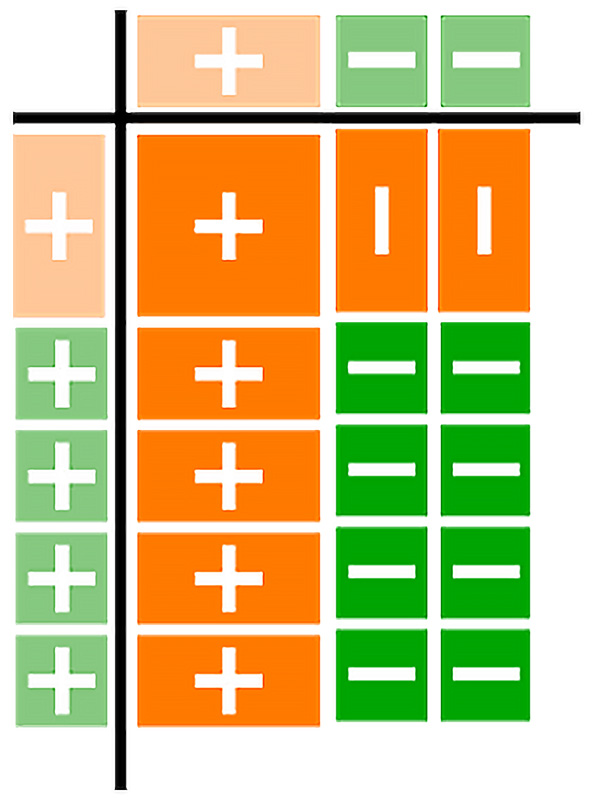 |
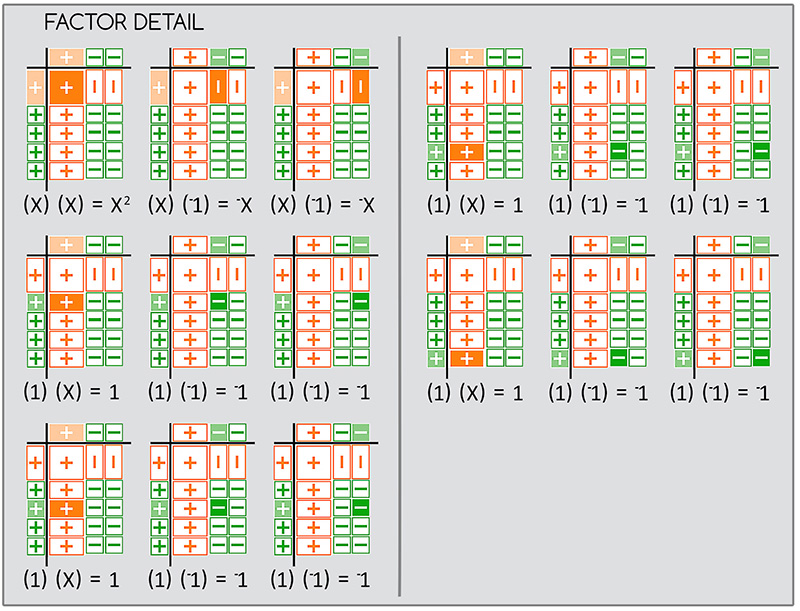 |
|
| Step 4: Cross out equal pairs (i.e., those that cancel each other out). | 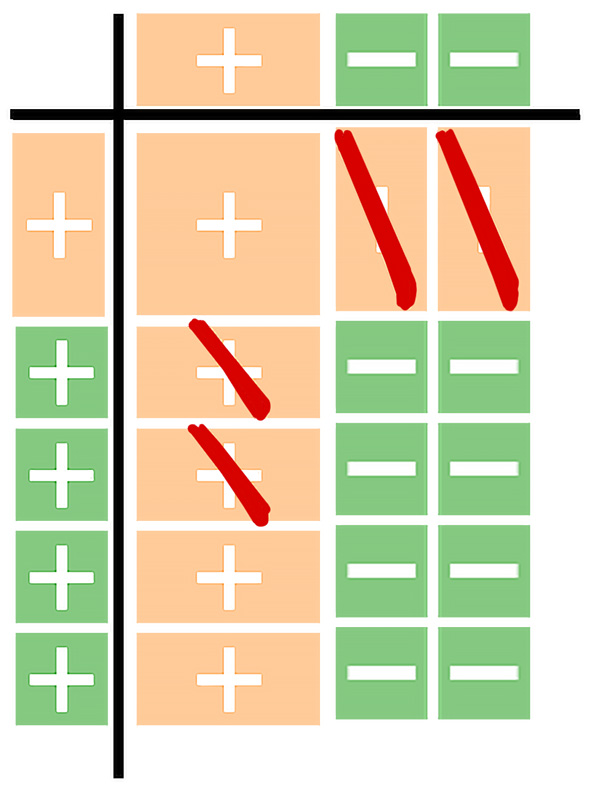 |
| Step 5: Write the answer. | (x + 4) (x – 2) = x 2 + 2x – 8 |
| Representational | |
| Step 1: Write out the problem. | (x + 4) (x – 2) |
| Step 2: Using algebra manipulatives, show (x + 4) (x – 2). | 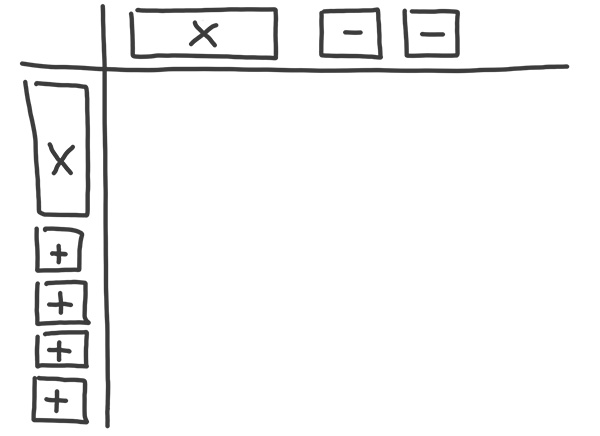 |
| Step 3: Multiply all factors and fill in the grid. | 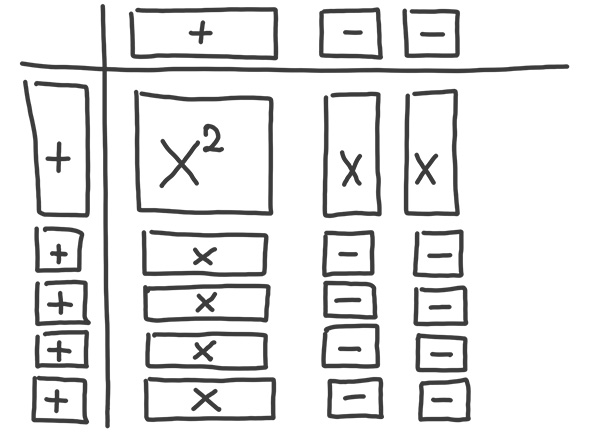 |
| Step 4: Cross out equal pairs (i.e., those that cancel each other out.) | 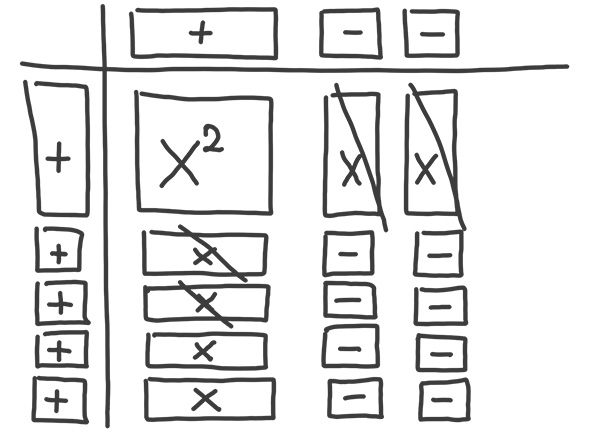 |
| Step 5: Write the answer. | (x + 4) (x – 2) = x 2 + 2x – 8 |
| Abstract | |
| (x + 4) (x – 2) = x 2 + 2x – 8 | |
| Concrete | |
| Step 1: Write out the problem. | x 2 + 4x + 4 |
| Step 2: Using algebra manipulatives, show x 2 + 4x + 4 (must be in a perfect square or rectangle). | 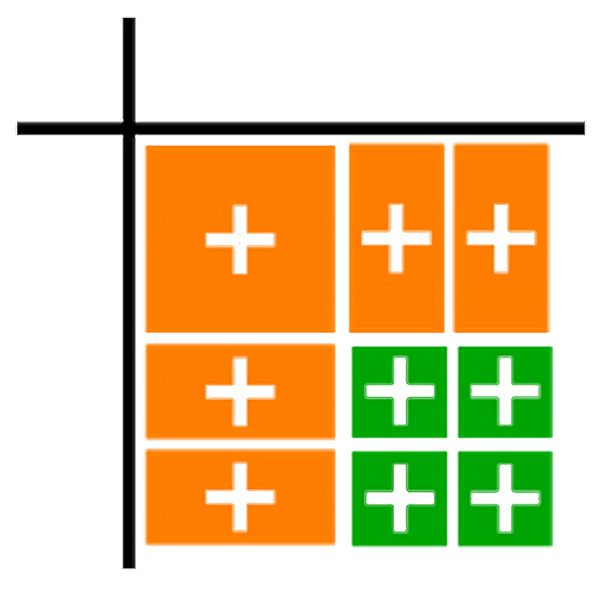 |
| Step 3: Factor the problem. | 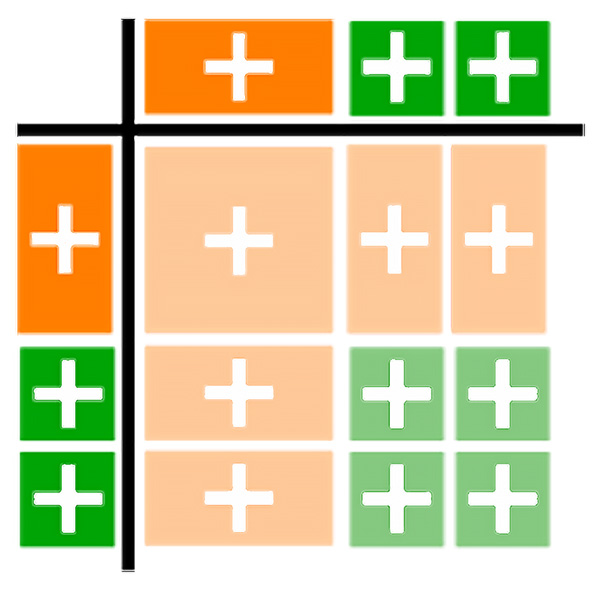 |
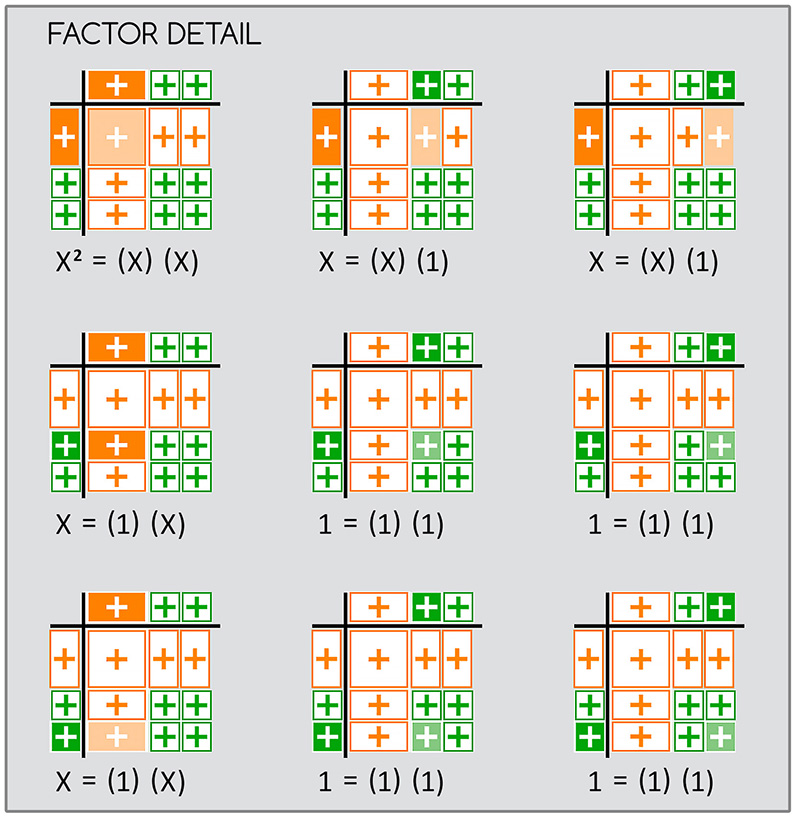 |
|
| Step 4: Cross out equal pairs (i.e., those that cancel each other out). | 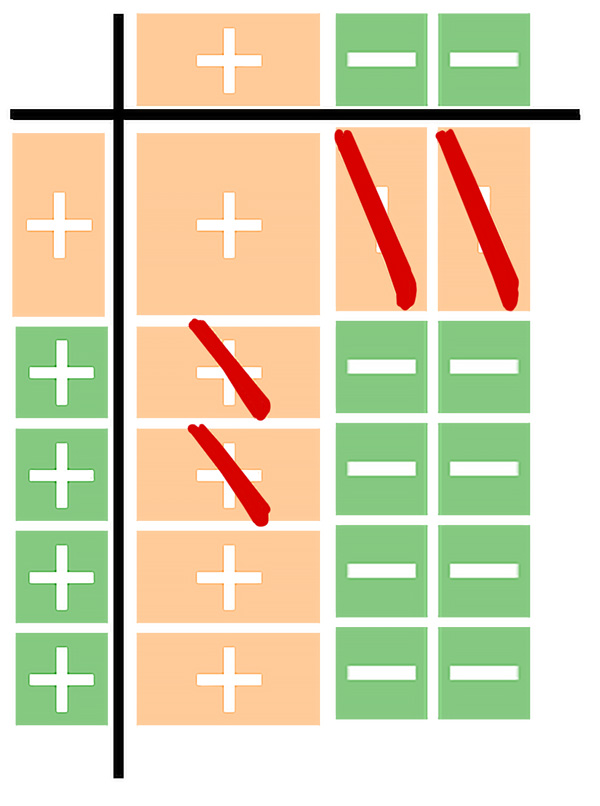 |
| Step 5: Write the answer. | (x + 4) (x – 2) = x2 + 2x – 8 |
| Representational | |
| Step 1: Write out the problem. | x 2 + 4x + 4 |
| Step 2: Using algebra manipulatives, show (x + 4) (x – 2). | 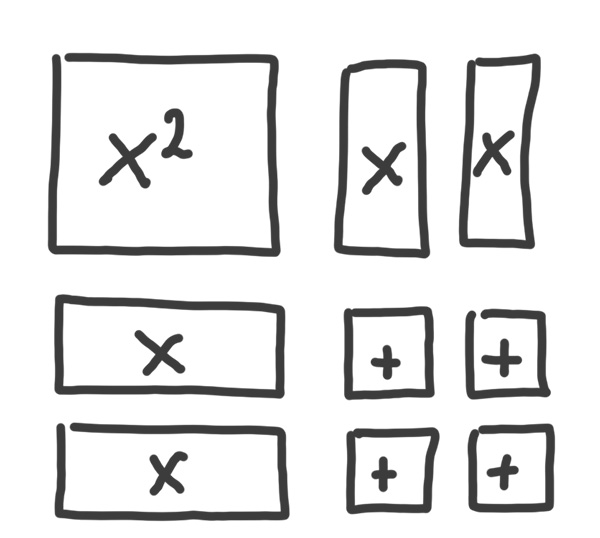 |
| Step 3: Multiply all factors and fill in the grid. | 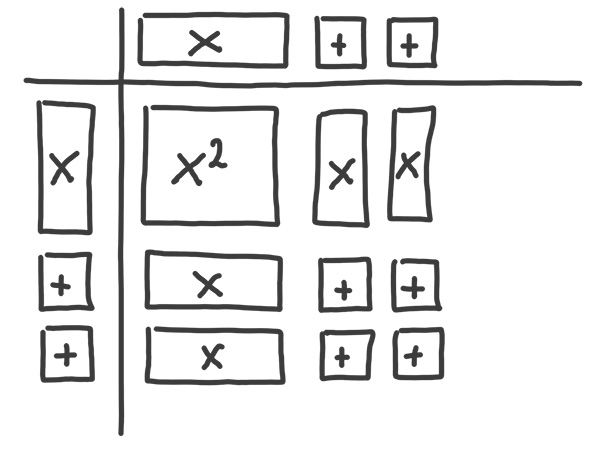 |
| Step 4: Write the answer. | x 2 + 4x + 4 = (x + 2)(x + 2) |
| Abstract | |
| x 2 + 4x + 4 = (x + 2)(x + 2) | |
Keep in Mind
- Activities during the concrete and representational stages must represent the actual process so that students are able to generalize the process during the abstract stage.
- Students must be able to manipulate the concrete objects; therefore, educators must have enough objects for students to use individually or in small groups (composed of no more than three students).
- Typically, students prefer virtual manipulatives over concrete manipulatives because they are more socially acceptable.
Bouck, E. C., Bassette, L., Shurr, J., Park, J., Kerr, J., & Whorley, A. (2017). Teaching equivalent fractions to secondary students with disabilities via the virtual-representational-abstract instructional sequence. Journal of Special Education Technology, 32, 220–231. https://doi.org/10.1177/0162643417727291
Bouck, E. C., Working, C., & Bone, E. (2018). Manipulative apps to support students with disabilities in mathematics. Intervention in School & Clinic, 53, 177–182. https://doi.org/10.1177/1053451217702115
Bouck, E. C., & Sprick, J. (2019). The virtual-representational-abstract framework for supporting students with disabilities in mathematics. Intervention in School and Clinic, 54, 173–180. https://doi.org/10.1177/1053451218767911
Bouck, E. C., Park, J., Satsangi, R., Cwiakala, K., & Levy, K. (2019). Using the virtual-abstract instructional sequence to support acquisition of algebra. Journal of Special Education Technology, 34(4), 253–268. https://doi.org/10.1177/0162643419833022
Satsangi, R., Bouck, E. C., Doughty, T. T., Bofferding, L., & Roberts, C. A. (2016). Comparing the effectiveness of virtual and concrete manipulatives to teach algebra to secondary students with learning disabilities. Learning Disability Quarterly, 39, 240–253. https://doi.org/10.1177/0731948716649754
Satsangi, R., Hammer, R., & Hogan, C. D. (2018). Studying virtual manipulatives paired with explicit instruction to teach algebraic equations to students with learning disabilities. Learning Disability Quarterly, 41(4), 227–242. https://doi.org/10.1177/0731948718769248
Shin, M., Bryant, D. P., Bryant, B. R., McKenna, J. W., Hou, F., & Ok, M. W. (2017). Virtual manipulatives: Tools for teaching mathematics to students with learning disabilities. Intervention in School and Clinic, 52(3), 148–153. https://doi.org/10.1177/1053451216644830
STAR Sheet
Metacognitive Strategies
About the Strategy
 Metacognitive strategies enable students to become aware of and understand their own thinking and how to transfer their learning to new contexts. Metacognition is the process of thinking about thinking or understanding one’s own learning patterns; this includes understanding the task, knowing what strategies work best for oneself, monitoring personal progress, and evaluating the results afterward. More specifically, metacognitive strategies help students learn to:
- Plan—Students decide how to approach the mathematical problem, first determining what the problem is asking and then selecting and implementing an appropriate strategy to solve it.
- Monitor—As students solve a mathematical problem, they check to see whether their problem-solving approach is working. After completing the problem, they consider whether the answer makes sense.
- Modify—If students determine that their problem-solving approach is not working or that their answer is incorrect, they can adjust their approach as they work to solve a mathematical problem.
What the Research and Resources Say
- When paired with cognitive strategies, metacognitive strategies have been shown to increase the understanding and ability of students with mathematics learning difficulties and disabilities to solve math problems (Pfannenstiel et al., 2015).
- Middle school students who received cognitive and metacognitive strategy instruction outperformed peers who received typical math instruction (Montague, Enders, & Dietz, 2011; Pfannenstiel, 2015).
Types of Activities to Implement
Below are examples of how three metacognitive strategies can be used in algebra.
Cue Cards
Cue cards, like those below, can help students remember important information such as formulas, definitions, or rules.
Addition of two numbers with like signs
- Find the sum of the numbers.
- Use the sign common to both numbers.
Addition of two numbers with unlike signs
- Find the difference between the numbers.
- Use the sign of the number with the greatest absolute value.
Mnemonics
In general, mnemonics are approaches that help students retain and recall information; therefore, they are sometimes referred to as memory-enhancing strategies. Some are simply words, sentences, or pictorial devices created to help students remember content (i.e., mnemonic devices), while others contain a more coordinated series of steps to help students perform a task (i.e., mnemonic strategies). Although there are different types of mnemonics, FOIL highlighted below is a first-letter strategy—wherein the first letters of the words in a list of items or steps are used to create another word (acronym) or sentence (acrostic).
FOIL
FOIL (First, Outside, Inside, Last) is a mnemonic device can help students remember the steps for multiplying two binomials. The figure below illustrates the guidelines students should follow to apply FOIL to algebra problems. This mnemonic is helpful when students complete the abstract phase of the CRA model.
F O I L
(x + 4) (x – 3)
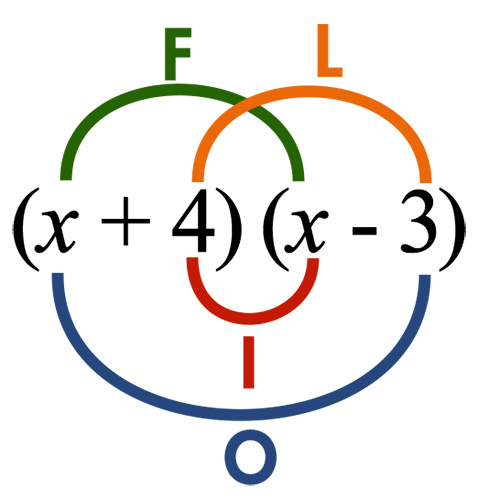
First (F) — multiply the first terms in each binomial (x • x = x2)
Outside (O) — multiply the outside terms in each binomial (x • –3 = –3x)
Inside (I) — multiply the inside terms in each binomial (4 • x = 4x)
Last (L) — multiply the last terms in each binomial (4 • –3 = –12)
Graphic Organizers
Graphic organizers are visual aids designed to help students organize and comprehend substantial amounts of text and content information. As illustrated in the Using Precise Mathematic Language STAR Sheet, a type of graphic organizer known as the Frayer Model can be used to build students’ understanding of key vocabulary terms across all subject areas. In the area of algebra, graphic organizers can provide students with steps and examples needed to solve mathematical problems. The first graphic organizer below provides steps on how to solve an exponent equation. The second provides a sequence of steps for factoring polynomials.
Exponent Equation
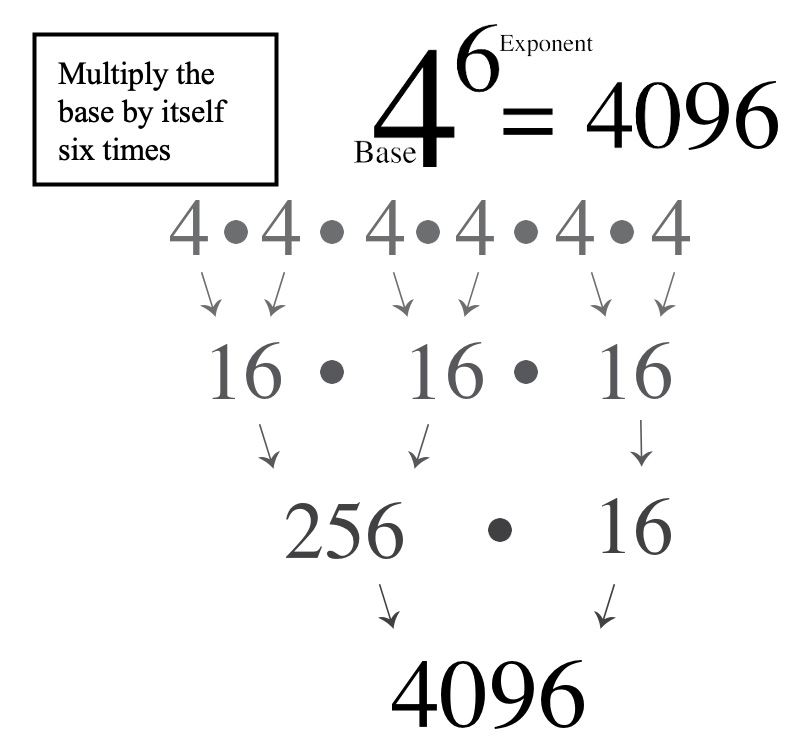
Factoring Polynomials
Problem: f 2 + 9f + 18
Degree is 2 (quadratic)
Number of terms is 3 (trinomial)
Coefficient of the squared term is 1
Steps for Factoring
- Place variables in parentheses
(f ) (f ) - Find greatest common factor (GCF)
9 = 1 x 9</br />3x3 18 = 1 x 18
2 x 9
3 x 6 - Divide
9 ÷ 3 = 3 18 ÷ 3 = 6 - Identify signs and complete parentheses
(f + 3) (f + 6) - Check by distributing Factoring polynomials
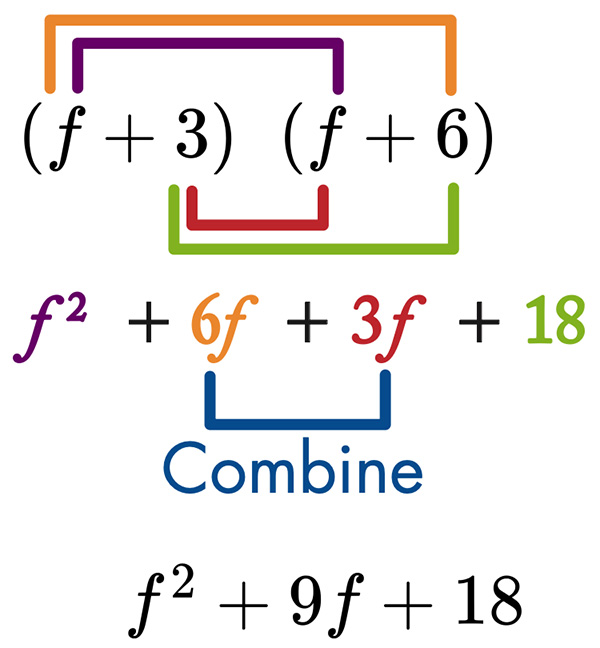 Multiply f by 6 — (f • 6 = 6f )
Multiply f by f — (f • f = f 2)
Multiply 3 by f — (3 • f = 3f )
Multiply 3 by 6 — (3 • 6 = 18)
Combine like terms — (6f + 3f = 9f ) - Practice problems
x2 – 3x – 9
x3 – 3x + 8
Keep in Mind
- These strategies are not substitutes for content instruction but should be used to enhance the content.
- Most of these strategies are not problem specific but are general strategies that can be applied across problem types.
- The use of these strategies must be explicitly taught, which includes being modeled by the teacher prior to student use.
- Ample practice and educator feedback are needed as students begin to select, create, and use these strategies.
Star, J. R., Caronongan, P., Foegen, A., Furgeson, J., Keating, B., Larson, M. R., Lyskawa, J., McCallum, W. G., Porath, J., & Zbiek, R. M. (2015). Teaching strategies for improving algebra knowledge in middle and high school students. National Center for Education Evaluation and Regional Assistance, Institute of Education Sciences, U.S. Department of Education. https://ies.ed.gov/ncee/wwc/docs/practiceguide/wwc_algebra_040715.pdf
Woodward, J., Beckmann, S., Driscoll, M., Franke, M., Herzig, P., Jitendra, A., Koedinger, K. R., & Ogbuehi, P. (2012). Improving mathematical problem solving in grades 4 through 8: A practice guide. National Center for Education Evaluation and Regional Assistance, Institute of Education Sciences, U.S. Department of Education. https://ies.ed.gov/ncee/wwc/Docs/PracticeGuide/MPS_PG_043012.pdf
Zollman, A. (2009). Students use graphic organizers to improve mathematical problem-solving communications. Middle School Journal, 41(2), 4–12. https://doi.org/10.1080/00940771.2009.11461707
Case
Level A • Case 1
Background
Student: Luke
Age: 15
Grade: 10th
Focus: Inequalities and absolute value
Scenario
It is January and Luke’s algebra class is learning about inequalities and absolute value. Although Luke’s teacher is pleased that her students are quickly grasping the concepts, she has noticed that Luke is having a great deal of difficulty. She knows the learning pace is too fast for him but feels slowing down would impede the progress of the other students. To address his needs, she has paired Luke with a peer to help him learn to solve:
- Inequalities that involve addition, subtraction, multiplication, and division
- Examples: h + 15 ≥ 5; m – 2.2 < 12.2; 9x > 18
- Compound inequalities
- Example: 2 < x < 5
- Absolute value equations
- Example: |3x – 2| = 10
Possible Strategies
- Using precise mathematical language
- Metacognitive strategies: cue cards
Assignment
- Read the introduction provided at the beginning of this case study.
- Read the STAR Sheets for each possible strategy listed above.
- For each strategy:
- Summarize the components.
- Describe how each strategy will support Luke.
Case
Level A • Case 2
Background
Student: Jaron
Age: 15
Grade: 9th
Focus: Exponents and exponential functions
Scenario
Jaron’s algebra class has begun working with exponents. Although Jaron understands how to solve for basic exponents (e.g., 46), he is having difficulty with more advanced exponent problems. To address Jaron’s needs, his teacher is planning to implement strategies to assist Jaron with:
- Simplifying exponent problems
- Examples: (5c5) (–b8c2); 104 – 102
- Simplifying quotients of powers
- Example: 27 ÷ 24
- Solving exponential function problems
- Example: 2x-1 =16
Possible Strategies
- Using precise mathematical language
- Concrete-Representational-Abstract (CRA) approach
Assignment
- Read the introduction provided at the beginning of this case study.
- Read the STAR Sheets for each possible strategy listed above.
- For each strategy:
- Summarize the components.
- Describe how each strategy will support Jaron.
Case
Level A • Case 3
Background
Student: LaTanya
Age: 15
Grade: 9th
Focus: Polynomials and factoring
Scenario
LaTanya’s class has begun working on polynomials and factoring. LaTanya had no difficulty at the beginning of the algebra course when working with expressions; however, she is now having trouble understanding the more advanced concepts. After working with LaTanya, her teacher realizes she is having difficulty with the many steps required to solve these problems. LaTanya’s teacher has decided to implement some strategies to help LaTanya, and other students, remember the process needed to:
- Simplify polynomial problems
- Examples: (x + 4) (x – 2); (2x + 2) + (3x – 3)
- Factor equations
- Examples: 4x2 + 12; x2 + 4x + 10
Possible Strategies
- Using precise mathematical language
- Concrete-Representational-Abstract (CRA) approach
- Metacognitive strategies: mnemonic devices
Assignment
- Read the introduction provided at the beginning of this case study.
- Read the STAR Sheets for each possible strategy listed above.
- Describe how each strategy will support LaTanya.
Case
Level B • Case 1
Background
Student: Tyler
Age: 16
Grade: 10th
Scenario
It is the beginning of the second semester and Tyler is having difficulty in his algebra class. He understands the basic concepts of algebra but has not mastered the skills needed to move to the higher-level skills that his class is working on. To address Tyler’s needs, his teacher has spoken with his parents about the possible need for additional support, including at home, to help him with the following goals:
- Solve exponent problems
- Examples: 46; (5c5) (–b8c2); 104 – 102
- Solve problems that require simplifying quotients of powers
- Example: 27 ÷ 24
- Solve compound inequalities
- Example: 2 < x < 5
- Solve inequalities that involve addition, subtraction, multiplication, and division
- Examples: h + 15 ≥ 5; m – 2 < 12.2; 9x > 18
- Solve absolute value equations
- Example: |3x – 2| = 10
Possible Strategies
- Using precise mathematical language
- Metacognitive strategies: graphic organizers
- Concrete-Representational-Abstract (CRA) approach
- Metacognitive strategies: mnemonic devices
Assignment
- Read the STAR Sheets for the four strategies listed above.
- Sequence Tyler’s goals in the order you would address them. (Consult your state standards or a mathematics curriculum for algebra.)
- For each goal:
- Identify a strategy to assist Tyler in meeting the goal.
- Explain how the strategy will assist Tyler in reaching his goals.
Case
Level B • Case 2
Background
Student: Bethari
Age: 14
Grade: 9th
Scenario
Bethari has been doing very well in algebra. She understands the basic concepts and enjoys solving problems. However, Bethari is having difficulty with concepts requiring higher-level reasoning skills. Specifically, she is having difficulty with multiplying polynomials and factoring. Bethari has a positive attitude and is motivated to learn strategies that will assist her in passing her algebra course. Her teacher has identified the following goals for her:
- Learn to distribute and simplify polynomial
- Examples: (x + 5) (x – 3); (4x + 6) + (5x – 8)
- Learn to factor equations.
- Examples: 9x2 + 12; x2 + 6x + 10
Possible Strategies
- Using precise mathematical language
- Concrete-Representational-Abstract (CRA) approach
- Metacognitive strategies: mnemonic devices
Assignment
- Read the STAR Sheets for the three strategies listed above.
- Explain how each strategy could assist Bethari in reaching her goals.
- Using one of these strategies, develop an activity that Bethari’s parents could use at home, and describe how they would be involved.
Case
Level C • Case 1
Background
Student: Ava
Age: 14.3
Grade: 9th
Scenario
Ava is a polite student who enjoys coming to school and has good attendance. She also enjoys working in groups with her peers, and they enjoy working with her. Her teacher notices, however, that she is having difficulty with the higher-level algebra concepts. Ava has a basic understanding of what to do and tries very hard, but she has trouble when working on problems independently. Being the middle of the school year, Ava’s teacher is concerned that she will continue having difficulty with the higher-level concepts and develop a negative attitude toward school.
Areas of Strength
- Proficient in basic facts
- Understands how to manipulate integers
- Can combine like terms
Assignment
- Develop three to four goals for Ava.
- Using the STAR Sheets, for each goal:
- Select a strategy to address it.
- Explain the benefit of using the strategy to address the goal.
- Select one goal and describe an independent practice activity that could assist Ava in achieving that goal.
To cite this case study unit, please use the following:
The IRIS Center. (2006, 2025). Algebra (part 2): Applying learning strategies to intermediate algebra. http://iris.peabody.vanderbilt.edu/wp-content/uploads/pdf_case_studies/ics_alg2.pdf
The contents of this resource were developed under a grant from the U.S. Department of Education, #H325E220001. However, those contents do not necessarily represent the policy of the U.S. Department of Education, and you should not assume endorsement by the Federal Government. Project Officer, Anna Macedonia.
Credits
Content ContributorsKim Paulsen Case Study DevelopersKim Paulsen EditorNicholas Shea |
Content ResearcherDestiny Schmitz GraphicsErika Dunton WebmasterJohn Harwood |
Licensure and Content Standards
This IRIS Case Study aligns with the following licensure and program standards and topic areas.
Council for Exceptional Children (CEC)
CEC standards encompass a wide range of ethics, standards, and practices created to help guide those who have taken on the crucial role of educating students with disabilities.
- Standard 5: Supporting Learning Using Effective Instruction
Interstate Teacher Assessment and Support Consortium (InTASC)
InTASC Model Core Teaching Standards are designed to help teachers of all grade levels and content areas to prepare their students either for college or for employment following graduation.
- Standard 8: Instructional Strategies
* For an answer key to this case study, please email your full name, title, and institutional affiliation to the IRIS Center at [email protected].