
Case Study
Algebra (Part 1): Applying Learning Strategies to Beginning Algebra
Introduction
 It is not uncommon for students to make mistakes when solving math problems. Sometimes these are careless errors, and other times they are due to conceptual misunderstandings or skill deficits. When students consistently struggle or perform poorly on mathematics tasks, educators might consider conducting an error analysis. An error analysis is a type of diagnostic assessment that can help a teacher determine what types of errors a student is making and why. More specifically, it is the process of identifying and reviewing a student’s errors to determine whether an error pattern exists—that is, whether a student is making the same type of error consistently. If a pattern does exist, the teacher can identify a student’s misconceptions or skill deficits and subsequently design and implement instruction to address that student’s specific needs.
Research on error analysis is not new: Researchers around the world have been conducting studies on this topic for decades. Error analysis has been shown to be an effective method for identifying patterns of mathematical errors for any student, with or without disabilities, who is struggling in mathematics.
Benefits of Error Analysis
An error analysis can help a teacher to:
- Identify which steps the student is able to perform correctly (as opposed to simply marking answers either correct or incorrect, something that might mask what the student is doing right)
- Determine what type(s) of errors a student is making
- Determine whether an error is a onetime miscalculation or a persistent issue that indicates an important misunderstanding of a mathematic concept or procedure
- Select an effective instructional approach to address the student’s misconceptions and to teach the correct concept, strategy, or procedure
Steps for Conducting an Error Analysis
An error analysis consists of the following steps:
Step 1. Collect data: Ask the student to complete at least 3 to 5 problems of the same type (e.g., multidigit multiplication).
Step 2. Identify error patterns: Review the student’s solutions, looking for consistent error patterns (e.g., errors involving regrouping).
Step 3. Determine reasons for errors: Find out why the student is making these errors by examining the procedures they use to solve problems or by asking them to explain their logic.
Step 4. Use the data to address error patterns: Decide what type of instructional strategy will best address a student’s skill deficits or misunderstandings.
Ashlock, R. B. (2010). Error patterns in computation (10th ed.). Boston: Allyn & Bacon.
Ben-Zeev, T. (1998). Rational errors and the mathematical mind. Review of General Psychology, 2(4), 366–383.
Cox, L. S. (1975). Systematic errors in the four vertical algorithms in normal and handicapped populations. Journal for Research in Mathematics Education, 6(4), 202–220.
Hwang, J., & Riccomini, P. J. (2021). A descriptive analysis of the error patterns observed in the fraction-computation solution pathways of students with and without learning disabilities. Assessment for Effective Intervention, 46(2), 132–142. https://doi.org/10.1177/1534508419872256
Idris, S. (2011). Error patterns in addition and subtraction for fractions among form two students. Journal of Mathematics Education, 4(2), 35–54.
Kingsdorf, S., & Krawec, J. (2014). Error analysis of mathematical word problem solving across students with and without learning disabilities. Learning Disabilities Research & Practice, 29(2), 66–74.
Lewis, K. E. (2016). Beyond error patterns: A sociocultural view of fraction comparison errors in students with mathematical learning disabilities. Learning Disability Quarterly, 39(4), 199–212. https://doi.org/10.1177/0731948716658063
Lewis, K. E., & Fisher, M. B. (2018). Clinical interviews: Assessing and designing mathematics instruction for students with disabilities. Intervention in School and Clinic, 53(5), 283–291. https://doi.org/10.1177/1053451217736864
Lewis, K. E., Sweeney, G., Thompson, G. M., & Adler, R. M. (2020). Integer number sense and notation: A case study of a student with a mathematics learning disability. The Journal of Mathematical Behavior, 59, 100797. https://doi.org/10.1016/j.jmathb.2020.100797
Lin, T.-H., Riccomini, P. J., & Liang, Z. (2025). Mathematical error patterns of students with mathematics difficulty: A systematic review. Learning Disability Quarterly. https://doi.org/10.1177/07319487241310873
Nelson, G., & Powell, S. R. (2018a). Computation error analysis: Students with mathematics difficulty compared to typically achieving students. Assessment for Effective Intervention, 43(3), 144–156. https://doi.org/10.1177/1534508417745627
Radatz, H. (1979). Error analysis in mathematics education. Journal for Research in Mathematics Education, 10(3), 163–172.
Riccomini, P. J. (2014). Identifying and using error patterns to inform instruction for students struggling in mathematics. Webinar slideshow.
Yetkin, E. (2003). Student difficulties in learning elementary mathematics. ERIC Clearinghouse for Science, Mathematics, and Environmental Education. http://www.ericdigests.org/2004-3/ learning.html
Each case study includes multiple STAR Sheets and cases.

STAR (STrategies And Resources) Sheets—These provide a description of a well-researched strategy that can help you solve the case studies in this unit.

Cases—These present a problem-based classroom issue or challenge and an assignment, which can be completed using one or more of the STAR Sheets. There are three progressive levels of cases: Level A (gathering information), Level B (analyzing information), and Level C (synthesizing information).
STAR Sheet
Collecting Data
About the Strategy
 Collecting data for an error analysis involves asking a student to complete a worksheet, test, or progress monitoring measure containing a number of problems of the same type or asking students to explain their thinking and processes.
What the Research and Resources Say
- Error analysis is one form of diagnostic assessment. The data collected can help teachers understand why students are struggling to make progress on certain tasks and align instruction with the student’s specific needs (National Center on Intensive Intervention, n.d.;
Kingsdorf & Krawec, 2014; Hwang & Riccomini, 2021; Lewis, 2016; Lewis et al., 2020; Nelson & Powell, 2018). - Error analysis data can be collected using formal measures (e.g., chapter test, standardized test) or informal measures (e.g., homework, in-class worksheet, interview) (Riccomini, 2014; Lewis, 2016; Lewis & Fisher, 2018).
- To help determine an error pattern, the data collection measure must contain at a minimum three to five problems of the same type (Special Connections, n.d.).
- Common error types include using the wrong operation, miscalculation (e.g., basic facts, regrouping), procedural errors (e.g., forgetting to regroup, performing an incorrect operation), and visual-spatial errors (e.g., column alignment, patterns, reading graphs). (Nelson & Powell, 2018; Lin et al., 2025; Rong & Monnen, 2022; Nelson & Powell, 2018).
Identifying Data Sources
To conduct an error analysis for mathematics, the teacher must first collect data. She can do so by using a number of materials completed by the student (i.e., student product). These include worksheets, progress monitoring measures, assignments, quizzes, and chapter tests. Homework can also be used, assuming the teacher is confident that the student completed the assignment independently. Regardless of the type of student product used, it should contain at a minimum three to five problems of the same type. This allows a sufficient number of items with which to determine error patterns.
Scoring
To better understand why students are struggling, the teacher should mark each incorrect digit in a student’s answer, as opposed to simply marking the entire answer incorrect. Evaluating each digit in the answer allows the teacher to more quickly and clearly identify the student’s error and to determine whether the student is consistently making this error across a number of problems. For example, take a moment to examine the worksheet below. By marking the incorrect digits, the teacher can determine that although the student seems to understand basic math facts, he is not regrouping the “1” to the tens column in his addition and multiplication problems.
Note: Marking each incorrect digit might not always reveal the error pattern. Review the STAR Sheets Identifying Error Patterns, Word Problems: Additional Error Patterns, and Determining Reasons for Errors to learn more about identifying the different types of errors students make.
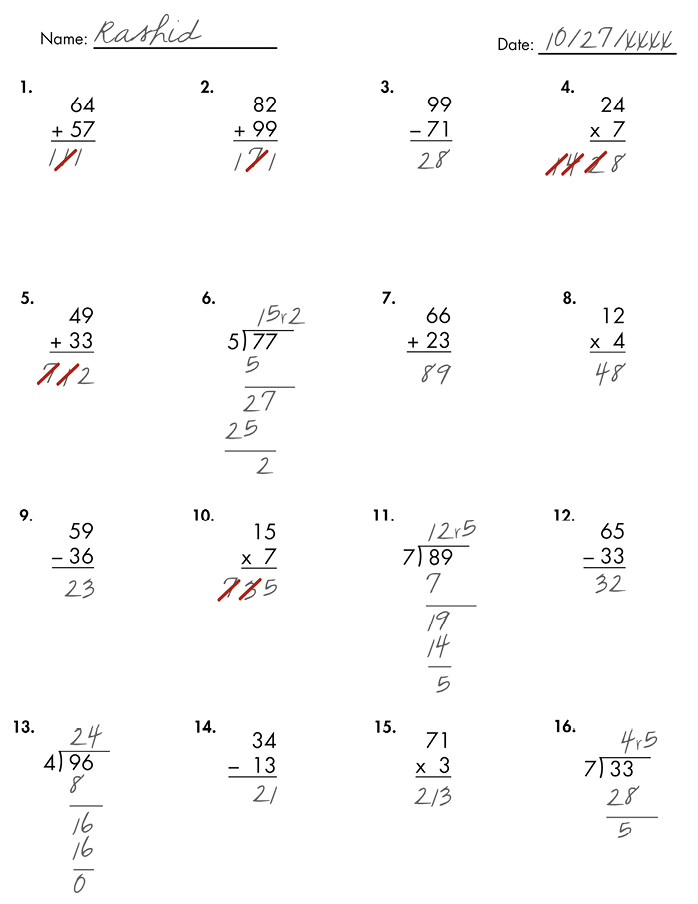
This math worksheet contains 16 problems with student answers and slashes through incorrect digits.
- Question 1 is 64 plus 57. The answer of 111 has the middle 1 crossed out.
- Question 2 is 82 plus 99. The answer of 171 has the 7 crossed out.
- Question 3 is 99 minus 71, with the answer of 28.
- Question 4 is 24 times 7. The answer of 1,428 has the 1, 4, and 2 crossed out.
- Question 5 is 49 plus 33. The answer of 712 has the 7 and 1 crossed out.
- Question 6 is 77 divided by 5, with the answer of 15 remainder 2.
- Question 7 is 66 plus 23, with the answer of 89.
- Question 8 is 12 times 4, with the answer of 48.
- Question 9 is 59 minus 36, with the answer of 23.
- Question 10 is 15 times 7. The answer of 735 has the 7 and 3 crossed out.
- Question 11 is 89 divided by 7, with the answer of 12 remainder 5.
- Question 12 is 65 minus 33, with the answer of 32.
- Question 13 is 96 divided by 4, with the answer of 24.
- Question 14 is 34 minus 13, with the answer of 21.
- Question 15 is 71 times 3, with the answer of 213.
- Question 16 is 33 divided by 7, with the answer of 4.5.
Tips
- Addition, subtraction, and multiplication problems should typically be scored from RIGHT to LEFT. By scoring from right to left, the teacher will be sure to note incorrect digits in the place value columns. However, division problems should be scored LEFT to RIGHT.
- If the student is not using a traditional algorithm to arrive at a solution, but instead is using a partial algorithm (e.g., partial sums, partial products), then addition, subtraction, multiplication, and division problems should be scored from LEFT to RIGHT.
Hwang, J., & Riccomini, P. J. (2021). A descriptive analysis of the error patterns observed in the fraction-computation solution pathways of students with and without learning disabilities. Assessment for Effective Intervention, 46(2), 132–142. https://doi.org/10.1177/1534508419872256
Kingsdorf, S., & Krawec, J. (2014). Error analysis of mathematical word problem solving across students with and without learning disabilities. Learning Disabilities Research and Practice, 29(2), 66–74.
Lewis, K. E. (2016). Beyond error patterns: A sociocultural view of fraction comparison errors in students with mathematical learning disabilities. Learning Disability Quarterly, 39(4), 199–212. https://doi.org/10.1177/0731948716658063
Lewis, K. E., & Fisher, M. B. (2018). Clinical interviews: Assessing and designing mathematics instruction for students with disabilities. Intervention in School and Clinic, 53(5), 283–291. https://doi.org/10.1177/1053451217736864
Lewis, K. E., Sweeney, G., Thompson, G. M., & Adler, R. M. (2020). Integer number sense and notation: A case study of a student with a mathematics learning disability. The Journal of Mathematical Behavior, 59, 100797. https://doi.org/10.1016/j.jmathb.2020.100797
Lin, T.-H., Riccomini, P. J., & Liang, Z. (2025). Mathematical error patterns of students with mathematics difficulty: A systematic review. Learning Disability Quarterly. https://doi.org/10.1177/07319487241310873
National Center on Intensive Intervention. (n.d.). Informal academic diagnostic assessment: Using data to guide intensive instruction. Part 3: Miscue and skills analysis. PowerPoint slides. http:// www.intensiveintervention.org/resource/informal-academic-diagnostic-assessment-using-data-guide-intensive-instruction-part-3
Nelson, G., & Powell, S. R. (2018a). Computation error analysis: Students with mathematics difficulty compared to typically achieving students. Assessment for Effective Intervention, 43(3), 144–156. https://doi.org/10.1177/1534508417745627
Riccomini, P. J. (2014). Identifying and using error patterns to inform instruction for students struggling in mathematics. Webinar series, Region 14 State Support Team.
Special Connections. (n.d.). Error pattern analysis. http://www.specialconnections. ku.edu/~specconn/page/instruction/math/pdf/patternanalysis.pdf
The University of Chicago School Mathematics Project. (n.d.). Learning multiple methods for any mathematical operation: Algorithms. http://everydaymath.uchicago.edu/about/why-it-works/ multiple-methods/About the Strategy
STAR Sheet
Identifying Error Patterns
About the Strategy
 Identifying error patterns refers to determining the type(s) of errors a student makes when solving mathematical problems. There are three types of errors:
- Factual errors—errors due to a lack of factual information (e.g., digit misidentification, counting errors)
- Procedural errors—errors due to the incorrect performance of steps in a mathematical process (e.g., not regrouping, decimal misplacement)
- Conceptual errors—errors due to misconceptions or a faulty understanding of the underlying principles and ideas connected to the mathematical problem (e.g., misunderstanding of place value, incorrectly applying rules to new problems)
For Your Information
Another type of error that a student might make is a careless error. The student fails to correctly solve a given mathematical problem despite having the necessary skills or knowledge. This might happen because the student is tired or distracted by activity elsewhere in the classroom. Although teachers can note the occurrence of such errors, doing so will do nothing to identify a student’s skill deficits. For many students, simply pointing out the error is all that is needed to correct it. However, it is important to note that students with learning disabilities often make careless errors.
What the Research and Resources Say
- Three to five errors on a particular type of problem constitute an error pattern (Howell, Fox, & Morehead, 1993; Radatz, 1979).
- Typically, student mathematical errors fall into three broad categories: factual, procedural, and conceptual. Each of these errors is related either to a student’s lack of knowledge or a misunderstanding (Fisher & Frey, 2012; Riccomini, 2014; Lin et al., 2025).
- Procedural errors are the most common type of error (Riccomini, 2014; Nelson & Powell, 2018).
- Because conceptual and procedural knowledge often overlap, it is difficult to distinguish conceptual errors from procedural errors (Rittle-Johnson, Siegler, & Alibali, 2001; Riccomini, 2014).
- Not every error is the result of a lack of knowledge or a skill deficit. Sometimes, a student makes a mistake as a result of being fatigued or distracted (i.e., careless errors) (Fisher & Frey, 2012).
Common Factual Errors
Factual errors occur when students lack factual information. Review the table below to learn about some of the common factual errors made by students.
| Factual Error | Examples |
| Has not mastered basic number facts
The student does not know basic mathematics facts and makes errors when adding, subtracting, multiplying, or dividing single-digit numbers. |
3 + 2 = 7 7 − 4 = 2 2 × 3 = 7 8 ÷ 4 = 3 |
| Misidentifies signs | 2 × 3 = 5 (The student identifies the multiplication sign as an addition sign.) 8 ÷ 4 = 4 (The student identifies the division sign as a minus sign.) |
| Misidentifies digits | The student identifies a 5 as a 2. |
| Makes counting errors | 1, 2, 3, 4, 5, 7, 8, 9 (The student skips 6.) |
| Does not know mathematical terms (vocabulary) | The student does not understand the meaning of terms such as numerator, denominator, greatest common factor, least common multiple, or circumference. |
| Does not know mathematical formulas |
The student does not know the formula for calculating the area of a circle. |
Common Procedural Errors
Procedural knowledge is an understanding of what steps or procedures are required to solve a problem. Procedural errors occur when a student incorrectly applies a rule or an algorithm (i.e., the formula or step-by-step procedure for solving a problem). Review the table below to learn more about some common procedural errors.
| Procedural Error | Examples | ||
| Regrouping Errors | |||
| Forgets to regroup
The student forgets to regroup when adding, multiplying, or subtracting. |
Example 1: The student adds 7 + 4 correctly but does not regroup one group of 10 to the tens column. 77
+ 54 121 Example 2: The student does not regroup one group of 10 from the tens column but instead subtracts the number that is less (3) from the greater number (6) in the ones column. 123
– 76 53 Example 3: After multiplying 2 × 6, the student fails to regroup one group of 10 from the tens column. 56
x 2 102 |
||
| Regroups across a zero
When a problem contains one or more 0s in the minuend (top number), the student is unsure of what to do. |
The student subtracts the 0 from the 2 instead of regrouping. 304
– 21 323 |
||
| Performs the incorrect operation
Although able to correctly identify the signs (e.g., addition, minus), students often subtract when they are supposed to add, or vice versa. However, students might also perform other incorrect operations, such as multiplying instead of adding. |
Example 1: The student adds instead of subtracts. 234
– 45 279 Example 2: The student multiplies instead of adds. 3
+ 2 6 |
||
| Fraction Errors | |||
| Fails to find common denominator when adding and subtracting fractions |
|
||
| Fails to invert and then multiply when dividing fractions |
|
||
| Fails to change the denominator in multiplying fractions |
|
||
| Incorrectly converts a mixed number to an improper fraction |
|
||
| Decimal Errors | |||
| Does not align decimal points when adding or subtracting
The student aligns the numbers without regard to where the decimal is located. |
The student does not align the decimal points correctly. In this case, .4 and .2 are in the tenths place and should be aligned. 120.4
+ 63.21 75.25 |
||
| Does not place the decimal in the appropriate place when multiplying or dividing
The student does not count and add the number of decimal places in each factor to determine the number of decimal places in the product. |
As with adding or subtracting, the student aligns the decimal point in the product with the decimal points in the factors. The student does not count and add the number of decimal places in each factor to determine the number of decimal places in the product. 3.4
x .2 6.8 |
||
Common Conceptual Errors
Conceptual knowledge is an understanding of underlying ideas and principles and a recognition of when to apply them. It also involves understanding the relationships among ideas and principles. Conceptual errors occur when a student holds misconceptions or lacks understanding of the underlying principles and ideas related to a given mathematical problem. Examine the table below to learn more about some common conceptual errors.
| Conceptual Error | Examples |
| Misunderstands place value
The student doesn’t understand place value and records the answer so that the numbers are not in the appropriate place value position. |
Example 1: The student adds all the numbers together ( 6 + 7 + 4 = 17 ), not understanding the values of the ones and tens columns. 67
+ 4 17 Example 2: The student records the answer with the numbers reversed, disregarding the appropriate place value position of the numbers or digits. 10
+ 9 91 Example 3: When expressing a number beyond two digits, the student does not have a conceptual understanding of the place value position. Write the following as a number:
Student answer:
|
| Overgeneralizes
Because of a lack of conceptual understanding, the student incorrectly applies rules or knowledge to novel situations. |
Example 1: Regardless of whether the greater number is in the minuend (top number) or subtrahend (bottom number), the student always subtracts the number that is less than the greater number, as is done with single-digit subtraction. 321
– 245 124 Example 2: Put the following fractions in order from smallest to largest. 77 1 12 Not understanding the relation between the numerator and its denominator (i.e., larger denominators mean smaller fractional parts), the student puts the fractions in the following order. 12 1 77 |
| Overspecializes
Because of a lack of conceptual understanding, the student develops an overly narrow definition of a given concept or of when to apply a rule or algorithm. |
Which of the triangles below are right triangles?
Associating a right triangle with only those with the same orientation as a, the student chooses a. |

Ashlock, R. B. (2010). Error patterns in computation (10th ed.). Boston: Allyn & Bacon.
Ben-Hur, M. (2006). Concept-rich mathematics instruction. Alexandria, VA: ASCD.
Cohen, L. G., & Spenciner, L. J. (2007). Assessment of children and youth with special needs (3rd ed.). Upper Saddle River, NJ: Pearson.
Educational Research Newsletter and Webinars. (n.d.). Students’ common errors in working with fractions. http://www.ernweb.com/educational-research-articles/students-common-errors-misconceptions-about-fractions/
El Paso Community College. (2009). Common mistakes: Decimals. http://www.epcc.edu/ CollegeReadiness/Documents/Decimals_0-40.pdf
El Paso Community College. (2009). Common mistakes: Fractions. http://www.epcc.edu/ CollegeReadiness/Documents/Fractions_0-40.pdf
Fisher, D., & Frey, N. (2012). Making time for feedback. Feedback for Learning, 70(1), 42–46.
Howell, K. W., Fox, S., & Morehead, M. K. (1993). Curriculum-based evaluation: Teaching and decision-making. Pacific Grove, CA: Brooks/Cole.
Lin, T.-H., Riccomini, P. J., & Liang, Z. (2025). Mathematical error patterns of students with mathematics difficulty: A systematic review. Learning Disability Quarterly. https://doi.org/10.1177/07319487241310873
National Council of Teachers of Mathematics. (2000). Principles and standards for school mathematics. Reston, VA: Author.
Nelson, G., & Powell, S. R. (2018a). Computation error analysis: Students with mathematics difficulty compared to typically achieving students. Assessment for Effective Intervention, 43(3), 144–156. https://doi.org/10.1177/1534508417745627
Riccomini, P. J. (2014). Identifying and using error patterns to inform instruction for students struggling in mathematics. Webinar series, Region 14 State Support Team.
Radatz, H. (1979). Error analysis in mathematics education. Journal for Research in Mathematics Education, 10(3), 163–172.
Rittle-Johnson, B., Siegler, R. S., & Alibali, M. W. ( 2001). Developing conceptual understanding and procedural skill in mathematics: An iterative process. Journal of Educational Psychology, 93(2), 346–362.
Sherman, H. J., Richardson, L. I., & Yard, G. J. (2009). Teaching learners who struggle with mathematics: Systematic intervention and remediation (2nd ed.). Upper Saddle River, NJ: Merrill/Pearson.
Siegler, R., Carpenter, T., Fennell, F., Geary, D., Lewis, J., Okamoto, Y., Thompson, L., & Wray, J. (2010). Developing effective fractions instruction for kindergarten through 8th grade: A practice guide (NCEE #2010-4039). Washington, DC: National Center for Education Evaluation and Regional Assistance, Institute of Education Sciences, U.S. Department of Education. http://ies.ed.gov/ncee/wwc/pdf/practice_guides/fractions_pg_093010.pdf
Special Connections. (n.d.). Error pattern analysis. http://www.specialconnections. ku.edu/~specconn/page/instruction/math/pdf/patternanalysis.pdf
STAR Sheet
Word Problems: Additional Error Patterns
About the Strategy
 A word problem presents a hypothetical real-world scenario that requires a student to apply mathematical knowledge and reasoning to reach a solution.
What the Research and Resources Say
- Students consider computational exercises more difficult when they are expressed as word problems rather than as number sentences (e.g., 3 + 2 =) (Sherman, Richardson, & Yard, 2009).
- When they solve word problems, students struggle most with understanding what the problem is asking them to do. More specifically, students might not recognize the problem type and therefore might not know what strategy to use (Jitendra et al., 2007; Sherman, Richardson, & Yard, 2009; Powell, 2011; Shin & Bryant, 2015; Lien et al., 2020).
- Word problems require a number of skills to solve (e.g., reading text, comprehending text, translating the text into a number sentence, determining the correct algorithm to use). As a result, many students, especially those with math and reading difficulties, find word problems challenging (Powell, Fuchs, Fuchs, Cirino, & Fletcher, 2009; Reys, Lindquist, Lambdin, & Smith, 2015; Lien et al., 2020).
- Word problems are especially difficult for students with learning disabilities (Krawec, 2014; Shin & Bryant, 2015).
Common Difficulties Associated With Solving Word Problems
A student might solve word problems incorrectly due to factual, procedural, or conceptual errors. However, a student might encounter additional difficulties when trying to solve word problems, many of which are associated with reading skill deficits, such as those described below.
Poor vocabulary knowledge: The student does not understand relevant mathematics terms (e.g., difference, factor, denominator).
Limited reading skills: The student has difficulty reading text with vocabulary and complex sentence structure. Because of this, the student struggles to understand what is being asked.
Inability to identify relevant information: The student has difficulty determining which pieces of information are relevant and which are irrelevant to solving the problem.
Lack of prior knowledge: The student has limited experience with the context in which the problem is embedded. For example, a student unfamiliar with cooking might have difficulty solving a fraction problem presented within the context of baking a pie.
Inability to translate the information into a mathematical equation: The student has difficulty translating the information in the word problem into a mathematical equation that they can solve. More specifically, the student might not be able to put the numbers in the correct order in the equation or determine the correct operation to use.
Example
Sample Word Problem
Jonathan would like to buy a new 21-speed bicycle. The bike costs $119.76. Jonathan received $25 for his birthday. He also worked for 3 months last summer and earned $59.50. Find the difference between what the bike costs and the amount of money Jonathan has.
The word problem to the right illustrates why students might have difficulty solving this type of problem. In addition to solving this word problem incorrectly due to factual, procedural, or conceptual errors, the student might struggle for reasons related to reading skill deficits.
- Poor vocabulary knowledge—The student might be unfamiliar with the term difference.
- Limited reading skills—The student might struggle with the problem’s final sentence because of its complex structure. Additionally, not understanding some of the non-mathematical vocabulary (e.g., received, earned ) might impede the student’s ability to solve the problem.
- Inability to identify relevant information—The student might attend to irrelevant information, such as the type of bicycle or the number of months Jonathan worked, and therefore solve the problem incorrectly.
- Lack of prior knowledge—The student might have limited knowledge about the process of making purchases.
- Inability to translate information into a mathematical equation—The student might have difficulty determining which operations to perform with which numbers. This situation might be made worse in cases involving problems with multiple steps.
Jitendra, A. K., Griffin, C. C., Haria, P., Leh, J., Adams, A., & Kaduvettoor, A. (2007). A comparison of single and multiple strategy instruction on third-grade students’ mathematical problem solving. Journal of Educational Psychology, 99(1), 115–127.
Krawec, J. L. (2014). Problem representation and mathematical problem solving of students of varying math ability. Journal of Learning Disabilities, 47(2), 103–115.
Lein, A. E., Jitendra, A. K., & Harwell, M. R. (2020). Effectiveness of mathematical word problem solving interventions for students with learning disabilities and/or mathematics difficulties:
A meta-analysis. Journal of Educational Psychology, 112(7), 1388–1408. https://doi.org/10.1037/edu0000453
Powell, S. R. (2011). Solving word problems using schemas: A review of the literature. Learning Disabilities Research & Practice, 26(2), 94–108.
Powell, S. R., Fuchs, L. S., Fuchs, D., Cirino, P. T., & Fletcher, J. M. (2009). Do word-problem features differentially affect problem difficulty as a function of students’ mathematics difficulty with and without reading difficulty? Journal of Learning Disabilities, 20(10), 1–12
Reys, R., Lindquist, M. M., Lambdin, D. V., & Smith, N. L. (2015). Helping children learn mathematics (11th ed.). Hoboken, NJ: John Wiley & Sons.
Sherman, H. J., Richardson, L. I., & Yard, G. J. (2009). Teaching learners who struggle with mathematics: Systematic intervention and remediation (2nd ed.). Upper Saddle River, NJ: Merrill/Pearson.
Shin, M., & Bryant, D. P. (2015). A synthesis of mathematical and cognitive performances of students with mathematics learning disabilities. Journal of Learning Disabilities, 48(1), 96–112.
STAR Sheet
Determining Reasons for Errors
About the Strategy
 Determining the reason for errors is the process through which teachers determine why the student is making a particular type of error.
What the Research and Resources Say
- Typically, a student’s errors are not random; instead, they are often based on incorrect algorithms or procedures applied systematically (Cox, 1975; Ben-Zeev, 1998; Nelson & Powell, 2018).
- To help students improve their mathematical performance, teachers must first identify and understand why students make particular errors (Radatz, 1979; Yetkin, 2003; Lin et al., 2025; Lewis, 2016).
- Knowing what a student is thinking when solving a problem can be a rich source of information about what the student does and does not understand (Hunt & Little, 2014; Baldwin & Yun, 2012; Lewis & Fisher, 2018).
Helpful Strategies
Determining exactly why a student is making a particular error is important in that it informs the teacher’s instructional response. Though it is sometimes obvious why a student is making a certain type of error, at other times, determining a reason proves more difficult. In these latter instances, the teacher can use one or more of the following strategies.
Interview the student—It is sometimes unclear why a student is making a particular type of error. For example, it can be difficult for a teacher to distinguish between procedural and conceptual errors. For this reason, it can be beneficial to ask a student to talk through the process for solving the problem. Teachers can ask general questions such as “How did you come up with that answer?” or prompt the student with statements such as “Show me how you got that answer.” Another reason teachers might want to interview the student is to make sure the student has the prerequisite skills to solve the problem.
Observe the student—A student might also reveal information through non-verbal means. This can include gestures, pauses, signs of frustration, and self-talk. The teacher can use information of this type to identify at what point in the problem-solving task that the student experiences difficulty or frustration. It can also help the teacher determine which procedure or set of rules a student is applying and why.
Look for exceptions to an error pattern—In addition to looking for error patterns, a teacher should note instances when the student does not make the same error on the same type of problem. This, too, can be informative because it might indicate that the student has a partial or basic understanding of the concept in question. For example, Cammy completed a worksheet on multiplying whole numbers by fractions. She seemed to get most of them wrong; however, she correctly answered the problems in which the fraction was 1/2. This seems to indicate that although Cammy conceptually understands what 1/2 of a whole is, she most likely does not know the process for multiplying whole numbers by fractions.
Considerations for Students With Learning Disabilities
Approximately 5%–8% of students exhibit mathematics learning disabilities. Therefore, it is important to understand that their unique learning differences might impact their ability to learn and correctly choose and apply solution strategies to solve mathematics problems. Teachers might notice that students who have learning disabilities:
- Have difficulty mastering basic number facts
- Make computational errors even though they might have a strong conceptual understanding
- Have difficulty making the connection between concrete objects and visual representations or abstract problems
- Struggle with mathematical terminology and written language
- Have visual-spatial deficits, which result in difficulty visualizing mathematical concepts (although this is quite rare)
Baldwin, E. E., & Yun, J. T. (2012). Mathematics curricula and formative assessments: Toward an error-based approach to formative data use in mathematics. Santa Barbara, CA: University of California Educational Evaluation Center.
Ben-Zeev, T. (1998). Rational errors and the mathematical mind. Review of General Psychology, 2(4), 366–383.
Cox, L. S. (1975). Systematic errors in the four vertical algorithms in normal and handicapped populations. Journal for Research in Mathematics Education, 6(4), 202–220.
Garnett, K. (n.d.). Math learning disabilities. http://www.ldonline.org article/Math_Learning_ Disabilities
Hunt, H. H., & Little, M. E. (2014). Intensifying interventions for students by identifying and remediating conceptual understandings in mathematics. Teaching Exceptional Children, 46(6), 187–196.
Lewis, K. E. (2016). Beyond error patterns: A sociocultural view of fraction comparison errors in students with mathematical learning disabilities. Learning Disability Quarterly, 39(4), 199–212. https://doi.org/10.1177/0731948716658063
Lewis, K. E., & Fisher, M. B. (2018). Clinical interviews: Assessing and designing mathematics instruction for students with disabilities. Intervention in School and Clinic, 53(5), 283–291. https://doi.org/10.1177/1053451217736864
Lin, T.-H., Riccomini, P. J., & Liang, Z. (2025). Mathematical error patterns of students with mathematics difficulty: A systematic review. Learning Disability Quarterly. https://doi.org/10.1177/07319487241310873
Nelson, G., & Powell, S. R. (2018a). Computation error analysis: Students with mathematics difficulty compared to typically achieving students. Assessment for Effective Intervention, 43(3), 144–156. https://doi.org/10.1177/1534508417745627
PBS, & the WGBH Educational Foundation. (2002). Difficulties with mathematics. http://www.pbs. org/wgbh/misunderstoodminds/mathdiffs.html
Radatz, H. (1979). Error analysis in mathematics education. Journal for Research in Mathematics Education, 10(3), 163–172.
Sherman, H. J., Richardson, L. I., & Yard, G. J. (2009). Teaching learners who struggle with mathematics: Systematic intervention and remediation. Upper Saddle River, NJ: Pearson.
Shin, M., & Bryant, D. P. (2015). A synthesis of mathematical and cognitive performances of students with mathematics learning disabilities. Journal of Learning Disabilities, 48(1), 96–112.
Special Connections. (n.d.). Error pattern analysis. http://specialconnections.ku.edu/~specconn/ page/instruction/math/pdf/patternanalysis.pdf
Yetkin, E. (2003). Student difficulties in learning elementary mathematics. ERIC Clearinghouse for Science, Mathematics, and Environmental Education. http://www.ericdigests.org/2004-3/ learning.html
STAR Sheet
Addressing Error Patterns
About the Strategy
 Addressing error patterns is the process of providing instruction that focuses on a student’s specific error.
What the Research and Resources Say
- By conducting an error analysis, the teacher can target specific misunderstandings or missteps, rather than reteaching the entire skill or concept (Fisher & Frey, 2012).
- Students will continue to make procedural errors if they do not receive targeted instruction to address those errors. Simply providing more opportunities to practice solving a given problem is typically not effective (Riccomini, 2014; Lewis & Fisher, 2018; Lin et al., 2025; Nelson & Powell, 2018).
- Simply teaching the formula or the steps to solve a mathematics problem is typically not sufficient to help students gain conceptual understanding (Sweetland & Fogarty, 2008).
- Addressing a student’s conceptual errors might require the use of concrete or visual representations, as well as a great deal of reteaching. Students can often use concrete objects to solve problems that they initially answered incorrectly (Riccomini, 2014; Yetkin, 2003; Lin et al., 2025).
- Without intervention, students have been shown to continue to apply the same error patterns one year later (Cox, 1975).
How to Address Student Errors
After determining the type of error a student is making, the teacher can address the error in one or more of the following ways.
Discuss the error with the student: After the teacher has interviewed the student and examined work products, the teacher should briefly describe the student’s error and explain that they will work together to correct it.
Provide effective instruction to address the student’s specific error: The teacher should target the student’s specific error instead of reteaching how to work this type of problem in general. For example, if a student’s error is related to not regrouping during addition, the teacher should focus on where exactly in the process the student makes the error. The teacher must pinpoint the instruction to focus on the error and help the student to understand what they are doing incorrectly. Simply reteaching the lesson will not ensure that the student understands the error and how to correctly solve the problem.
Use effective strategies: With the type of error in mind, the teacher should select an effective strategy that will help to correct the student’s misunderstandings or missteps. Below are two effective strategies that teachers might find helpful to address some—if not all—error patterns.
Keep in Mind
The type of instruction a teacher uses to correct conceptual errors will likely differ from that used to address factual or procedural errors. Simply teaching a student the formula or the steps to solve a mathematics problem will not help the student gain conceptual understanding.
Manipulatives

Geoboard Credit: Kyle Trevethan
Manipulatives are objects that students can interact with to gain conceptual understanding (i.e., understand processes or abstract concepts) and to solve problems. Manipulatives can be:
- Physical—examples include base 10 blocks or a geoboard (a small board with nails on which students stretch rubber bands to explore a variety of basic geometry concepts)
- Virtual—examples include clickable dice on an app or integer chips
Manipulatives help a student to represent the mathematical idea they are trying to learn or the problem they are trying to solve. For example, the teacher might demonstrate the idea of fractions by using fraction blocks or fraction strips. It is important that the teacher explicitly make the connection between the concrete object and the abstract or symbolic concept being taught. After a student has gained a basic understanding of the mathematical concept, the concrete objects should be replaced by visual representations such as images of a number line or geoboard. The goal is for the student to eventually understand and apply the concept with numerals and symbols.
It is important that the teacher’s instruction match the needs of the student. Teachers should keep in mind that some students will need concrete objects to understand a concept, whereas others will be able to understand the concept using visual representations. Additionally, some students will require the support of concrete objects longer than other students.
For Your Information
Recall that students with learning disabilities sometimes have visual-spatial deficits, which make it difficult for them to learn concepts using visual representations. For these students, teachers should teach concepts using concrete materials accompanied by strong, precise verbal descriptions or explanations.
Explicit Instruction
Explicit instruction is a structured instructional method in which educators first provide students with a rationale and clear expectations for learning skills or concepts. Then the educator models, scaffolds, provides opportunities for guided and independent practice as well as engagement, and offers feedback until students have independently mastered the skill or concept.
| Components of Explicit Instruction | |
| Modeling |
|
| Scaffolding |
|
| Guided Practice |
|
| Independent Practice |
|
| Engagement |
|
| Feedback |
|
Adapted from Bender (2009), pp. 31–32
Reassess student skills: After providing instruction to correct the student’s error(s), the teacher should conduct a formal or informal assessment to make sure that the student has mastered the skill or concept in question.
Instructional Tips
- Check for prerequisite skills: Make sure the student has the prerequisite skills needed to solve the problem they have been struggling with. For example, if the student is making errors while adding two-digit numbers, the teacher needs to make sure the student knows basic math facts. If the student lacks the necessary pre-skills, the teacher should begin instruction at that point.
- Model examples and non-examples: Be sure to model the completion of a minimum of three to five problems of the kind the student is struggling with. Add at least one non-example of the error pattern to prevent overgeneralization (i.e., incorrectly applying the rule or knowledge to novel situations) and overspecialization (i.e., developing an overly narrow definition of the concept or when to apply a rule or procedure). For example, in the case of a student who does not regroup when subtracting, a teacher modeling how to solve this type of problem should also include problems that do not require regrouping.
Examples and Non-Examples
Problems 1 and 3 are examples that require regrouping, whereas Problem 2, which does not require regrouping, is a non-example.

- Pinpoint error: During modeling and guided practice, focus only on the place in the problem where the student makes an error. It is not necessary to work through the entire problem. For example, if the student’s error pattern is failing to find the common denominator when adding and subtracting fractions, the teacher would only model the process and explain the underlying conceptual knowledge of finding the common denominator. The student would stop at that point, as opposed to completing the problem, because they know the process from that point forward. The teacher should then continue in the same manner for the remaining problems.

[Stop at this point because you have addressed the error pattern; the student knows how to add fractions]
- Provide ample opportunities for practice: As with modeling, provide a minimum of three to five problems for guided practice, making sure to include a non-example.
- Start with simple problems: During modeling and guided practice, begin with simple problems and gradually progress to more difficult ones as the student gains an understanding of the error and how to correctly complete the problem.
- Move the error around: When possible, move the error around so that it does not always occur in the same place. For example, if the student’s error is regrouping when multiplying, the teacher should include examples that require regrouping in the ones and tens column, instead of always requiring the regrouping to occur in the ones column.
Colarussso, R., & O’Rourke, C. (2004). Special education for all teachers (3rd ed.). Dubuque, IA: Kendall Hunt.
Cox, L. S. (1975). Systematic errors in the four vertical algorithms in normal and handicapped populations. Journal for Research in Mathematics Education, 6(4), 202–220.
Fisher, D., & Frey, N. (2012). Making time for feedback. Feedback for Learning, 70(1), 42–46.
Lewis, K. E., & Fisher, M. B. (2018). Clinical interviews: Assessing and designing mathematics instruction for students with disabilities. Intervention in School and Clinic, 53(5), 283–291. https://doi.org/10.1177/1053451217736864
Lin, T.-H., Riccomini, P. J., & Liang, Z. (2025). Mathematical error patterns of students with mathematics difficulty: A systematic review. Learning Disability Quarterly. https://doi.org/10.1177/07319487241310873
Nelson, G., & Powell, S. R. (2018a). Computation error analysis: Students with mathematics difficulty compared to typically achieving students. Assessment for Effective Intervention, 43(3), 144–156. https://doi.org/10.1177/1534508417745627
Riccomini, P. J. (2014). Identifying and using error patterns to inform instruction for students struggling in mathematics. Webinar series, Region 14 State Support Team. http://www. ohioregion14.org/perspectives/?p=1005
Sweetland, J., & Fogarty, M. (2008). Prove it! Engaging teachers as learners to enhance conceptual understanding. Teaching Children Mathematics, 68–73. http://www.uen.org/ utahstandardsacademy/math/downloads/level-2/5-2-ProveIt.pdf
Yetkin, E. (2003). Stude nt difficulties in learning elementary mathematics. ERIC Clearinghouse for Science, Mathematics, and Environmental Education. http://www.ericdigests.org/2004-3/ learning.html
Case
Level A • Case 1
Background
Student: Dalton
Age: 12
Grade: 7th
Scenario
Mrs. Moreno, a seventh-grade math teacher, is concerned about Dalton’s performance. Because Dalton has done well in her class up to this point, she believes that he has strong foundational mathematics skills. However, since beginning the lessons on multiplying decimals, Dalton has performed poorly on his independent classroom assignments. Mrs. Moreno decides to conduct an error analysis on his last homework assignment to determine what type of error he is making.
Possible Strategies
- Collecting Data
- Identifying Error Patterns
Assignment
- Read the Introduction.
- Read the STAR Sheets for the possible strategies listed above.
- Score Dalton’s classroom assignment below. For ease of scoring, an answer key has been provided.
- Examine the scored worksheet and determine Dalton’s error pattern.
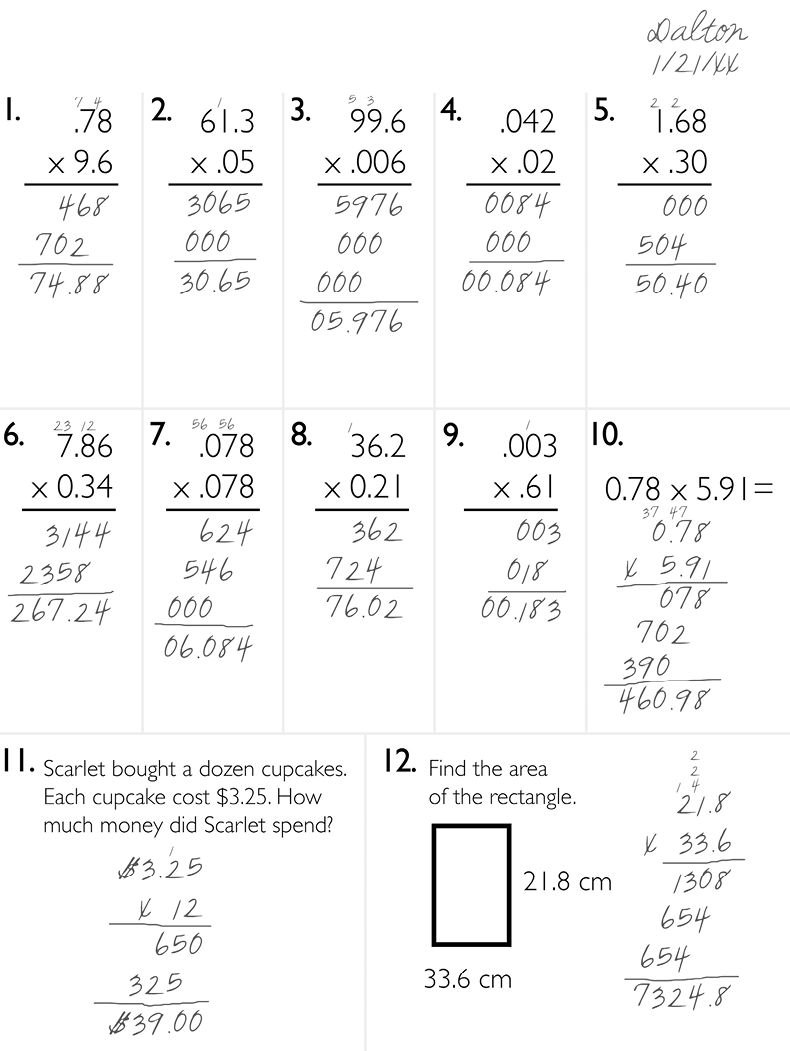
This math worksheet contains 12 problems with student answers.
- Question 1 is .78 times 9.6, with the answer of 74.88.
- Question 2 is 61.3 times .05, with the answer of 30.65.
- Question 3 is 99.6 times .006, with the answer of 05.976.
- Question 4 is .042 times .02, with the answer of 00.084.
- Question 5 is 1.68 times .30, with the answer of 50.40.
- Question 6 is 7.86 times 0.34, with the answer of 267.24.
- Question 7 is .078 times .078, with the answer of 06.084.
- Question 8 is 36.2 times 0.21, with the answer of 76.02.
- Question 9 is .003 times .61, with the answer of 00.183.
- Question 10 is 0.78 times 5.91, with the answer of 460.98.
- Question 11 is “Scarlet bought a dozen cupcakes. Each cupcake cost $3.25. How much money did Scarlet spend?” The problem is answered with $3.25 times 12 equals $39.00.
- Question 12 is “Find the area of the rectangle,” with a picture of a rectangle with the length labeled 21.8 centimeters and the width labeled 33.6 centimeters. The problem is answered with 21.8 times 33.6 equals 7,324.8.
Case
Level A • Case 2
Background
Student: Madison
Age: 8
Grade: 2nd
Scenario
Madison is a bright and energetic third grader with a specific learning disability in math. Her class just finished a chapter on money, and her teacher, Ms. Brooks, was pleased with Madison’s performance. Ms. Brooks believes that Madison’s success was largely due to the fact that she used play money to teach concepts related to money. As is noted in Madison’s individualized education program (IEP), she more easily grasps concepts when using concrete objects (i.e., manipulatives such as play coins and dollar bills). In an attempt to build on this success, Ms. Brooks again used concrete objects—in this case, cardboard clocks with movable hands—to teach the chapter on telling time. The class is now halfway through that chapter, and to Ms. Brooks’s disappointment, Madison seems to be struggling with this concept. Consequently, Ms. Brooks decides to conduct an error analysis on Madison’s most recent quiz.
Possible Strategies
- Collecting data
- Identifying error patterns
Assignment
- Read the Introduction.
- Read the STAR Sheets for the possible strategies listed above.
- Score Madison’s quiz below by marking each incorrect response.
- Examine the scored quiz and determine Madison’s error pattern.
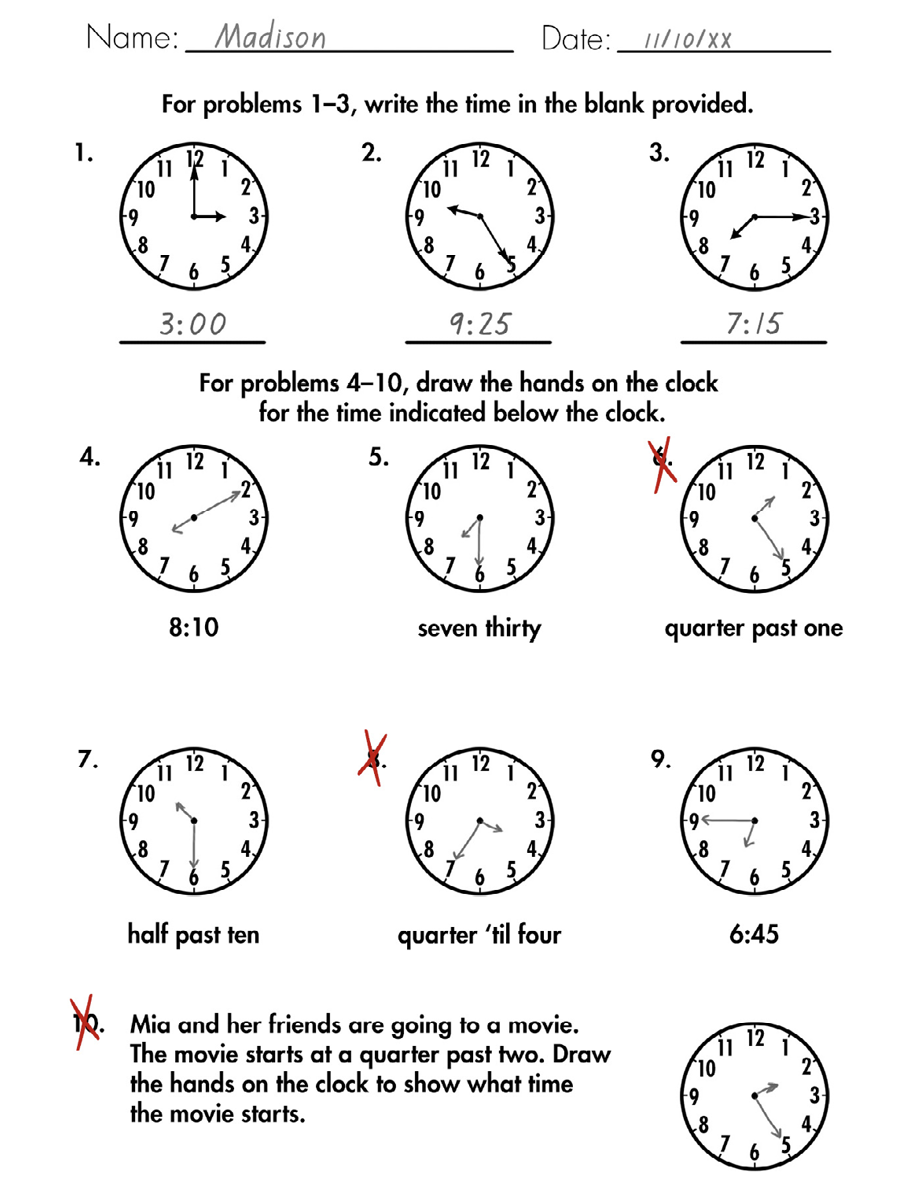
This math worksheet contains 10 problems with student answers. For Problems 1 through 3, the student records the time based on the position of the hour and minute hands.
- Problem 1 shows a clock with the hour hand on 3 and the minute hand on 12, with the answer of 3:00.
- Problem 2 shows a clock with the hour hand between 9 and 10 and the minute hand on 5, with the answer of 9:25.
- Problem 3 shows a clock with the hour hand a little past 7 and the minute hand at 3, with the answer of 7:15.
For Problems 4 through 9, the student draws the hands on the clock for the indicated time.
- Problem 4 has the prompt of “8:10,” with the hour hand drawn at 8 and the minute hand at 2.
- Problem 5 has the prompt of “seven thirty,” with the hour hand drawn a little past 7 and the minute hand at 6.
- Problem 6 has the prompt of “quarter past one,” with the hour hand drawn at 1 and the minute hand at 5.
- Problem 7 has the prompt of “half past ten,” with the hour hand drawn a little past 10 and the minute hand at 6.
- Problem 8 has the prompt of “quarter ’til four,” with the hour hand drawn at 4 and the minute hand at 7.
- Problem 9 has the prompt of “6:45,” with the hour hand drawn a little before 7 and the minute hand at 9.
- Problem 10 is a word problem: “Mia and her friends are going to a movie. The movie starts at a quarter past two. Draw the hands on the clock to show what time the movie starts.” The problem is answered with the hour hand drawn a little past 2 and the minute hand at 5.
Case
Level B • Case 1
Background
Student: Shayla
Age: 10
Grade: 5th
Scenario
Shayla and her family just moved to a new school district. Her math class is currently learning how to add and subtract fractions with unlike denominators. Shayla’s math teacher, Mr. Holden, is concerned because Shayla is performing poorly on assignments and quizzes. Before he can provide instruction to target Shayla’s skill deficits or conceptual misunderstandings, he needs to determine why she is having difficulty. For this reason, he decides to conduct an error analysis to discover what type of errors she is making.
Possible Strategies
- Collecting Data
- Identifying Error Patterns
- Word Problems: Additional Error Patterns
Assignment
- Read the Introduction.
- Read the STAR Sheets for the possible strategies listed above.
- Score Shayla’s assignment below by marking each incorrect digit.
- Examine the scored assignment and discuss at least three possible reasons for Shayla’s error pattern.

-
This math worksheet contains 13 problems with student answers.
- Question 1 is one-fourth plus two-eighths, with the answer of four-eighths.
- Question 2 is seven-eighteenths minus two-ninths, with the answer of three-eighteenths.
- Question 3 is one-sixth plus four-twelfths, with the answer of six-twelfths.
- Question 4 is five-tenths minus two-fifths, with the answer of one-tenth.
- Question 5 is three-thirds minus one-sixth, with the answer of five-sixths.
- Question 6 is three-eighths plus two-fourths, with the answer of seven-eighths.
- Question 7 is one-half plus one-fourth, with the answer of three-fourths.
- Question 8 is three-fifteenths minus one-fifth, with the answer of zero.
- Question 9 is “Liam’s mother had 2 pies. One was chocolate and one was lemon. She gave Lia one-half of the lemon pie and she gave his brother one-fourth of the chocolate pie. How much more pie did she give Liam?” The problem is answered with three-fourths of a pie.
- Question 10 is “Kiley is keeping track of how much it rains at her house. She is using a 6-inch rain gauge. Monday she measured five-sixteenths of an inch of rain. Tuesday she measured one-eighth of an inch of rain. How much has it rained at Kiley’s house altogether?” The problem is answered with seven-sixteenths of an inch.
- Question 11 is “Mrs. Dale’s science class is growing beans. Last week Emmy’s bean grew five-sixths of an inch. Tyler’s bean grew one-half inch. Find the difference between how much Emmy’s bean grew and how much Tyler’s bean grew?” The problem is answered with eight-sixths of an inch.
- Question 12 is “Della is cutting paper for an origami art project. She needs to cut off seven-eighths of a centimeter. So far she has cut off one-fourth of a centimeter. How much more does she need to cut off?” The problem is answered with nine-eighths of a centimeter.
- Question 13 is “For spirit day, the students can wear blue or gold. Mr. Barton has 30 students in his class. On spirit day, one-third of the students wore blue and one-sixth of the class wore gold. In total, how many students wore spirit colors?” The problem is answered with three-sixths of the students.
Case
Level B • Case 2
Background
Student: Elías
Age: 7
Grade: 2nd
Scenario
A special education teacher at Bordeaux Elementary School, Mrs. Gustafson has been providing intensive intervention to Elías, who has a learning disability, and collecting progress monitoring data for the past six weeks. His data indicate that he is not making adequate progress to meet his end-of-year goals. Mrs. Gustafson decides that she needs to conduct a diagnostic assessment to identify areas of difficulty and to determine specific instructional needs. As part of the diagnostic assessment, Mrs. Gustafson conducts an error analysis using Elías’s progress monitoring data.
Possible Strategies
- Collecting Data
- Identifying Error Patterns
- Determining Reasons for Errors
Assignment
- Read the Introduction.
- Read the STAR Sheets for the possible strategies listed above.
- Score Elías’s progress monitoring probe below by marking each incorrect digit.
- When Mrs. Gustafson scores the probe, she finds two possible explanations. One is that Elías is making a conceptual error, and the other is that he doesn’t understand or is not applying the correct procedure.
- Assume that his error pattern is procedural. Describe Elías’s possible procedural error pattern.
- Assume that his error pattern is conceptual. Describe Elías’s possible conceptual error pattern.
- Because the instructional adaptations Mrs. Gustafson will make will depend on Elías’s error pattern, she must determine the reasons for his errors. Explain at least one strategy Mrs.Gustafson could use to determine Elías’s error type.

-
This math worksheet contains 10 problems with student answers. All numbers added and subtracted are in columns.
- Question 1 is 18 plus 22, with the answer of 310.
- Question 2 is 74 plus 13, with the answer of 87.
- Question 3 is 66 minus 21, with the answer of 45.
- Question 4 is 99 minus 77, with the answer of 22.
- Question 5 is 13 plus 29, with the answer of 312.
- Question 6 is 96 minus 62, with the answer of 34.
- Question 7 is 57 minus 52, with the answer of 5.
- Question 8 is 83 plus 39, with the answer of 1,112.
- Question 9 is 20 minus 15, with the answer of 5.
- Question 10 is 61 plus 10, with the answer of 710.
Case
Level C • Case 1
Background
Student: Wyatt
Age: 12
Grade: 6th
Scenario
Mr. Goldberg has been teaching a unit on fractions. He was pleased that all of his students seemed to quickly master adding and subtracting two fractions. However, when he began teaching the students how to multiply fractions, a small number of them did not readily learn the content. But after a quick mini-lesson, it appears that all but three students seem to understand how to solve the problems. In particular, Wyatt seems to be really struggling. Mr. Goldberg decides that he needs to collect data to help determine the type(s) of errors Wyatt is making so that he can provide appropriate instruction to help Wyatt succeed. To do so, he decides to evaluate Wyatt’s most recent independent classroom assignment.
Assignment
- Read the Introduction.
- Read the STAR Sheets.
- Score Wyatt’s classroom assignment below by marking each incorrect digit.
- Review Wyatt’s scored assignment sheet.
- Describe Wyatt’s error pattern.
- Discuss any exceptions to this error pattern. What might these indicate?
- Based on Wyatt’s error pattern, which of the two strategies described in the Addressing Error Patterns STAR Sheet would you recommend that Mr. Goldberg use to remediate this error?
Explain your response.
-
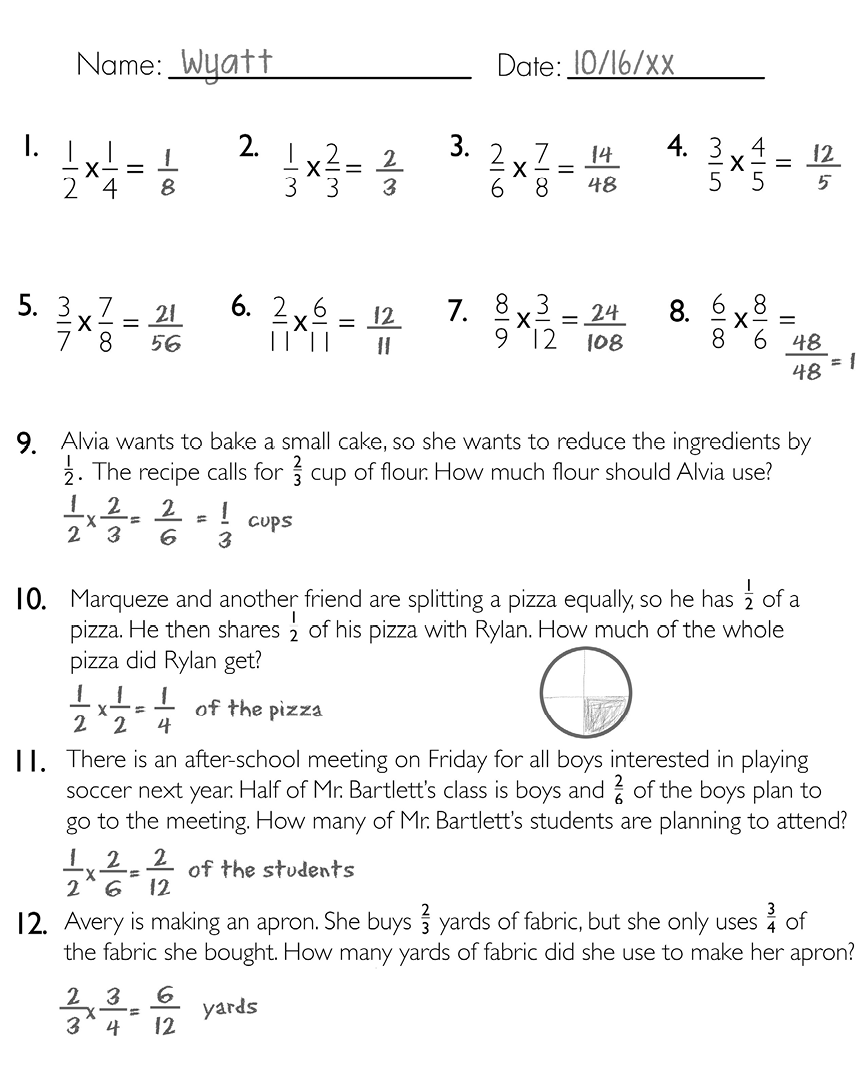
This math worksheet contains 12 problems with student answers.
- Question 1 is one-half times one-fourth, with the answer of one-eighth.
- Question 2 is one-third times two-thirds, with the answer of two-thirds.
- Question 3 is two-sixths times seven-eighths, with the answer of fourteen forty-eighths.
- Question 4 is three-fifths times four-fifths, with the answer of twelve-fifths.
- Question 5 is three-sevenths times seven-eighths, with the answer of twenty-one fifty-sixths.
- Question 6 is two-elevenths times six-elevenths, with the answer of twelve-elevenths.
- Question 7 is eight-ninths times three-twelfths, with the answer of twenty-four over one hundred eight.
- Question 8 is six-eighths times eight-sixths, with the answer of forty-eight forty-eighths or one.
- Question 9 is “Alvia wants to bake a small cake, so she wants to reduce the ingredients by one-half. The recipe calls for two-thirds of a cup of flour. How much flour should Alvia use?” The problem is answered with two-sixths or one-third of a cup.
- Question 10 is “Marqueze and another friend are splitting a pizza equally, so he has one-half of a pizza. He then shares one-half of his pizza with Rylan. How much of the whole pizza did Rylan get?” The problem is answered with one-fourth of the pizza.
- Question 11 is “There is an after-school meeting on Friday for all boys interested in playing soccer next year. Half of Mr. Bartlett’s class is boys and two-sixths of the boys plan to go to the meeting. How many of Mr. Bartlett’s students are planning to attend?” The problem is answered with two-twelfths of the students.
- Question 12 is “Avery is making an apron. She buys two-thirds of a yard of fabric, but she only uses three-fourths of the fabric she bought. How many yards of fabric did she use to make her apron?” The problem is answered with six-twelfths of a yard.
To cite this case study unit, please use the following:
The IRIS Center. (2016, 2025). Mathematics: Identifying and addressing student errors. Retrieved from https://iris.peabody.vanderbilt.edu/mcontent/cs_parent/ics_matherr/
The contents of this resource were developed under a grant from the U.S. Department of Education, #H325E220001. However, those contents do not necessarily represent the policy of the U.S. Department of Education, and you should not assume endorsement by the Federal Government. Project Officer, Anna Macedonia.
Credits
Content ContributorsJanice Brown Case Study DevelopersJanice Brown EditorsJason Miller Content ResearcherDestiny Schmitz |
ReviewersDiane Pedrotty Bryant GraphicsBrenda Knight WebmasterJohn Harwood Geoboard Credit: Kyle Trevethan |
Licensure and Content Standards
This IRIS Case Study aligns with the following licensure and program standards and topic areas.
Council for Exceptional Children (CEC)
CEC standards encompass a wide range of ethics, standards, and practices created to help guide those who have taken on the crucial role of educating students with disabilities.
- Standard 1: Learner Development and Individual Learning Differences
Interstate Teacher Assessment and Support Consortium (InTASC)
InTASC Model Core Teaching Standards are designed to help teachers of all grade levels and content areas to prepare their students either for college or for employment following graduation.
- Standard 6: Assessment
- Standard 7: Planning for Instruction
* For an answer key to this case study, please email your full name, title, and institutional affiliation to the IRIS Center at [email protected].