Case Study
Effective Room Arrangement: Middle & High School

Case Study
Effective Room Arrangement: Middle & High School
Introduction
 Effective room arrangement refers to the thoughtful composition of a classroom’s many physical elements (e.g., desks, books, other materials) to establish a learning environment that facilitates effective instruction and promotes student growth. Carefully arranged classrooms not only help develop significant relationships with students and celebrate students’ backgrounds but create a safe learning environment. Moreover, well-designed classroom environments:
- Decrease the likelihood of inappropriate student behavior
- Facilitate appropriate social interactions among students
- Provide structure and predictability
- Increase academic engagement
- Positively impact student performance
Through effective classroom arrangement, teachers can facilitate a variety of instructional activities and support the unique needs of their students. They can also reduce disruptive behaviors and the subsequent loss of instructional time. Keep in mind that because every classroom has its own needs, there is no one best way to design a classroom environment. That said, teachers can use the practices described in this case study as a sound foundation for building their own effective classrooms.
Now let’s look at the practices we will cover:
- Facilitating efficient traffic patterns
- Supporting frequent interaction
- Matching room arrangement with instructional format
- Minimizing distractions and disruptive events
These practices will be explored on the following IRIS STAR Sheets.
Milner, H. R., Cunningham, H. B., Delale-O’Connor, L., & Kestenberg, E. G. (2019). “These kids are out of control”: Why we must reimagine “classroom management” for equity. Corwin.
Each case study includes multiple STAR Sheets and cases.

STAR (STrategies And Resources) Sheets—These provide a description of a well-researched strategy that can help you solve the cases.

Cases—These present a problem-based classroom issue or challenge and an assignment, which can be completed using one or more of the STAR Sheets. There are three progressive levels of cases: Level A (gathering information), Level B (analyzing information), and Level C (synthesizing information).
STAR Sheet
Facilitating Efficient Traffic Patterns
About the Strategy
 Facilitating efficient traffic patterns involves arranging the physical aspects of the classroom (e.g., materials, equipment, other students) to ensure that teachers and students alike can move through the room and access materials without difficulty.
What the Research and Resources Say
- Eliminating physical barriers and creating ample walkways can facilitate students’ and teachers’ movement and prevent disruptions and collisions with objects or others (Jones & Jones, 2007).
- By intentionally designing and managing effective traffic patterns, teachers can increase classroom safety (Sprague, 2007).
- Effective traffic patterns and easy accessibility to storage, resources, and tools are important components of conducive learning environments (Emmer & Evertson, 2017).
- Flexible access to furniture, equipment, and supplies helps establish student independence in the learning environment (HEFCE, 2006).
Strategies to Implement
- Arrange the classroom to promote a smooth traffic flow that lessens the likelihood that areas will become congested or be left unsupervised.
- Assess the classroom for the presence or absence of a “bump factor.” Challenging behaviors (academic and social-emotional) are more likely to occur if students or teachers are routinely bumping into objects or others.
- Place frequently utilized supplies, equipment, and materials in easy-to-access locations.
- Create walking space between and around classroom furniture and Unused or unnecessary furniture and equipment should be removed.
- Teach students procedures and routines to navigate the classroom, including transitioning between activities, accessing materials and supplies, and practicing emergency drills and other safety procedures.
Keep in Mind
- One way to test the traffic patterns in the classroom is simply to walk through the designated areas with the chairs placed as though students were seated in them.
- Because blocked walkways can be problematic or even hazardous in an emergency, it is a good idea to make note of items that might hinder efficient traffic patterns while practicing emergency drills.
- Some students, such as those who use wheelchairs and walkers, might benefit from additional space for movement (e.g., wider aisles) as well as storage for any special equipment.
For Your Information
Efficient traffic patterns allow teachers to more easily incorporate purposeful movement during instruction (e.g., physical games, hands-on tasks, role-plays). This type of movement has many benefits, such as helping students to:
- Contend with stress and anxiety (which is a natural occurrence for adolescents due to hormonal shifts that they experience, especially for those who live in poverty and experience chronic stress)
- Process information
- Maintain engagement
- Feel more positive and motivated
- Reduce off-task behavior
- Improve academic achievement
Ellison, C. M., Boykin, A. W., Towns, D. P., & Stokes, A. (2000). Classroom cultural ecology: The dynamics of classroom life in schools serving low-income African American children (Report No. CRESPAR-R-44). National Center for Research on Teacher Learning.
Emmer, E. T., & Evertson, C. M. (2017). Classroom management for middle and high school teachers (10th ed.). Pearson. https://www.pearson.com/en-us/subject-catalog/p/classroom-management-for-middle-and-high-school-teachers/P200000007735/9780134442563?srsltid=AfmBOooggPDdg95gZvM2k5kcdF5gMCMRkLM0O5gNvknEIB5J8S6BoP3x
HEFCE. (2006). Designing spaces for effective learning: A guide to 21st century learning space design. JISC Development Group. https://resources.finalsite.net/images/v1741805287/d41org/yvy5ovocew8sro8foqw2/learningspaces.pdf
Helgeson, J. (2011). Four simple ways to add movement in daily lessons. Kappa Delta Pi Record, 47(2), 80–84. https://doi.org/10.1080/00228958.2011.10516567
Hillman, C. H., Pontifex, M. B., Raine, L. B., Castelli, D. M., Hall, E. E., & Kramer, A. F. (2009).
The effect of acute treadmill walking on cognitive control and academic achievement in preadolescent children. Neuroscience, 159(3), 1044–1054. https://doi.org/10.1016/j.neuroscience.2009.01.057
Jensen, E. (2009). Teaching with poverty in mind. ASCD. https://www.ascd.org/books/teaching-with-poverty-in-mind?variant=109074
Jones, V. F., & Jones, L. S. (2007). Comprehensive classroom management: Creating positive learning environments (8th ed.). Allyn & Bacon.
Sprague, J. (2007, September). Creating schoolwide prevention and intervention strategies: Effective strategies for creating safer schools and communities. Hamilton Fish Institute on School and Community Violence.
Strean, W. B. (2011). Creating student engagement? HMM: Teaching and learning with humor, music, and movement. Creative Education, 2(3), 189–192. https://doi.org/10.4236/ce.2011.23026
Trussell, R. P. (2008). Classroom universals to prevent problem behaviors. Intervention in School and Clinic, 43(3), 179–185. https://doi.org/10.1177/1053451207311678
Wells, S. L. (2012). Moving through the curriculum: The effect of movement on student learning, behavior, and attitude. Rising Tide, 5, 1–17. http://mat2012wells.pbworks.com/w/file/fetch/54431635/Wells,%20MRP.pdf
STAR Sheet
Supporting Frequent Interaction
About the Strategy
 Supporting frequent interaction is the practice of arranging the physical aspects of the classroom (e.g., materials, equipment, desks) to ensure that the teacher can move easily throughout the environment to more efficiently access, engage with, and monitor student learning and behavior.
What the Research and Resources Say
- Teacher interaction with students is correlated to student seating location (Good & Brophy, 2008; Emmer & Evertson, 2017; Rogers, 2011; Weinstein & Novodvorsky, 2011).
- Frequent teacher movement encourages students to remain on task and offers the teacher insight into student discussions, work habits, and progress (Weinstein & Novodvorsky, 2011).
- When the teacher is in close proximity, the rate and probability of student engagement increases (Hazari et al., 2015; Wubbels et al., 2015).
- When teacher-to-student interactions increase, positive adult-student relationships develop, students are more likely to be engaged, and the occurrences of problem behaviors decrease (Hafen et al., 2015; Simonson & Myers, 2015; Nguyen et al., 2018; Kwok, 2019).
- To effectively monitor and supervise learning, the teacher must move frequently throughout the classroom and maintain constant lines of sight to each student (Emmer & Evertson, 2017; Weinstein & Novodvorsky, 2011).
Strategies to Implement
- Create a clear line of sight to students to easily monitor them from any location.
- Consciously place bookcases, file cabinets, and other pieces of equipment to create accessible walkways for students. Check for blind spots by standing in different locations in the room.
- Circulate among students as they work to assess and address each student’s academic and behavioral needs.
- Move frequently throughout the room when providing instruction to monitor student engagement and performance.
- Move throughout the classroom with purpose to avoid distracting students.
Keep in Mind
- By continuously moving throughout the classroom, the teacher can maintain proximity to all students, thereby heightening their attention to tasks and expected behaviors.
- Frequent movement among students allows the teacher to offer immediate learning assistance and provide frequent encouragement and timely feedback, all of which increases student engagement.
- Some students benefit from more frequent teacher interaction and monitoring.
Emmer, E. T., & Evertson, C. M. (2017). Classroom management for middle and high school teachers (10th ed.). Pearson. https://www.pearson.com/en-us/subject-catalog/p/classroom-management-for-middle-and-high-school-teachers/P200000007735/9780134442563?srsltid=AfmBOooggPDdg95gZvM2k5kcdF5gMCMRkLM0O5gNvknEIB5J8S6BoP3x
Good, T. L., & Brophy, J. E. (2018). Looking in classrooms (10th ed.). Pearson.
Hafen, C. A., Ruzek, E. A., Gregory, A. Allen, J. P., & Mikami, A. Y. (2015). Focusing on teacher-student interactions eliminates the negative impact of students’ disruptive behavior on teacher perceptions. International Journal of Behavioral Development, 39(5), 426–431. https://doi.org/10.1177/0165025415579455
Hazari, Z., Cass, C., & Beattie, C. (2015). Obscuring power structures in the physics classroom: Linking teacher positioning, student engagement, and physics identity development. Journal of Research in science teaching, 52(6), 735–762. https://doi.org/10.1119/perc.2013.inv.001
Kwok, A. (2019). Classroom management actions of beginning urban teachers. Urban Education, 54(3), 339–367. https://doi.org/10.1177/0042085918795017
Lampi, A.R., Fenti, N. S., & Beaunae, C. (2005). Making the three p’s easier: Praise, proximity, and precorrection. Beyond Behavior, 15(1), 8–12.
Nguyen, T. D., Cannata, M., & Miller, J. (2018). Understanding student behavioral engagement: Importance of student interaction with peers and teachers. The Journal of Educational Research, 111(2), 163–174. https://doi.org/10.1080/00220671.2016.1220359
Rogers, B. (2011). Classroom behavior: A practical guide to effective teaching, behavior management, and colleague support (3rd ed.). Sage.
Simonsen, B., & Myers, D. (2014). Classwide positive behavior interventions and supports: A guide to proactive classroom management. Guilford.
Weinstein, C. S., & Romano, M. E. (2014). Elementary classroom management: Lessons from research and practice (6th ed.). McGraw Hill
Wubbels, T., Brekelmans, M., de Brok, P., Wijsman, L., Mainhar, T., & van Tarwijk, J. (2015). Teacher-student relationships and classroom management. In E. T. Emmer & E. J. Sabornie (Eds.), Handbook of classroom management (2nd ed., pp. 363–386). https://doi.org/10.4324/9780203074114
STAR Sheet
Matching Room Arrangement with Instructional Format
About the Strategy
 Matching room arrangement with instructional format involves promoting student academic and social-emotional learning by arranging the classroom to facilitate the lesson and supporting activities.
What the Research and Resources Say
- Seating arrangements should match the instructional format (e.g., whole-group, small-group) because these arrangements establish both academic and social expectations (Chance, 2015; Emmer & Evertson, 2017; Gremmen et al., 2016; Weinstein & Novodvorsky, 2011; Wong & Wong, 2009).
- Flexible room arrangement supports a variety of instructional formats, which help keep students actively engaged (Wong & Wong, 2009; Harvey & Kenyon, 2013).
- Students feel increasingly challenged and competent when their classroom environment is clearly and coherently structured to support specific kinds of instruction and activities (Kunter et al., 2007).
- Grouped seating arrangements can increase student social interaction, while seating in rows can increase on-task behavior and the amount of independent work that students complete (Gremmen et al., 2016; Wong & Wong, 2009).
- Room arrangements that support collaborative activities can improve social interactions among peer learners, which in turn can help improve student academic performance (HEFCE, 2006).
Strategies to Implement
- For each lesson, select an instructional format and then choose a room arrangement that best supports it.
| Instructional Arrangement | Room Arrangement | Benefits |
| Independent work (e.g., tests, lectures) | Seats are arranged in rows or paired rows (see Examples A and B on next page) |
|
| Group work (e.g., learning centers, small-group discussions) | Seats are arranged in clusters (see Examples C and D on next page) |
|
| Demonstrations or discussions | Seats are arranged in a U shape or multiple U’s of five or six students (see Examples E and F on next STAR Sheet) |
|
- Involve students in designing effective arrangements for different instructional formats to increase their engagement in academic learning and to build their sense of ownership of the classroom.
- If you frequently rearrange the classroom for specific instructional formats within a class period, teach students how to do so quickly in response to a verbal or visual cue. Though this will require practice, it will create smoother transitions between activities.
- Provide a clear line of sight from wherever the students are seated to wherever instruction is taking place (e.g., at a smart board, overhead projector screen, at the demonstration table).
Possible Room Arrangements
Note: The classroom designs on the next page offer only a few arrangement options. Due to the variety of student seating types and room sizes, we are unable to provide an exhaustive array. Additionally, for illustrative purposes, the classroom designs below contain only the basic features of a typical classroom. As such, features such as bulletin boards, supply and storage areas, and equipment have not been included.
Independent Work/Tests/Beginning of the Year/Lecture
Example A
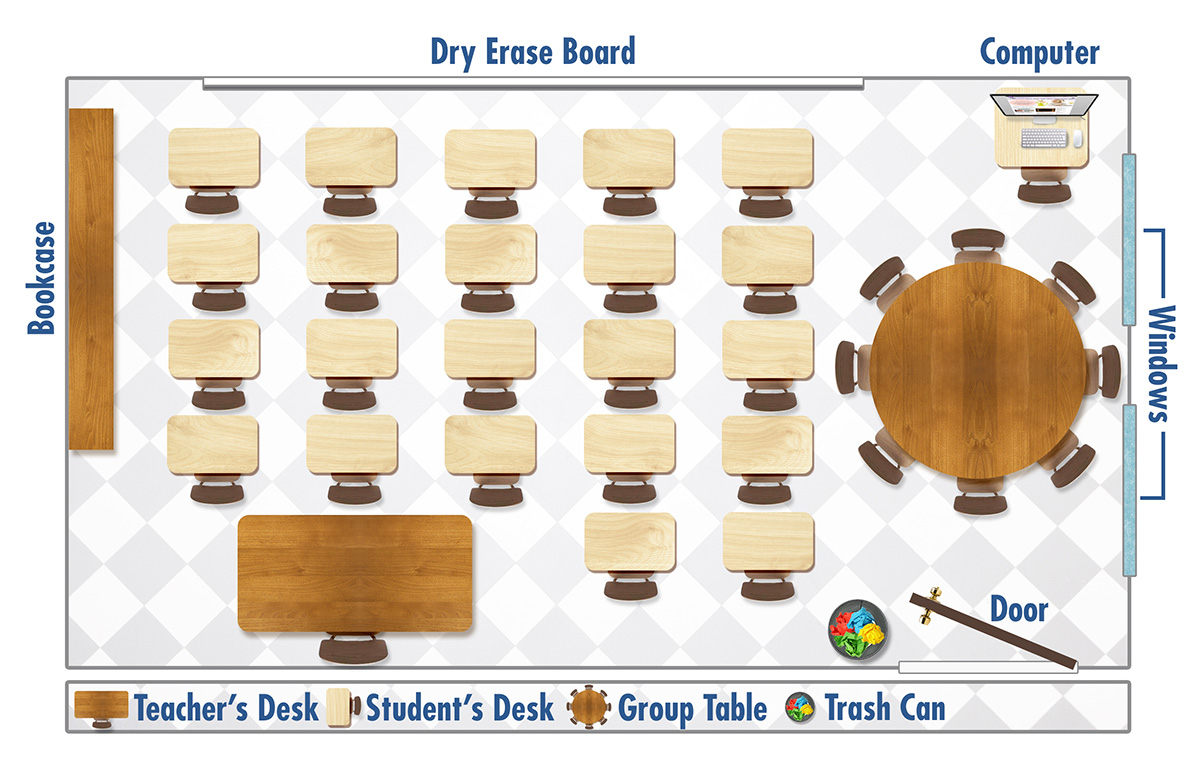
There are 22 student desks arranged in five rows: four rows with five desks and one row with the teacher’s desk and two student desks. The teacher’s desk is in line with the two student desks in the last row and spans the width of almost three student desks. All desks, including the teachers, are facing north. The classroom door is in the southeast corner. The trash can is on the south wall located next to the door. On the west wall, a bookcase runs the length of the first four rows, which is approximately half the wall. The dry-erase board covers two-thirds the length of the north wall. In the northeast corner, there is a computer on a desk. There is an eight-person circular table on the east wall framed in by the computer to the north, windows to the east, the door to the south, and rows of desks to the west.
Example B
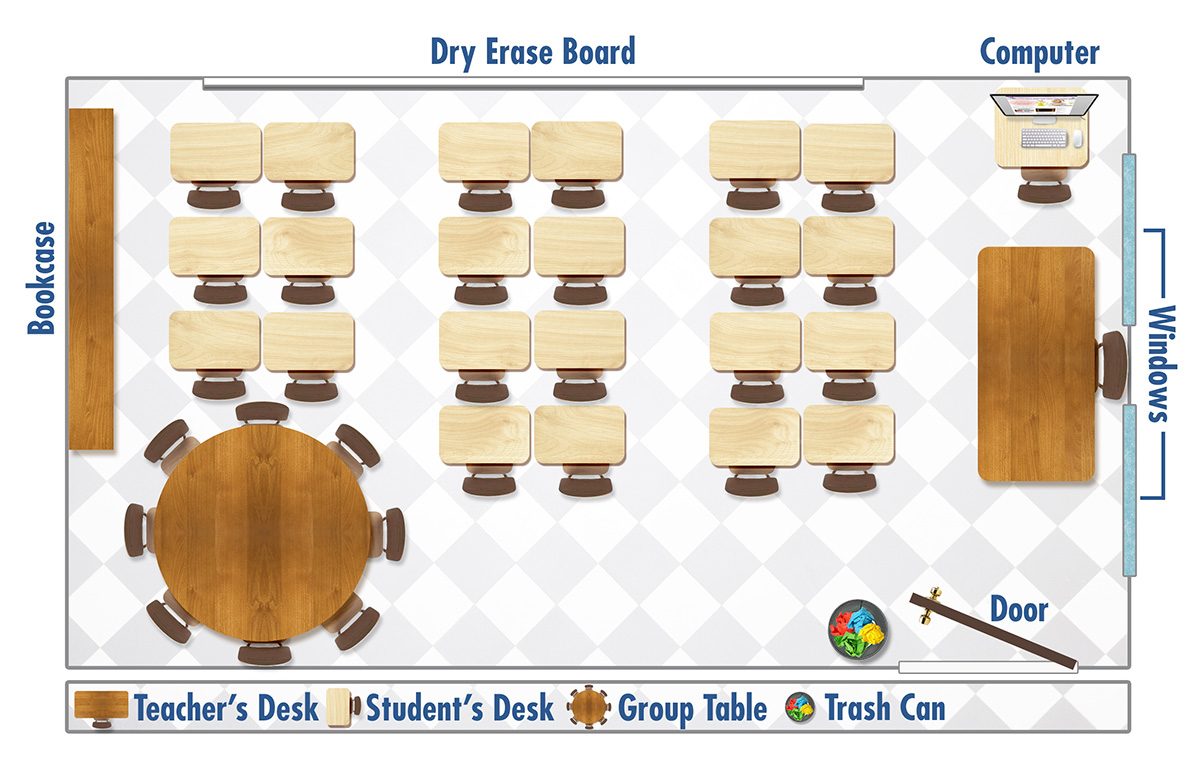
There are 22 student desks arranged in four rows: three rows with three pairs of desks and one row with two pairs of desks. All desks are facing north. The classroom door is in the southeast corner. The trash can is on the south wall located next to the door. There is an eight-person circular table in the southwest corner that protrudes into the row with two pairs of desks. On the west wall, a bookcase runs the length of the four rows, which is approximately half the wall. The dry-erase board covers two-thirds the length of the north wall. In the northeast corner, there is a computer on a desk. The teacher’s desk, which faces the student desks, is located on the east wall framed in by the computer to the north, windows to the east, the classroom door to the south, and rows of desks to the west.
Group Work/Stations
Example C
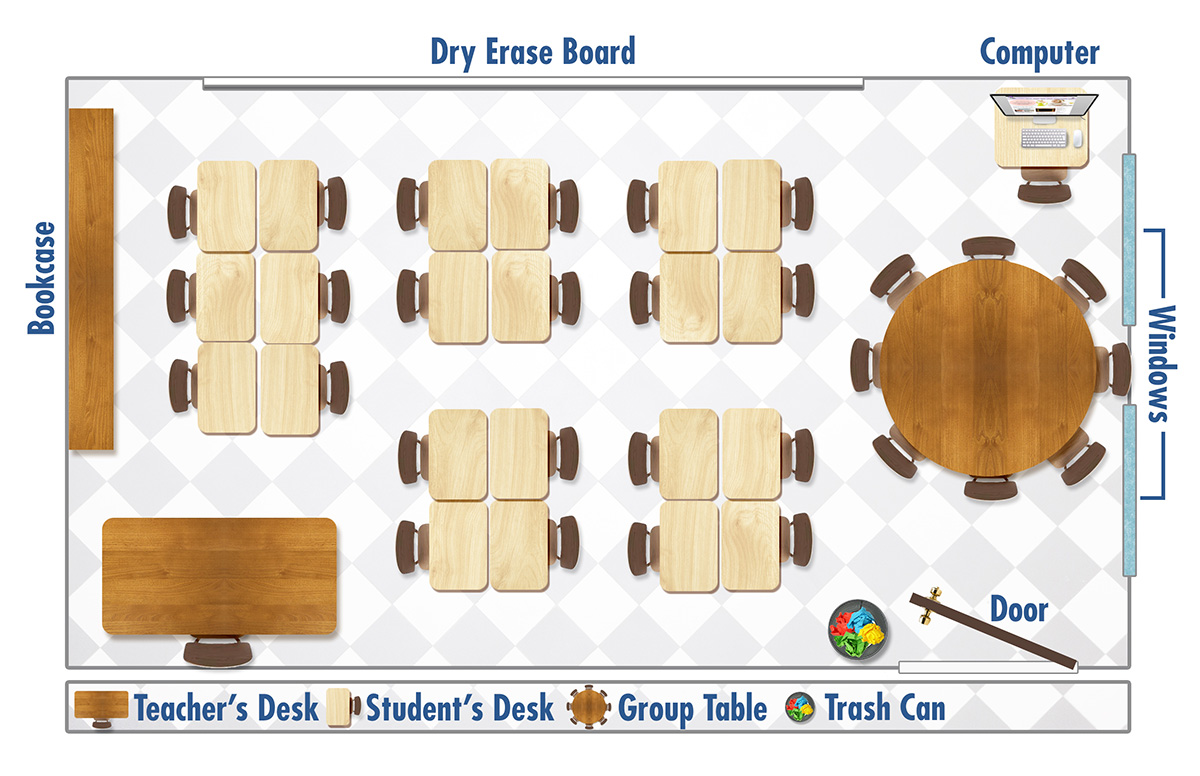
There are 22 student desks arranged in five groups: four of the groups have four desks (two facing west and two facing east) and the other group has six desks (three facing west and three facing east). The classroom door is in the southeast corner. The trash can is on the south wall located next to the door. The teacher’s desk is in the southwest corner and faces north. On the west wall, a bookcase runs the length of four desks, which is approximately half the wall. The dry-erase board covers two-thirds the length of the north wall. In the northeast corner, there is a computer on a desk. There is an eight-person circular table on the east wall framed in by the computer to the north, windows to the east, the door to the south, and groups of desks to the west.
Example D
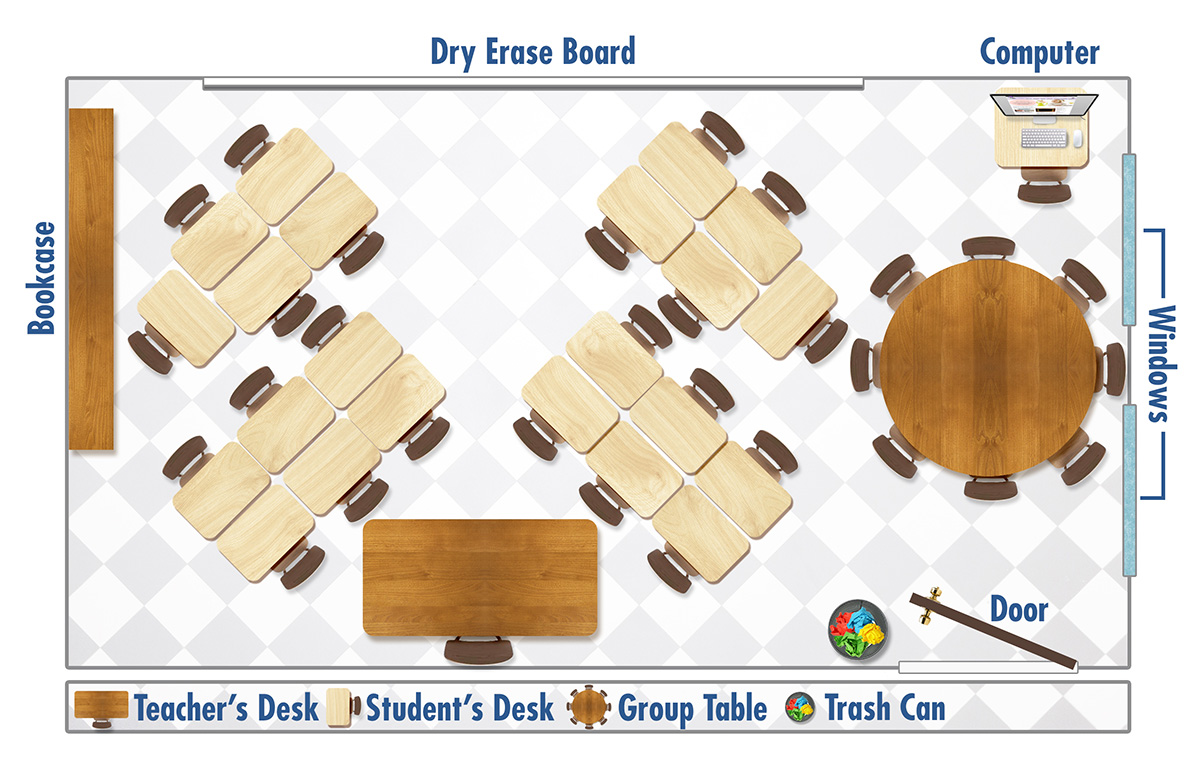
There are 22 student desks arranged off the west side of the room. Two groups nearest the west wall are angled northeast: a five-person group of desks in the north (two facing northwest, two facing southeast, and one on the southern end facing the group) with a six-person group toward the south (three facing northwest and three facing southeast). This configuration is mirrored on the eastern side, leaving space for an aisle that leads to the teacher’s north-facing desk on the south wall. The classroom door is in the southeast corner. The trash can is on the south wall located next to the door. A bookcase runs along approximately half of the west wall next to the northern group of desks. The dry-erase board covers two-thirds the length of the north wall. In the northeast corner, there is a computer on a desk. There is an eight-person circular table on the east wall framed in by the computer to the north, windows to the east, the door to the south, and groups of desks to the west.
Demonstration/Discussion
Example E
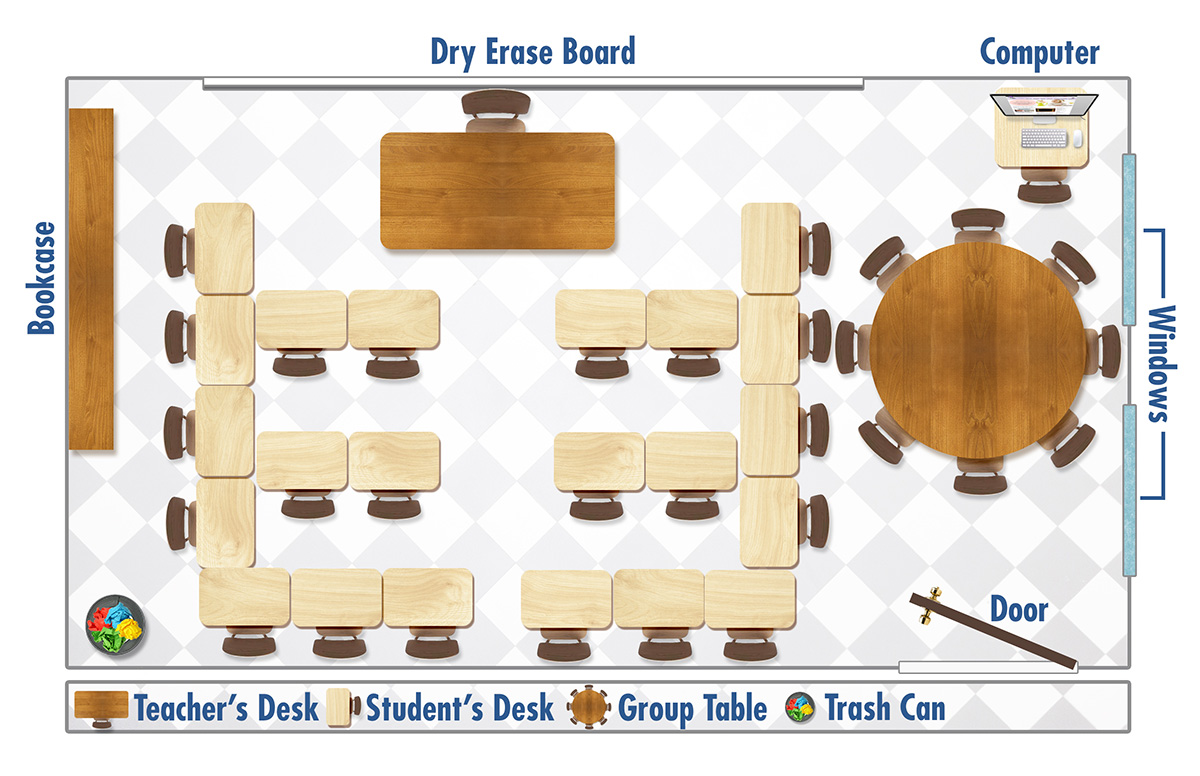
Description: There are 22 student desks arranged in the center of the room via a large C-shaped formation that contains a smaller one, with the openings facing north. The large formation is made up of a row of seven north-facing desks flanked by columns of three inward-facing desks on either end. The small formation is made up of a row of five north-facing desks flanked by two inward-facing desks on either end. The teacher’s south-facing desk is in front of a dry-erase board on the north wall and is framed in by the small C-shaped formation. The dry-erase board covers two-thirds the length of the wall. In the northeast corner, there is a computer on a desk. There is an eight-person circular table on the east wall framed in by the computer to the north, windows to the east, the door to the south, and desks to the west. The door is in the southeast corner, and the trash can is in the southwest corner. On the west wall, a bookcase runs the length of four desks, which is approximately half the wall.
Example F
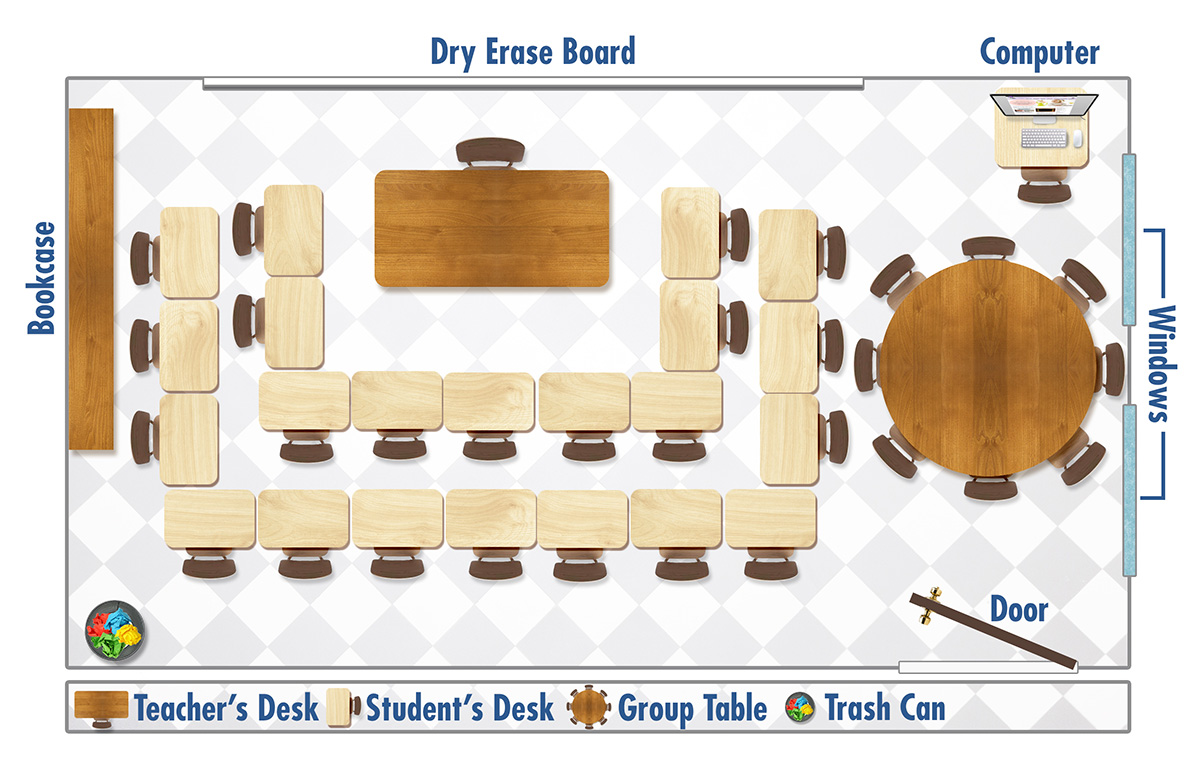
There are 22 student desks arranged in the center of the room. On the west side, the desks are configured in an E-shaped formation via a column of four east-facing desks that intersect with three offshoots of north-facing pairs. This configuration is mirrored on the east side of the room via a column of four west-facing desks that intersect with three offshoots of north-facing pairs. The teacher’s desk is against a dry-erase board on the north wall and is centered above the E-shaped formations. The dry-erase board covers two-thirds the length of the wall. In the northeast corner, there is a computer desk. There is an eight-person circular table on the east wall framed in by the computer to the north, windows to the east, the door to the south, and desks to the west. The door is in the southeast corner, and the trash can is in the southwest corner. On the west wall, a bookcase runs the length of four desks, which is approximately half the wall.
Keep in Mind
- Different instructional formats might require different room arrangements.
- Continual rearrangement of the classroom can be disruptive. Teachers should plan their room arrangement to fit most of the day’s instruction and adjust it to meet other lesson purposes only when necessary.
- When designing seating arrangements to support different instructional formats, teachers should make sure there is enough room to move freely about the classroom and monitor student engagement.
- Students who have their back to an instructional area can more easily avoid engaging with the lesson than those who are facing the area.
- U-shaped classroom arrangements are most effective in classes of 20 or fewer students. For larger classes, teachers might want to create multiple smaller U’s of five or six students.
Chance, P. L. (2015). Class meetings. In W. G. Scarlett (Ed.), The Sage encyclopedia of classroom management, (Vol. 1, pp. 141–143). Sage. https://doi.org/10.4135/9781483346243
Emmer, E. T., & Evertson, C. M. (2017). Classroom management for middle and high school teachers (10th ed.). Pearson. https://www.pearson.com/en-us/subject-catalog/p/classroom-management-for-middle-and-high-school-teachers/P200000007735/9780134442563?srsltid=AfmBOooggPDdg95gZvM2k5kcdF5gMCMRkLM0O5gNvknEIB5J8S6BoP3x
Gremmen, M. C., van den Berg, Y. H. M., Segers, E., & Cillessen, A. H. N. (2016). Considerations for classroom seating arrangements and the role of teacher characteristics. Social Psychological Education, 19(4), 749–774. https://doi.org/10.1007/s11218-016-9353-y
Harvey, E. J., & Kenyon, M. C. (2013). Classroom seating considerations for 21st century students and faculty. Journal of Learning Spaces, 2(1). https://files.eric.ed.gov/fulltext/EJ1152707.pdf
HEFCE. (2006). Designing spaces for effective learning: A guide to 21st century learning space design. JISC Development Group. https://resources.finalsite.net/images/v1741805287/d41org/yvy5ovocew8sro8foqw2/learningspaces.pdf
Kunter, M., Baumert, J. & Köller, O. (2007). Effective classroom management and the development of subject-related interest. Learning and Instruction, 17(5) 494–509. https://doi.org/10.1016/j.learninstruc.2007.09.002
Weinstein, C. S., & Romano, M. E. (2014). Elementary classroom management: Lessons from research and practice (6th ed.). McGraw Hill.
Wong, H. K., & Wong, R. T. (2009). The first days of school: How to be an effective teacher (4th ed.). Harry K. Wong Publications.
STAR Sheet
Minimizing Distractions and Disruptive Events
About the Strategy
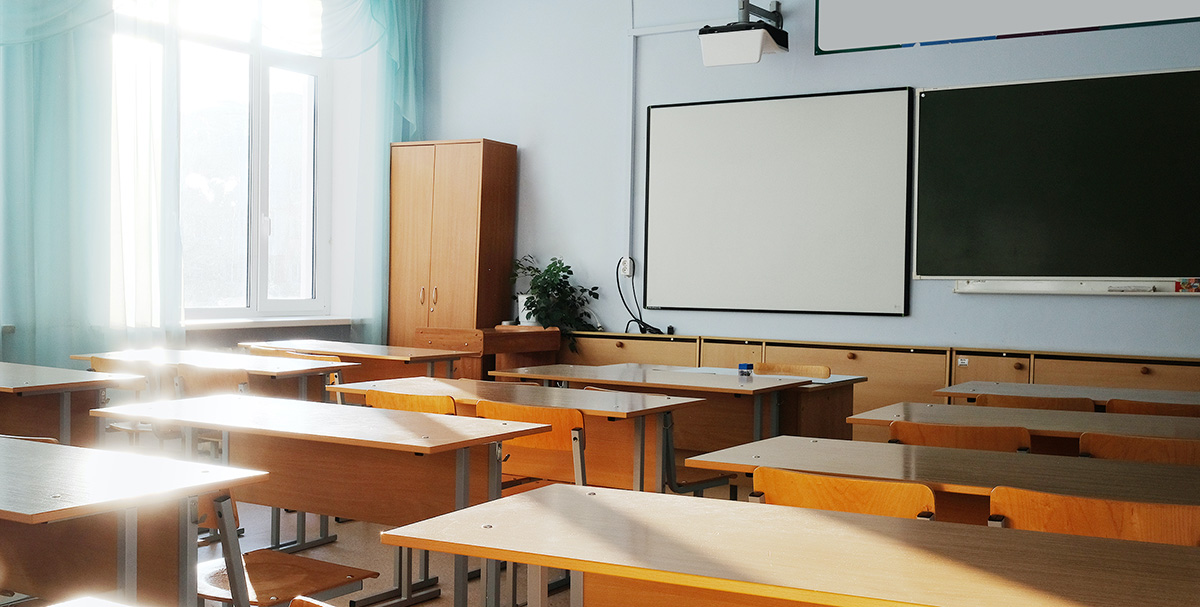 Minimizing distractions and disruptive events involves arranging the physical aspects of the classroom (e.g., materials, equipment, students’ desks) to reduce distractions and the occurrence of challenging behaviors that might interfere with learning.
What the Research and Resources Say
- Effective teachers proactively prevent distractions and disruptive events by purposefully organizing the materials and space in their classrooms (Stronge et al., 2011).
- By minimizing classroom distractions, teachers can increase students’ sense of psychological safety. This is particularly important for students who might be experiencing stressful situations or events (e.g., poverty, homelessness, abuse) (Weinstein & Novodvorsky, 2011).
- Thoughtful room arrangement can help reduce student distractions when incompatible activities (e.g., independent work and small-group instruction) are taking place at the same time (Weinstein & Novodvorsky, 2011).
- Because crowded rooms tend to foster challenging behaviors, teachers should arrange the room to provide ample space for learning (Weinstein, 1979; Garrett, 2014).
Strategies to Implement
- Identify potential distractions in the classroom. These might include structural elements of the classroom itself (e.g., windows, doors), equipment (e.g., computers, an aquarium), noises (e.g., from the pencil sharpener), and individuals.
- Sit at each location in the classroom to experience potential distractions that students could encounter.
- Relocate items, equipment, or individuals as needed to minimize distractions.
- Arrange high-traffic areas (e.g., pencil sharpener, trash can) to avoid congestion and to minimize distraction caused by their use.
- Arrange classroom elements (e.g., desks, carpeted areas) to avoid crowding.
- Provide work areas that are quiet and distraction-free.
- Position the desks of students with challenging behaviors (e.g., academic and social-emotional) near areas with limited distractions and greater access to work materials and teacher support.
Keep in Mind
- Individual students find different things distracting. Whereas one student might be distracted by a noise in the classroom, another might ignore it entirely.
- Although some items cannot be relocated, the teacher can minimize their disruptive effects through other means. For example, a distracting computer monitor might be turned to a different angle or blocked by a temporary partition like a trifold display.
Emmer, E. T., & Evertson, C. M. (2017). Classroom management for middle and high school teachers (10th ed.). Pearson. https://www.pearson.com/en-us/subject-catalog/p/classroom-management-for-middle-and-high-school-teachers/P200000007735/9780134442563?srsltid=AfmBOooggPDdg95gZvM2k5kcdF5gMCMRkLM0O5gNvknEIB5J8S6BoP3x
Garret, T. (2014). Effective classroom management: The essentials. Teachers College Press. https://www.tcpress.com/effective-classroom-management-the-essentials-9780807755747
Learn NC. (2002). Classroom environment: The basics. http://www.learnnc.org/lp/pages/734
Scheuermann, B., & Hall, J. A. (2008). Positive behavioral supports for the classroom. Pearson/Merrill Prentice Hall.
Simonsen, B., Fairbanks, S., Briesch, A., Myers, D., & Sugai, G. (2008). Evidence-based practices in classroom management: Considerations for research to practice. Education and Treatment of Children, 31(3), 351–380. https://doi.org/10.1353/etc.0.0007
Stronge, J. H., Ward, T. J., & Grant, L. W. (2011). What makes good teachers good? A cross-case analysis of the connection between teacher effectiveness and student achievement. Journal of Teacher Education, 62(4), 339–355. https://doi.org/10.1177/0022487111404241
Weinstein, C. S. (1979). The physical environment of the school: A review of the research. Review of Educational Research, 49(4), 577–610. https://doi.org/10.3102/00346543049004577
Weinstein, C. S., & Novodvorsky, I. (2011). Middle and secondary classroom management: Lessons from research and practice (4th ed.). McGraw Hill.
Case
Level A • Case 1
Background
Student: Kiani
Age: 16
Grade: 10th
Scenario
Kiani, a sophomore with autism, is attending a new rural county high school. The district merged multiple smaller high schools to provide more course options than offered at the smaller sites. Last year as a freshman, she was one of 56 total students. She is now one of 224 students in her sophomore class. Kiani was initially apprehensive about attending a new school, but with time and support from her teachers, she has become comfortable in her new setting. Kiani was excited about the chance to take Spanish because it was not offered at her small high school, and it quickly became her favorite class.
Lately, Kiani seems disconnected during her Spanish I class’s small-group conversation exercises. During these exercises, students are asked to converse in groups of two to three and discuss a “hot topic” prompt using as much Spanish as possible. Kiani’s participation, however, has been inconsistent, and sometimes she fails to take part at all. Her teacher is surprised, as Kiani usually enjoys discussing topics of her choice. Kiani’s IEP requires that she be seated near the dry-erase board, where her teacher displays the class’s learning targets, assignments, and lesson directions. However, after making a sketch of the classroom arrangement (see below), her teacher suspects that Kiani’s seating location (starred) might be a factor in her disconnected behavior. Because of this, the teacher decides to rearrange the classroom to help Kiani:
- Increase the frequency of her participation in each assigned conversation exercise
- Increase the duration of her participation in each assigned conversation exercise to five minutes
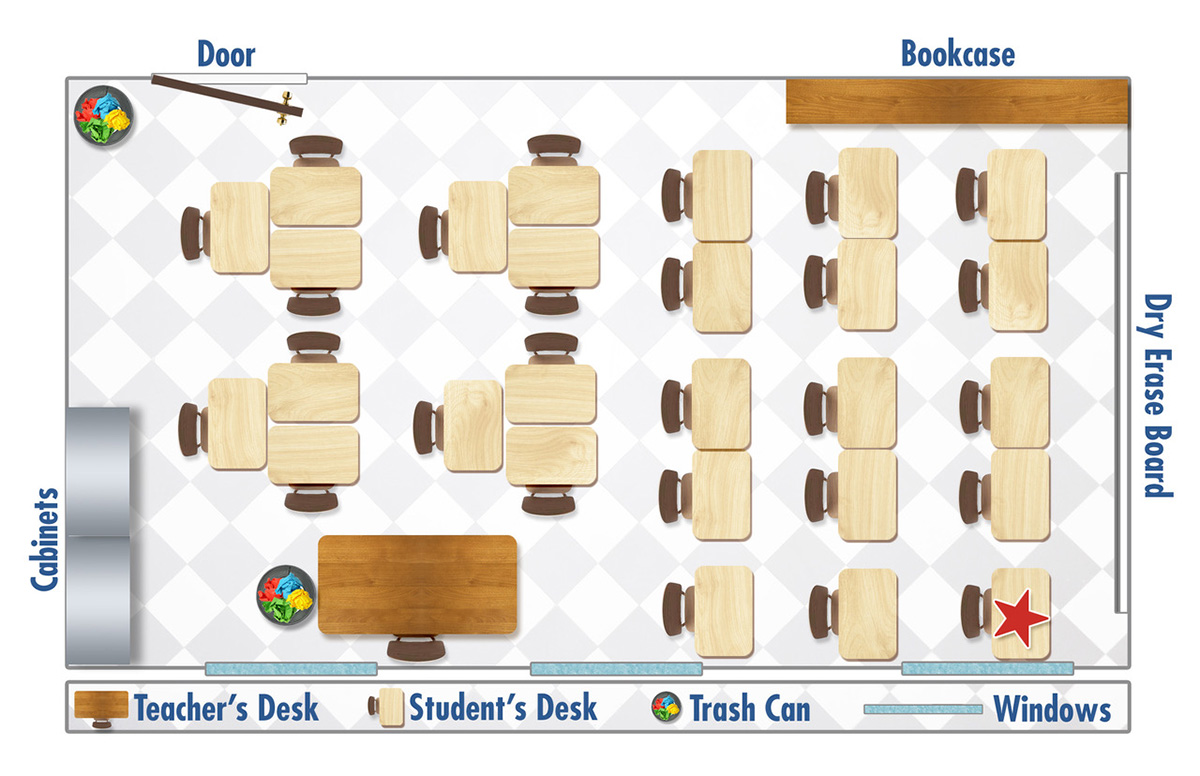
There are 27 student desks arranged in three rows. From west to east, the northernmost and middle row contain two three-person groups (two inward-facing desks with an east-facing desk on the western side) and three pairs of east-facing desks, and the southernmost row contains the north-facing teacher’s desk and three individual east-facing desks. The easternmost individual desk is starred for Kiani. There are cabinets in the southwest corner as well as the door and a trash can in the northwest corner. A bookcase is in the northeast corner, with a dry-erase board on the east wall. There are three windows along the south wall.
Possible Strategies
- Matching room arrangement with instructional format
- Minimizing distractions and disruptive events
Assignment
- Read the STAR Sheets for the possible
- Use the seating arrangement sketch above to identify two issues (one for each strategy) that could be negatively affecting Kiani’s participation.
Case
Level A • Case 2
Background
Student: Sadiq
Age: 12
Grade: 7th
Scenario
Sadiq is a seventh grader who missed much of his sixth-grade year after sustaining a spinal cord injury during a football game. Following months of difficult in-patient physical therapy to rebuild his motor memory, balance, and the muscle strength in his legs, Sadiq has returned to school, although he is not yet fully recovered. His balance is still somewhat precarious, and a fall could be disastrous. Because of this, Sadiq uses a walker most of the time. In English class, he is seated in a protective position near his teacher’s desk (starred), where he has a place to put and easily access his walker. The quality of his academic work shows that he is quickly catching up with his peers; however, his social skills are not progressing at the same pace. He frequently displays inappropriate behavior, which is impacting his ability to make friends. With all this in mind, Sadiq’s teacher reassigns his seating location to help him:
- Increase his positive social interactions with peers
- Increase his safe movement to and from the smart board, his seat, and the classroom to give Sadiq the same opportunities as the other students
There are 28 student desks arranged in two rows. From west to east, the northernmost row has a six-person group with three east-facing and three west-facing desks (with Desk A in the middle of the former) and two four-person groups with a pair of east-facing and west-facing desks. From west to east, the second row has the teacher’s desk, two four-person groups with a pair of east-facing and west-facing desks, and a six-person group with three east-facing and west-facing desks. Sadiq’s seat is the southernmost east-facing desk in the four-person group nearest the teacher’s desk. Desk B is the northernmost west-facing desk in the six-person group, and Desk C is the southernmost west-facing desk in the middle group of four. Along the west wall is a bookcase, on the north wall is a smart board, in the northeast corner is a trash can next to a computer, on the east wall are two windows, and in the southeast corner is the door.
Possible Strategies
- Facilitating efficient traffic patterns
- Supporting frequent interaction
Assignment
- Read the STAR Sheets for the possible strategies listed above.
- Using the table below:
- Identify the pros of each seating location.
- Identify the cons of each seating location.
- Rank the seating locations from most suitable (1) to least suitable (3).
| Seat | Pros | Cons | Rank |
| A | |||
| B | |||
| C |
Case
Level B • Case 1
Background
Student: Sophia
Age: 17
Grade: 12th
Scenario
Sophia, a high school senior, is taking biology lab as a requirement for graduation. It is midway through the semester, and she is barely passing the class. Sophia has attention deficit hyperactivity disorder (ADHD) and is nearly always in motion, whether it be adjusting her lab equipment, rearranging her seat, or pacing around the lab. Her apparent restlessness is usually evidence that she is off task. During these lab sessions, the biology teacher begins with whole-group instruction and a demonstration of the activity and then allows students to work in small groups to complete the activity. As the students are working, the teacher moves from group to group to support students’ learning and check their progress. Unfortunately, Sophia’s lack of focus often hinders her participation in small-group activities and prevents her from completing independent assignments. To address this issue, the biology teacher speaks with a colleague who wonders whether Sophia’s seating location could be causing her distractions. With this in mind, Sophia’s teacher makes a sketch (see below) of the classroom and notices several reasons Sophia might be off task. The teacher plans to meet with Sophia to discuss ways they can rearrange her seating position (starred) in order to help Sophia:
- Increase the amount of time on task during small-group lab activities
- Increase the number of assignments completed
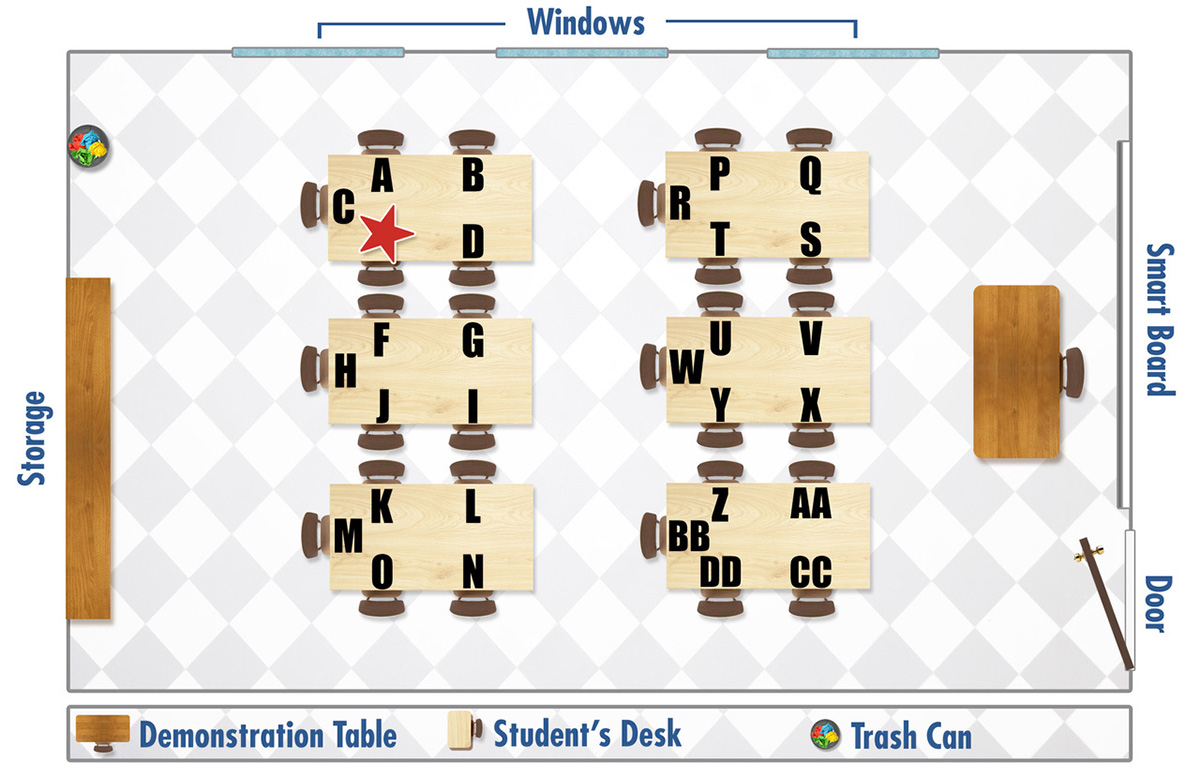
There are 30 student seats in three rows of two tables, with each table comprised of two north-facing and south-facing seats as well as an east-facing seat on the west end. In the northernmost row, clockwise from the top left, the western table is labeled A, B, D, a star to denote Sophia’s seat, and C. Clockwise from the top left, the eastern table is labeled P, Q, S, T, and R. In the middle row, clockwise from the top left, the western table is labeled F, G, I, J, and H. Clockwise from the top left, the eastern table is labeled U, V, X, Y, and W. In the southernmost row, clockwise from the top left, the western table is labeled K, L, N, O, and M. Clockwise from the top left, the eastern table is labeled Z, AA, CC, DD, and BB. On the west wall is the storage closet with a trash can in the northwest corner, on the north wall are three windows, on the east wall is a smart board with a west-facing teacher’s desk in front, and in the southeast corner is the door.
Possible Strategies
- Facilitating efficient traffic patterns
- Supporting frequent interaction
- Matching room arrangement with instructional format
- Minimizing distractions and disruptive events
Assignment
- Review the STAR Sheets for the possible strategies listed above.
- Referencing the classroom sketch above, list two potential reasons Sophia could be off task. Make sure to identify at least one reason for whole-group demonstration and one for small-group lab activities.
- Using the classroom sketch above:
- Suggest a seating location for Sophia that could potentially increase her on-task behavior during both whole-group demonstration and small-group activities.
- Give a rationale for the seating location, making sure to reference the strategy or strategies you used to do so.
Case
Level B • Case 2
Background
| Students: | Owen | Regina | Portia | Quincé |
| Ages: | 16 | 18 | 15 | 17 |
| Grade: | 10th | 12th | 10th | 11th |
Scenario
Oliver, Aliyah, Abigail, and Paulo rejoin their general education class for social studies following their mathematics class in the special education classroom. The special education teacher has suggested that the social studies teacher place these fourth graders at seating locations separate from one another to allow them more opportunities to interact with their peers. To help facilitate their seating assignments, the special education teacher offered the following informatio:
Owen
- Is shy
- Is easily distracted, especially by computers
- Does a good job of pretending to be on task when he does not understand how to do something or isn’t interested
Regina
- Works well in groups
- Is a strong reader and writer
- Requires a wheelchair for mobility
Portia
- Needs to be near the smart board to see written material
- Is easily distracted by other students
- Likes to volunteer to help the teacher
Quincé
- Is talkative
- Benefits from movement
- Gets along well with other students
Possible Activities
- Facilitating efficient traffic patterns
- Supporting frequent interaction
- Matching room arrangement with instructional format
- Minimizing distractions and disruptive events
Assignment
- Review the STAR Sheets for each strategy listed
- Assign each of the four students one of the lettered seating locations in the classroom sketch
- Explain why you selected these specific seating locations and indicate which strategies you used to make your decisions.

There are 30 student seats in three rows of two tables on the west side of the classroom. Each table has two north-facing and south-facing seats as well as a west-facing seat on the east end. In the northernmost row, clockwise from the top left, the western table is labeled A, B, C, D, and E. Clockwise from the top left, the eastern table is labeled P, Q, R, S, and T. In the middle row, clockwise from the top left, the western table is labeled F, G, H, I, and J. Clockwise from the top left, the eastern table is labeled U, V, W, X, and Y. In the southernmost row, clockwise from the top left, the western table is labeled K, L, M, N, and O. Clockwise from the top left, the eastern table is labeled Z, AA, BB, CC, and DD. On the east side is a large group of tables with 12 computers, which has six east-facing and west-facing seats. On the southern end of this group is the north-facing teacher’s desk. In the southwest corner is the door with a pencil sharpener, trash can, and storage cabinet east of it on the southern wall; on the west wall is the smart board; on the north wall are two pairs of windows; and on the east wall is the dry-erase board.
Case
Level C • Case 1
Background
Student: Jamison
Age: 14.8
Grade: 8th
Scenario
Jamison is an eighth grader who has recently transitioned from a remedial to a regular mathematics class at a large, urban junior high school for eighth and ninth graders. Jamison is a well-liked, team-oriented individual who enjoys lots of friends across multiple social groups. As a strong forward on the school basketball team, Jamison also demonstrates leadership skills on and off the court. Much as was the case in his remedial class, mathematics instruction in Jamison’s new classroom is typically conducted through paired- and small-group interactions. The special education teacher anticipates that Jamison’s strengths will help him to compensate for prior struggles with math. Although Jamison has progressed this semester to just below grade level in this subject, he remains slightly insecure.
Areas of Strength
- Participates well in group activities
- Has a strong interest in science and sports
- Follows oral directions well
Assignment
- Review all of the STAR Sheets.
- Complete the room arrangement sketch below to meet the class’s instructional needs and to support Jamison. Be sure to include:
- 26 student desks, including one designated with a star for Jamison
- 1 teacher desk
- 1 group table
- 1 trash can
- When you have completed your room arrangement sketch:
- Explain your rationale for the sketched classroom arrangement.
- Justify your decisions for Jamison’s seating location.
- Identify which strategies you used to help make your decisions.
- Indicate how those decisions support Jamison.

This is a diagram of an incomplete classroom. The classroom has a bookcase on the west side, a dry-erase board on the north wall, a computer in the northeast corner, two windows on the east wall, and a door in the southeast corner. The diagram has labeled images to place within the classroom: a teacher’s desk, a student desk (to signify the 26 student desks), a star to mark Jamison’s desk, an eight-person circular table, and a trash can.
To cite this case study unit, please use the following:
Poole, I., Evertson, C., & the IRIS Center. (2002, 2017). Effective room arrangement: Middle & high school. Retrieved from https://iris. peabody.vanderbilt.edu/wp-content/uploads/pdf_case_studies/ ics_effrmarr_middle_high.pdf
The contents of this resource were developed under a grant from the U.S. Department of Education, #H325E120002. However, those contents do not necessarily represent the policy of the U.S. Department of Education, and you should not assume endorsement by the Federal Government. Project Officer, Anna Macedonia.
Credits
Content ContributorsInge Poole Case Study DevelopersKim Skow EditorsJason Miller |
ReviewersEd Emmer GraphicsBrenda Knight WebmasterJohn Harwood PhotosShutterstock |
Licensure and Content Standards
This IRIS Case Study aligns with the following licensure and program standards and topic areas.
Council for Exceptional Children (CEC)
CEC standards encompass a wide range of ethics, standards, and practices created to help guide those who have taken on the crucial role of educating students with disabilities.
- Standard 2: Learning Environments
Interstate Teacher Assessment and Support Consortium (InTASC)
InTASC Model Core Teaching Standards are designed to help teachers of all grade levels and content areas to prepare their students either for college or for employment following graduation.
- Standard 3: Learning Environments
* For an answer key to this case study, please email your full name, title, and institutional affiliation to the IRIS Center at [email protected].
