Case Study
Written Expression: Grades 2–5

Case Study
Written Expression: Grades 2–5
Introduction
This case study set presents a number of writing strategies for helping students in the elementary and middle-school grades who struggle with writing. In order for students to benefit from instruction in written expression they must possess some prerequisite skills. These are:
- Transcription skills: handwriting and spelling
- Grammar skills: knowledge of sentence form and structure
Students who struggle with writing often demonstrate little knowledge of the process involved. Specifically, these students have difficulty with what are called the lower-level skills (e.g., handwriting, spelling, or grammar) as well as the higher-level skills (e.g., idea formulation and topic selection, planning, producing, or organizing and revising text).
The preferred method of implementing the strategies outlined in this case study set is to use the Self-Regulation Strategy Development (SRSD) model, which, as the title implies, requires students to utilize self-regulation strategies. For those without this knowledge, we recommend that you view the IRIS Modules:
- SRSD: Using Learning Tips for Enhance Student Learning
- SOS: Helping Students Become Independent Learners
SRSD is a research-validated model that involves explicitly and systematically teaching a strategy. Though the SRSD model is sequential in nature, it nevertheless allows teachers to revisit stages of the process when the learning needs of their students require them to do so. The SRSD model is composed of the following stages:
| Stages of the SRSD Model | |
| Stage 1: Develop and Activate Background Knowledge |
Before teaching any tips for students, teachers should evaluate students’ skills (e.g., task analyze writing skills—Are students able to write and spell with reasonable fluency? Can students name and describe the parts of a story?). |
| Stage 2: Discuss the Strategy |
Talk with the students about the strategy you are going to teach them. Discuss its advantages, how it can help them in their assignments, and when it should be used. |
| Stage 3: Model the Strategy |
The teacher talks aloud throughout modeling as he or she goes over the steps in the strategy, describes what the students will do at each step, and demonstrates how the strategy is used. (Note: It is often helpful for the teacher to use a script.) |
| Stage 4: Memorize the Strategy |
Make sure that students memorize the steps and procedures in the strategy. |
| Stage 5: Support the Strategy |
Practice using the strategy with the students. For example, a student and teacher could write a story collaboratively. Initially, the teacher will support the implementation of the strategy. Over time, the teacher will decrease this support. |
| Stage 6: Independent Performance |
Evaluate the students’ ability to independently apply the strategy. To support generalization of the strategy, the students should be given opportunities to apply the strategy in different contexts (e.g., different classes). To support maintenance of the strategy, the students should be asked to apply the strategy in the weeks and months after instruction. |
Self-Regulation Strategies Key Ideas
Self-regulation is the ability to control one’s behavior. When used in conjunction with learning in the classroom, it is the method or procedure that learners use to manage their learning. Students who practice self-regulation strategies are often more active participants in their learning, aware of their thought processes, motivated, and independent. Self-regulation includes four areas, which can be used independently or in combination:
- Self-monitoring – a technique that requires students to keep track of their progress and record the results.
- Self-instruction – a technique that involves students talking themselves through a task or activity (e.g., “I can do it!”, “First, I pick my topic.”).
- Goal setting – a technique in which the student and the teacher determine what the student is trying to achieve and how to get there.
- Self-reinforcement – a technique in which students select reinforcers and reward themselves for reaching or exceeding a criterion.
Note: Research indicates that the SRSD model is more effective at improving writing performance than are all other instructional approaches. We recommend the use of this model to teach the writing strategies that are presented in this case study set.
Each case study includes multiple STAR Sheets and cases.

STAR (STrategies And Resources) Sheets—These provide a description of a well-researched strategy that can help you solve the cases.

Cases—These present a problem-based classroom issue or challenge and an assignment, which can be completed using one or more of the STAR Sheets. There are three progressive levels of cases: Level A (gathering information), Level B (analyzing information), and Level C (synthesizing information).
STAR Sheet
Narratives
About the Strategy
Planning and organizing is a necessary pre-writing exercise that includes knowing the components of the writing assignment, selecting a topic, and brainstorming ideas to include in the composition.
Narratives are stories that can be presented in different ways (e.g., short story, drama, song). Narrative elements include sequential story events—typically about something specific—and a character whose actions are mitigated by an intention or need. Finally, an unforeseen occurrence might transpire, resulting in a dilemma for the character.
What the Research and Resources Say
- Researchers have found that when students have specific knowledge about writing elements (e.g., the parts of a story) their writing development and quality increases (Olinghouse & Graham, 2009).
- Students in primary grades do not spend sufficient writing time planning and revising connected text. Their writing improves when they are taught these skills (Cutler & Graham, 2008).
- One of the most common types of writing assignments in which primary grade students participate is narrative writing (Cutler & Graham, 2008).
- Compared to their peers, struggling writers, including those with learning disabilities, have difficulty planning and organizing their writing and benefit from using writing strategies (Saddler & Graham, 2005; Baker et al., 2003).
Strategies to Implement
The following strategies help students to systematically plan and organize their narratives. When used with the SRSD model, these strategies have been scientifically validated and have been shown to improve students’ narratives and story writing.
POW + WWW, What = 2, How = 2
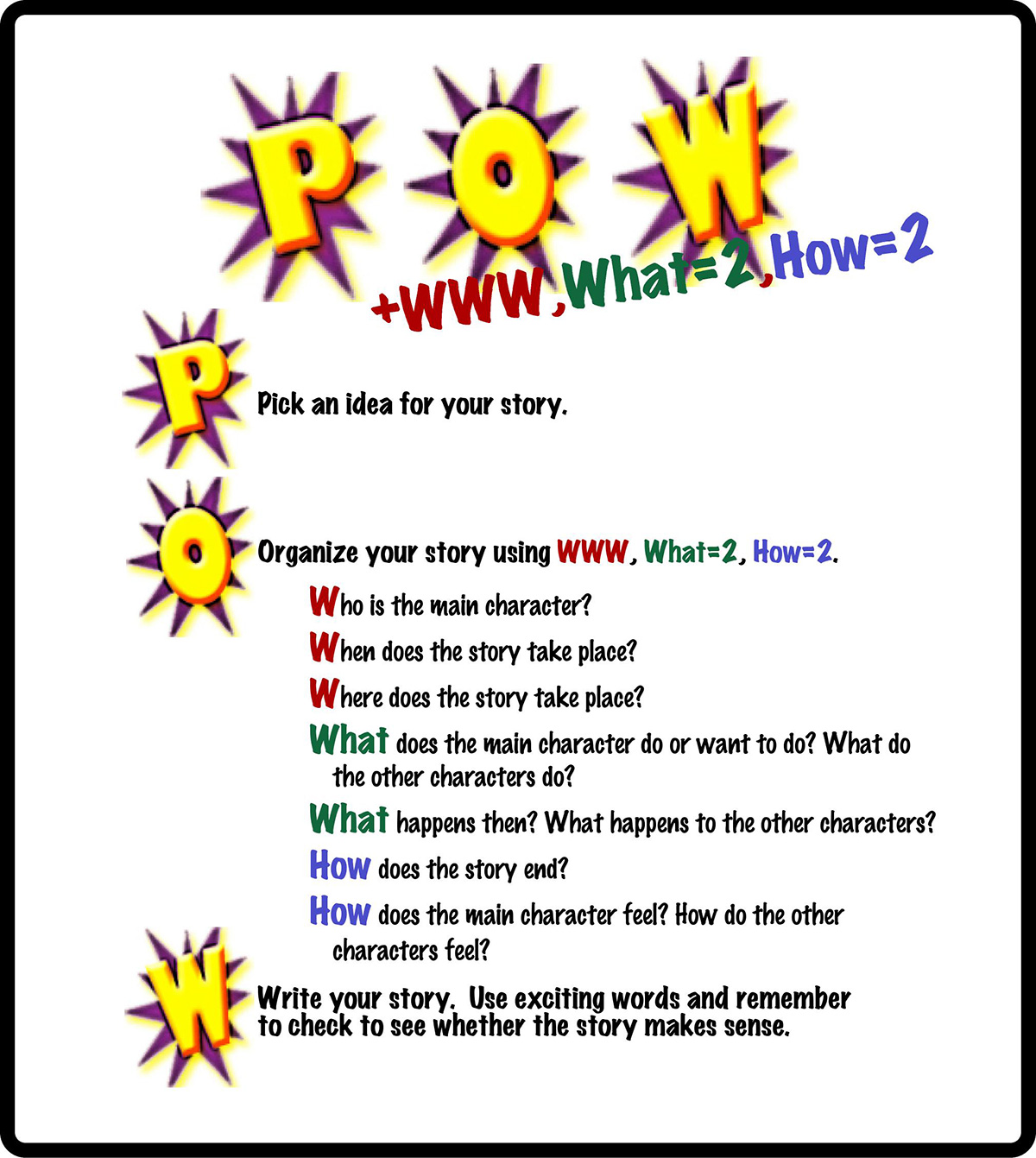
POW + WWW, What = 2, How = 2 is a strategy that helps students write better stories. The POW component of the strategy is designed to help students pick their idea, organize (i.e., plan), and write their story. The WWW, What = 2, How = 2 component is intended to help students organize their notes (the “O” in POW).
(Adapted from Powerful Writing Strategies for All Students, by K. R. Harris, S. Graham, L. Mason, and B. Friedlander, 2008, p. 116)
Pick an idea for your story. Organize your story using WWW, What = 2, How = 2: Who is the main character? When does the story take place? Where does the story take place? What does the main character do or want to do? What do the other characters do? What happens then? What happens to the other characters? How does the story end? How does the main character feel? How do the other characters feel? Write your story. Use exciting words and remember to check to see whether the story makes sense.
POW + C-SPACE
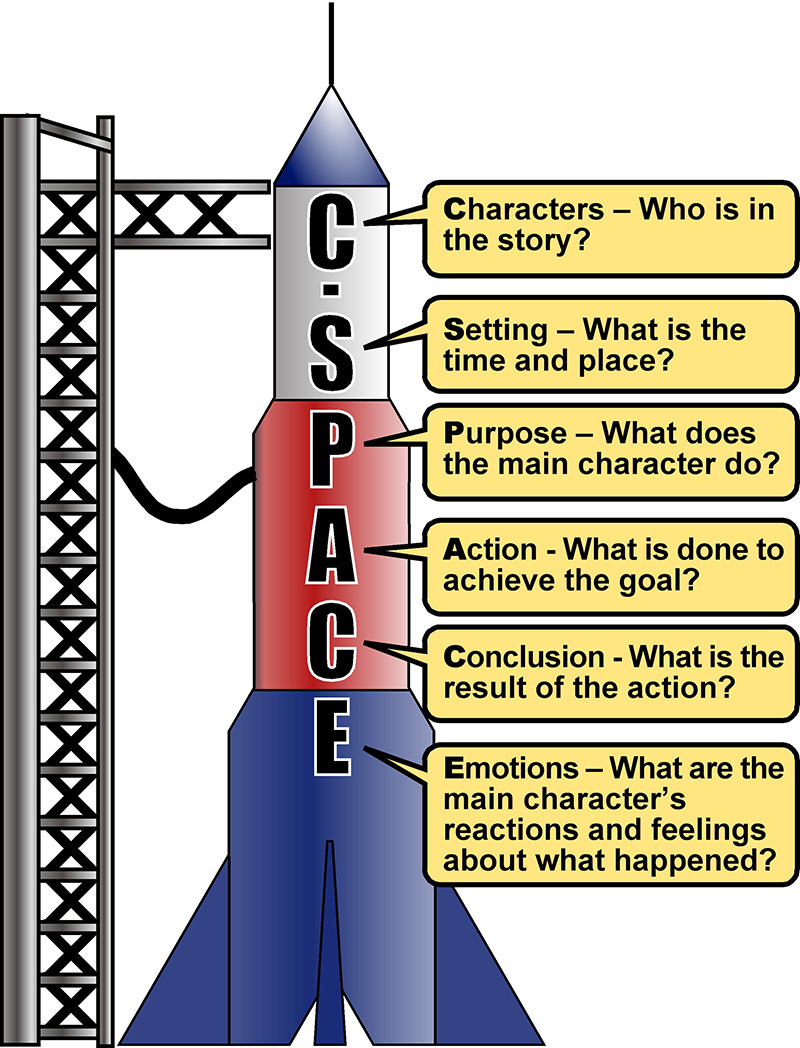
The POW + C-SPACE strategy is designed to help students develop a writing plan and think about the details that should be included in stories. The POW component of the strategy is designed to help students to pick their idea, organize (i.e., plan), and write their story. The C-SPACE component of the strategy is designed to help students to organize their notes (the “O” in POW).
(Adapted from Powerful Writing Strategies for All Students, by K. R. Harris, S. Graham, L. Mason, and B. Friedlander, 2008, p. 148)
Characters – Who is in the story? Setting – What is the time and place? Purpose – What does the main character do? Action – What is done to achieve the goal? Conclusion – What is the result of the action? Emotions – What are the main characters reactions and feelings?
Graphic organizer for WWW, What = 2, How = 2

(Adapted from Powerful Writing Strategies for All Students, by K. R. Harris, S. Graham, L. Mason, and B. Friedlander, 2008, p. 148)
Sample graphic organizer for WWW, What = 2, How = 2. WWW box: Who – Who are the characters? When – When did the story take place? Where – Where did the story take place? What = 2 box: What – What did the main character do? What – What happened after he or she did it? How = 2 box: How – How did the story end? How – How did the main character feel?
Examples
Cue cards for C-SPACE

(Adapted from Powerful Writing Strategies for All Students, by K. R. Harris, S. Graham, L. Mason, and B. Friedlander, 2008, p. 148)
Six sample C-SPACE cue cards with space-themed animations. For example, the first Character card features an alien and the Setting card features planets.
Tips for Implementation
- Increase the frequency of writing assignments. Writing proficiency is a predictor of academic success for students in school, and it increases student knowledge.
- Teach and use varied vocabulary with students to increase effective writing.
- After students have completed a narrative, instruct them to label its elements (e.g., setting, characters, feelings) to ensure that they have included the necessary components.
- Allow students to use graphic organizers to help plan or organize their stories.
- Make cue cards to help students to plan or organize their stories.
Keep in Mind
It should be stressed that how a strategy is taught is what ultimately determines its effectiveness. One highly effective and empirically proven model is the Self-Regulated Strategy Development (SRSD) model.
- Students may lack background knowledge necessary for writing a narrative.
- In some cases, students may have knowledge on a topic but fail to activate this background knowledge.
- Students must understand specific concepts related to writing narratives (e.g., sequence of events, problem or conflict, resolution) in order to be successful writers.
Baker, S., Gersten, R., & Graham, S. (2003). Teaching expressive writing to students with learning disabilities: Research-based applications and examples. Journal of Learning Disabilities, 36, 109–123. https://doi.org/10.1177/002221940303600204
Cutler, L., & Graham, S. (2008). Primary grade writing instruction: A national survey. Journal of Educational Psychology, 100(4), 907–919. https://doi.org/10.1037/a0012656
Harris, K. R., Graham, S., Mason, L., & Friedlander, B. (2008). Powerful writing strategies for all students. Brookes. https://products.brookespublishing.com/Powerful-Writing-Strategies-for-All-Students-P186.aspx
McKeough, A., Palmer, J., Jarvey, M., & Bird, S. (2007). Best narrative writing practices when teaching from a developmental framework. In S. Graham, C. A. MacArthur, & J. Fitzgerald (Eds.), Best Practices in Writing Instruction (p. 53). Guilford Press.
Persky, H. R., Daane, M. C., & Jin, Y. (2003). The nation’s report card: Writing 2002. (NCES 2003-529). U.S. Department of Education. Institute of Education Sciences. National Center for Education Statistics. https://nces.ed.gov/nationsreportcard/pdf/main2002/2003529.pdf
Olinghouse, N., & Graham, S. (2009). The relationship between the discourse knowledge and the writing performance of elementary-grade students. Journal of Educational Psychology, 101(1), 37–50. https://doi.org/10.1037/a0013462
Reid, R., & Lienemann, T. O. (2006). Strategy instruction for students with learning disabilities. Guilford Press.
Saddler, B., & Graham, S. (2005). The effects of peer-assisted sentence combining instruction on the writing performance of more and less skilled young writers. Journal of Educational Psychology, 97, 43–54. https://doi.org/10.1037/0022-0663.97.1.43
STAR Sheet
Persuasive Essays
About the Strategy
Planning and organizing is a necessary pre-writing exercise that involves knowing the components of the writing assignment, selecting a topic, and brainstorming ideas to include in the composition.
Persuasive writing is a type of writing that informs the audience (e.g., teacher, peers) of the writer’s opinion or thoughts about a specific topic.
What the Research and Resources Say
- Students in primary grades do not spend sufficient writing time planning and revising connected text. Their writing improves when they are taught these skills (Cutler & Graham, 2008).
- Compared to their peers, students who struggle with writing, including those with learning disabilities, have difficulty planning and organizing their writing and benefit from using writing strategies (Baker et al., 2003).
- Though persuasive writing assignments are used less frequently with students in the primary grades, students in these grades can learn to use persuasive writing (Cutler & Graham, 2008).
- Young students are capable of understanding writing for an audience (e.g., teacher, self, peer), an important feature of writing persuasive essays (Dray et al., 2009).
- When producing persuasive text, students are able to pull from their understanding of an important social issue (Dray et al., 2009).
- By the time many students graduate from high school, they do not have the writing skills they need in college or in the work force (Achieve, 2005; Kiuhara et al., 2009).
Strategies to Implement
The following strategies help students to systematically plan and write persuasive essays. These strategies have been scientifically validated and have been shown to improve students’ writing.
POW + TREE
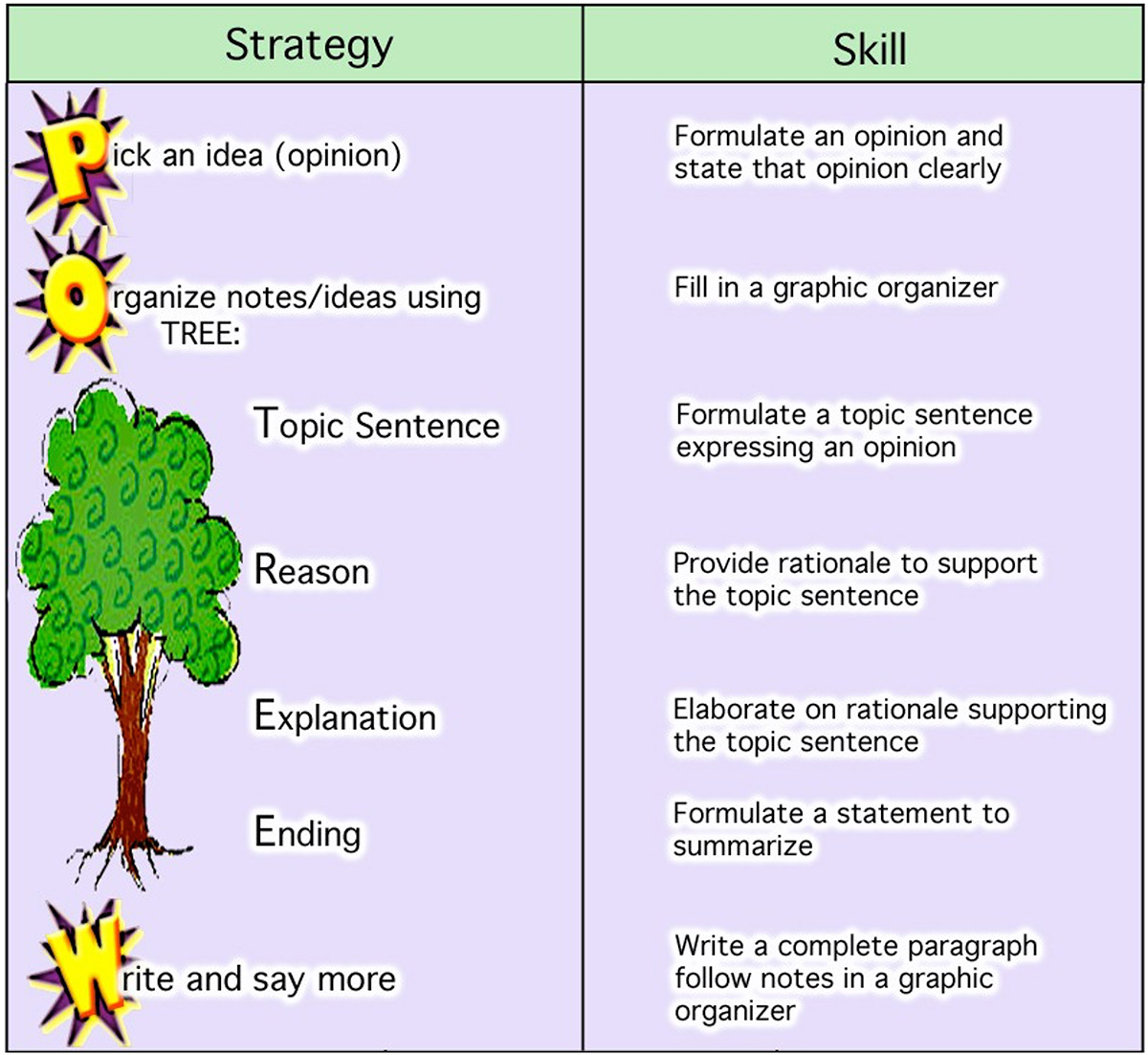
POW + TREE is a strategy that helps students to convey their opinions in their essays. The POW component of the strategy is designed to help students pick their idea, organize (i.e., plan), and write their story. The TREE component is intended to help students organize their notes (the “O” in POW).
(Adapted from Powerful Writing Strategies for All Students, by K. R. Harris, S. Graham, L. Mason, and B. Friedlander, 2008, p. 148)
POW table featuring strategies in the left column and corresponding skills in the right column. For example, “Pick an idea” on the left corresponds to “Formulate an opinion and state that opinion clearly” on the right.
STOP and DARE
STOP and DARE is another strategy students can use to plan and organize persuasive essays. The strategy has two mnemonics components, which are designed to emphasize reflection and planning. The STOP mnemonic helps students to plan and organize their persuasive essays.

Suspend Judgment: Students consider each side of the topic before taking a position.
Take a Side: Determine which side will have the strongest argument or which side you believe in.
Organize Ideas: Select ideas that make powerful arguments by putting an asterisk next to the ideas that you want to be sure and use. Identify several arguments that you will refute. Put your ideas in numerical order.
Plan More as You Write: Keep planning as you continue to write.
Use the DARE mnemonic as a reminder to use all of the components of a good essay.
Develop a Topic Sentence
Add supporting Ideas
Reject Arguments for the Opposing Side
End with a Conclusion
(Adapted from Powerful Writing Strategies for All Students, by K. R. Harris, S. Graham, L. Mason, and B. Friedlander, 2008, p. 223)
Examples
Graphic organizer for the TREE component of the POW+TREE strategy

(Adapted from De La Paz, S. 2001; Harris, K. R., Graham, S., Mason, L., & Friedlander, B. 2008, p. 185)
POW+TREE graphic organizer featuring a Topic box (What is my topic sentence?), Reasons box (What are the reasons? Give at least three to support your idea.), Explanation box (Give examples or explanations for each reason.), and an Ending box (Conclude the essay with an interesting sentence that summarizes your thoughts.).
Cue cards with transition words that students can use in their persuasive essays

(Adapted from De La Paz, S. 2001; Harris, K. R., Graham, S., Mason, L., & Friedlander, B. 2008, p. 226)
Cue cards for transition words in persuasive writing. For example, the Sequencing and Adding Ideas card lists “First, Second, Third, In addition, Another, Also, Besides, In fact.”
Tips for Implementation
- Make sure that students understand the elements of a persuasive essay. When students are organizing their notes, ask them to recall and be sure to include these elements.
- Remind students that the topic sentence reveals the writer’s opinion as well as what the essay will be about.
- Allow students to use graphic organizers to help plan or organize their persuasive essays.
- Make cue cards to help students to plan or organize their persuasive essays.
Keep in Mind
It should be stressed that how a strategy is taught is what ultimately determines its effectiveness. One highly effective and empirically proven model is the Self-Regulated Strategy Development (SRSD) model.
- Strategies such as STOP and DARE are commonly combined with self-regulation strategies. See the introduction to this module to learn more about using the Self-Regulation Strategy Development model.
- When students understand both sides of the argument, it helps them to further develop their counter argument.
- Good writers plan before they begin. Good planning leads to better arguments.
- Taking part in pre-writing activities helps students to generate ideas about what they already know about their topic.
Achieve, Inc. (2005). Rising to the challenge: Are high school graduates prepared for college and work? https://www.achieve.org/files/pollreport_0.pdf
Baker, S., Gersten, R., & Graham, S. (2003). Teaching expressive writing to students with learning disabilities: Research-based applications and examples. Journal of Learning Disabilities, 36, 109–123. https://doi.org/10.1177/002221940303600204
Cutler, L., & Graham, S. (2008). Primary grade writing instruction: A national survey. Journal of Educational Psychology, 100(4), 907–919. https://doi.org/10.1037/a0012656
De La Paz, S. (2001). Stop and DARE: A persuasive writing strategy. Intervention in School and Clinic, 36, 234–243. https://doi.org/10.1177/105345120103600409
Dray, A. J., Selman, R. L., & Schultz, L. H. (2009). Communicating with intent: A study of social awareness and children’s writing. Journal of Applied Developmental Psychology, 30(2), 116–128. https://doi.org/10.1016/j.appdev.2008.11.003
Graham, S., & Harris, K. (2007). Best practices in teaching planning. In S. Graham, C. A. MacArthur, & J. Fitzgerald (Eds.), Best Practices in Writing Instruction (p. 138). Guilford Press.
Graham, S., & Perin, D. (2007). Writing next: Effective tips for improve writing of adolescents in middle and high schools. Carnegie Corporation of New York. https://www.carnegie.org/publications/writing-next-effective-strategies-to-improve-writing-of-adolescents-in-middle-and-high-schools/
Harris, K. R., Graham, S., Mason, L., & Friedlander, B. (2008). Powerful writing strategies for all students. Brookes. https://products.brookespublishing.com/Powerful-Writing-Strategies-for-All-Students-P186.aspx
Harris, K. R., Santangelo, T., & Graham, S. (2008). Self-regulated strategy development in writing: Going beyond NLEs to a more balanced approach. Instructional Science, 36, 395–408. https://doi.org/10.1007/s11251-008-9062-9
Kiuhara S. A., Graham, S., & Hawken, L. S. (2009). Teaching writing to high school students: A national survey. Journal of Educational Psychology, 101(1), 136–160. https://doi.org/10.1037/a0013097
Olinghouse, N., & Graham, S. (2009). The relationship between the discourse knowledge and the writing performance of elementary-grade students. Journal of Educational Psychology, 101(1), 37–50. https://doi.org/10.1037/a0013462
STAR Sheet
Revising Strategies
About the Strategy
Revising is the process of adding, deleting, or changing written text for the purpose of improving clarity and cohesion. It is a critical part of writing a composition. This process consists of:
- Identifying a discrepancy between the text and the writer’s intent
- Determining the problem and deciding what should be changed and how to change it
- Making the changes
What the Research and Resources Say
- Students in primary grades do not spend sufficient writing time planning and revising connected text. Their writing improves when they are taught these skills (Cutler & Graham, 2008).
- Skilled writers edit and revise their writing by making content revisions, editing their spelling, capitalization, and punctuation, and by improving the overall appearance of their writing; whereas, less skilled writers tend not to review or make such corrections (Saddler & Graham, 2007).
- Students who struggle with writing, including those with learning disabilities, typically have trouble with the revision process (Graham & Harris, 2003).
Strategies to Implement
There are a number of revising strategies that help students to revise written compositions. This section contains scientifically validated strategies that help students revise their writing.
Compare, Diagnose, Operate
The Compare, Diagnose, Operate strategy helps students to revise their compositions. Students can use this strategy to revise their own writing or that of their peers. This strategy consists of four steps as outlined below:

Compare: Read the text.
Find sentences in which you can add to, delete, or move sentences.
Diagnose: What is wrong?
Something doesn’t sound quite right!
The intention was not made.
The essay is out of sequence.
The reader may not understand what was meant.
The text is drifting from the main point.
The idea is incomplete or weak.
Operate: What do I need to do?
Add more information (details, examples).
Omit a particular part of the text (phrase, sentence).
Rewrite the text in different way.
Rearrange the wording.
Operate: Do it!
Make the revisions.
(Adapted from Powerful Writing Strategies for All Students, by K. R. Harris, S. Graham, L. Mason, and B. Friedlander, 2008, p. 299)
The Six Steps for Revising (including SCAN)
The Six Steps for Revising strategy, including SCAN, is used for revising persuasive essays. The SCAN strategy is embedded in the Six Steps in order to help students to check each of their sentences for clarity, relevance, and grammar errors.
Six Steps for Revising (including SCAN)
- Read the essay
- Identify the sentence that tells the opinion or belief. Is it clearly written?
- Give two reasons why you believe it?
- Use SCAN on each sentence:
C = Is it Connected to my belief?
A = Can you Add more?
N = Note errors?
- Make changes as necessary
- Reread the essay and make more changes.
(Adapted from Harris, K. R., Graham, S., Mason, L., & Friedlander, B., 2008, p. 281)
WRITER
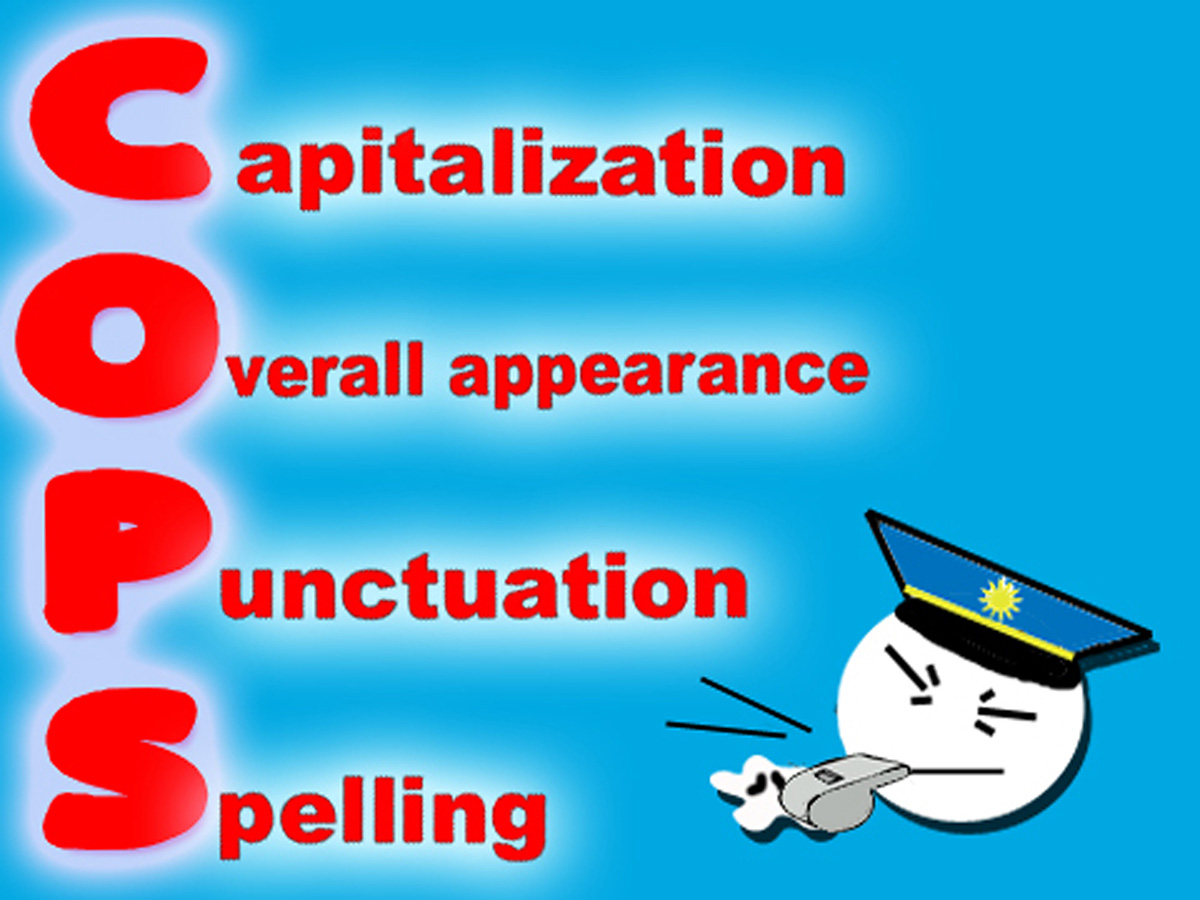
WRITER is a strategy that addresses revisions for any type of writing. It contains the sub-strategy COPS to help with surface revisions (i.e., capitalization, punctuation, spelling, and overall appearance).
COPS
Write on every other line to leave room for edits
Read the paper for meaning
Interrogate yourself using the COPS strategy:
C = Have I Capitalized the first word and all proper nouns?
O = How is the Overall appearance?
P = Have I used end Punctuation, commas, and semicolons correctly?
S = Do the words look like they are Spelled right, can I sound them out, or should I use the dictionary?
Take the paper to someone else to proofread
Execute a final copy
Reread your paper a final time
Examples
Cue card for COPS
Cue cards for SCAN

(Adapted from Harris, K. R., Graham, S., Mason, L., & Friedlander, B., 2008, p. 281)
Tips for Implementation
- Evaluate students’ knowledge of writing. Students who struggle with writing, including those with learning disabilities, may lack the knowledge to determine whether important components of a genre (e.g., settings or topic sentences) are missing.
- Evaluate the extent to which the students realize that they are writing for an audience (e.g., teacher, peer) and that, depending on that audience, they we might write differently.
- Remind students that good writers revise their work—and good writing can improve grades!
- Teach students how to use the caret symbol (^) to show when they want to add information to their compositions.
- Help students understand that sometimes writers do not write what they intended to say.
- When students comment that an essay does not need any revisions, help them to understand that most writing can be improved.
- Cue cards can be used to support students in revising their compositions.
Keep in Mind
It should be stressed that how a strategy is taught is what ultimately determines its effectiveness. One highly effective and empirically proven model is the Self-Regulated Strategy Development (SRSD) model.
- Students may lack an awareness of their audience (e.g., teacher, self, peer).
- The revision process can occur at any time during writing, and revisions can range from surface level (e.g., spelling, punctuation) to those that involve additions, reorganizations, or changes to the meaning of text.
- Language difficulties (e.g., expressing ideas, limited vocabulary) may inhibit effective editing.
Cutler, L., & Graham, S. (2008). Primary grade writing instruction: A national survey. Journal of Educational Psychology, 100(4), 907–919. https://doi.org/10.1037/a0012656
De La Paz, S., Swanson, P., & Graham, S. (1998). The contribution of executive control to the revising by students with learning and writing difficulties. Journal of Educational Psychology, 90, 488–460. https://doi.org/10.1037/0022-0663.90.3.448
Graham, S. (1997). Executive control in the revising of students with learning and writing difficulties. Journal of Educational Psychology, 89, 223–234. https://doi.org/10.1037/0022-0663.89.2.223
Graham, S., & Harris, K. R. (2003). Students with learning disabilities and the process of writing: A meta-analysis of SRSD Studies. In H. L. Swanson, K. R. Harris, & S. Graham (Ed.), Handbook of Learning Disabilities. Guilford Press.
Harris, K., Graham, S., Mason, L., & Friedlander, B. (2008). Powerful writing strategies for all students. Brookes. https://products.brookespublishing.com/Powerful-Writing-Strategies-for-All-Students-P186.aspx
MacArthur, C. A., Graham, S., & Schwartz, S. (1991). Knowledge of revision and revising behavior among students with learning disabilities. Learning Disability Quarterly, 14, 61–73. https://doi.org/10.2307/1510373
Saddler, B., & Graham, S. (2007). The relationship between writing knowledge and writing performance among more and less skilled writers. Reading and Writing Quarterly, 23(3) 231–247. https://doi.org/10.1080/10573560701277575
Case
Level A • Case 1
Background
Student: Corey
Age: 7.5
Grade: 2
Focus: Narrative
Scenario
Corey is an enthusiastic second grader with a good vocabulary. He enjoys writing but has difficulty organizing his narratives into a complete story. He also has difficulty staying on topic, tending instead to string related thoughts and ideas together without considering his intended purpose.
When I Was Younger
When I was younger I uset to play a lot and dance. Me and my brother Justin we uset to play a long time. My brother Josh he is fun we play we do stuff together. My other brother Victor we love to play together. My other brother chewy he loves to play. When my mom was younger she was butiful and playful she is funny to. When my dad was funny and cute and kind. When my uncle was younger he was atkding like a alien he was so funny and adoribul. When my dogs was younger they was playing tag together. When my grandma was younger she was funny and budeful and she was funny looken.
As the school year has progressed, Corey’s teacher, Mr. Brandt, has become concerned about the lack of progress with Corey’s narrative writing skills. He decides to teach Corey a narrative writing strategy to help him achieve the following goal:
- Given a narrative writing prompt, Corey will write a complete story.
Possible Strategies
- Planning and Organizing Strategies: Narratives
Assignment
- Read the Introduction and the Planning and Organizing Strategies: Narratives STAR Sheet for the possible strategies.
- Describe the POW + WWW, What = 2, How = 2 and the POW + C-SPACE writing strategies.
- Explain how each writing strategy could help Corey to meet his goal.
Case
Level A • Case 2
Background
Student: Kaynia
Age: 8.7
Grade: 3
Focus: Persuasive Essay
Scenario
Kaynia is an active girl who plays well with others and demonstrates great physical vigor. Kaynia’s performance is satisfactory in most content areas; however, she has a difficult time during writing class. A focus of Kaynia’s third-grade writing class is persuasive essay writing. Although most of her peers are able to write persuasive essays, Kaynia is quite frustrated. She has good ideas but is not able to clearly articulate her point of view.
It depends what pet it is. I think children should choose a hamster, cat, dog, bird or a fish. If you have a pet you should take care of it. I chose my pet but I got a cage so I had to buy a hamster. Children should not buy dangerous pets. I love pets. Children should choose good pets. I feel that if you have a pet you should be responsible. I feel that children should choose a good size pet. Some people hate pets and love some pets.
Kaynia’s teacher remembers a staff development on Strategy Instruction she attended and decides to teach Kaynia a persuasive essay writing strategy she learned during it. Kaynia’s teacher has the following instructional goal:
- Given a writing prompt, Kaynia will write a persuasive essay, clearly articulating her point of view and providing supporting arguments.
Possible Strategies
- Planning and Organizing Strategies: Persuasive Essays
Assignment
- Read the Introduction and the Planning and Organizing Strategies: Persuasive Essays STAR Sheet for the possible strategies.
- Describe the POW + TREE and the STOP and DARE strategies.
- Explain how each writing strategy could help Kaynia meet her goal.
- How can the POW+TREE graphic organizer shown on the STAR Sheet help Kaynia to monitor her use of the strategy?
Case
Level B • Case 1
Background
Student: Jessica
Age: 9.11
Grade: 4
Focus: Narrative
Scenario
Jessica likes school and especially enjoys sharing personal experiences with her class. Her teacher, Mrs. Tracy, has noticed how frustrated Jessica becomes when she is given a narrative writing assignment. Despite Jessica’s confidence in verbally communicating each idea, she appears to go “blank” when given the task of planning and organizing her narrative.
Once I had a great time at my friends party. We went swimming and went to anamusement park. I got scared on the roller coaster. I screamed like a little girl. So after we had a party and cake. After that we played games and got lots of tickets. A good day.
Mrs. Tracy has taught the writing process to her class, but Jessica continues to struggle, and Mrs. Tracy has become concerned with her lack of progress. The state’s high-stakes writing assessments are largely based on a student’s ability to plan/ organize and write a high-quality narrative. Mrs. Tracy brings her concern to the fourth-grade team, which in turn suggests that she teach Jessica a strategy specifically for writing narratives. Mrs. Tracy has the following instructional goal:
- Given a narrative writing prompt, Jessica will write a complete narrative.
Possible Activities
- Planning and Organizing Strategies: Narratives
Assignment
- Read the Introduction and the Planning and Organizing Strategies: Narratives STAR Sheet for the possible strategies.
- Explain how each strategy could be used to assist Jessica in reaching her instructional goal.
- Considering Jessica’s strengths and the curricular demands, which strategy do you feel would be more appropriate and why?
Case
Level B • Case 2
Background
Student: Henry
Age: 10.4
Grade: 5
Focus: Persuasive Writing
Scenario
Henry is an outgoing boy who does well in all his classes; however, recently he has been demonstrating some negative behaviors in writing class. Henry’s teacher, Ms. Faz, has heard (on multiple occasions) Henry saying, “I can’t do this! I hate writing!”
I think we should have home work for these reasons. We can learn. It will help us on are homework. It will help me. I will be may be board but it will help me because I will learn more. I like math homework especially unless I have to write about math. I like that I can be alone when I do my homework. I’m happy that we have homework. I will improve in school if I have homework. I like homework because it can be fun. I feel so happybecause we have homework.
During a conference with Henry, he tells Ms. Faz that he used to like to write, but this year the assignments seem a lot harder. When the teacher gives him a writing assignment, he has no idea where to begin.
Ms. Faz has the following instructional goal:
- Given a writing prompt, Henry will write a persuasive essay, clearly articulating his point of view, providing supporting arguments, and refuting opposing arguments.
Possible Activities
- Planning and Organizing Strategies: Persuasive Essays
Assignment
- Read the Introduction and the Planning and Organizing Strategies: Persuasive Essays STAR Sheet for the possible strategies.
- Explain how each of the two writing strategies could be used to assist Henry in reaching his instructional goal.
- Ms. Faz was planning to teach her students the STOP and DARE strategy. Do you think this strategy will help Henry met his goal? Why or why not?
- Decide on two self-regulatory statements that Ms. Faz could use when modeling the strategy for Henry.
Case
Level B • Case 3
Background
Student: Ja’Min
Age: 11.2
Grade: 5
Focus: Revising
Scenario
Ja’Min is something of a reclusive boy who enjoys reading and playing by himself. He is serious about his schoolwork and will on occasion participate in class discussions. Ja’Min does well in most of his classes, but he has difficulty in writing class. When it comes to writing, he appears to use effective Tips for plan/ organize and to draft his compositions; however, when it comes to revising his compositions, he tends to focus on the mechanics of writing (i.e., handwriting, spelling, punctuation, grammar, and format) rather than clarity of meaning. Ja’Min has difficulty making adjustments to his written compositions to ensure that they communicate his full intent.
Once there was a fight between humans and beasts. The humans were fighting for food to survive. Once they got food they would go to these secret caves to eat the food. The humans would use spears and sticks with sharp ends. They often would fight with mammoths, tigers, lions and even bears. Now once there was a Giant Mammoth who was the king of all mammoths. So the whole tribe went to attack the king mammoth the battle was intense, but when they defeated the king a meteor shower was coming. The humans had to travel away from the caves. They escaped the meteors but they had to start a new life in a strange land. So they started building houses and the world we live in now was ventually built by those cave people.
His teacher is concerned that, if uncorrected, Ja’Min’s current difficulties might eventually affect his performance in other classes. As he moves up in grades, his ability to communicate effectively through written language becomes increasingly important. Ja’Min’s teacher has the following instructional goals:
- Ja’Min will revise a previously written composition while keeping in mind his audience (e.g., teacher, peers).
- Ja’Min will revise a previously written composition to better communicate his intentions.
Possible Strategies
- Revising Strategies
Assignment
- Read the Revising Strategies STAR Sheet for the possible strategies.
- Decide which of Ja’Min’s goals you would address first and explain why.
- Identify a strategy and explain why or how it will assist Ja’Min in reaching his goals.
Case
Level C • Case 1
Background
Student: Terrence
Age: 10.2
Grade: 5
Scenario
Terrence is a new student in Mr. Fossberg’s fifth-grade class. His father is in the military, and Terrence has attended four schools in the past six years. He has adapted well socially and has many new friends. He has a positive attitude toward school and does well in most of his classes. He does especially well in math and science; however, he is demonstrating serious deficits in writing. He has great transcription skills (i.e., spelling, handwriting, and grammar), but when it comes to composing a written composition he does not appear to have much experience.
When given a writing assignment, Terrence is able to come up with terrific ideas; however, he does not organize his thoughts and ideas into a coherent composition. He tends to engage in “knowledge telling”—that is, his writing consists of free associations that are hard for anyone but him to understand. Terrence also writes without considering organization, goals, or audience. He said that none of the schools he had attended taught writing the same way, and he was confused about what he was supposed to do.
Fishing is the best sport there is. Once I went fshing. I betted my dad that I could catch a bigger fsh than he could. At frst I cought nothing. The sky was bright and I was heated up. Our boat was not the best. The contest went for hours, very long hours. I have to do chores for a month if I lost. Next I caught a maximum fsh. My dad caught two medium fsh. then we both caught fve more fsh! And I won the bet. What other sport has this much excitement?
His teacher, Mr. Fossberg, is concerned. Writing is an important part of the fifth-grade curriculum, and all of his other students know strategies to plan/ organize, write, edit, and revise their compositions. Mr. Fossberg is particularly concerned about Terrence’s ability to write a persuasive essay, part of the school’s fifth-grade promotional requirements. Mr. Fossberg consulted with the school’s learning specialist. She gave him some information on strategy instruction in written expression and self-regulation.
Areas of Strength
- Has a positive attitude
- Has great transcription skills
- Does well academically and is a hard worker
- Understands the importance of learning to write a complete, high-quality narrative
- Is willing to try strategies to improve his writing skills
Assignment
- Develop an instructional goal for Terrence.
- Choose a combination of one planning/ organizing strategy and one revising strategy to assist Terrence in meeting his instructional goal.
- Provide a rationale for teaching Terrence each strategy.
- Choose one strategy. Explain how you would use the six-step SRSD model to teach Terrence this strategy.
Case
Level C • Case 2
Background
Student: Margarita
Age: 8.8
Grade: 3
Scenario
Margarita is well-liked by her teachers and peers. Her teachers describe her as hardworking with a positive attitude. Margarita does well overall in her classes, although, last year she began to demonstrate some frustration with the increased amount of writing that was required. Margarita does a nice job planning, organizing, and drafting persuasive essays, but when it comes to revising, she tends to have difficulty. She says, “I don’t know what else to do. I’ve already written my paper.”
I think children my age should be allowed to choose their own pets because most of the time stopping them is their parents. They usually say “you children need responsibility”. This is our chance to show them our responsibility! They always say that they aren’t going to walk them but we will. The only reason I think that you shouldn’t is if one of your parents is allergic to dogs, cats, or whatever kind of pet you want. Otherwise I think you should be able to decide to pick your own pet. Just because your mom wants your to get a canary. doesn’t mean bye, bye, little Lassie. Well, at least that’s what I think. That’s why I think children my own age should be allowed to choose their own pet.
Her teacher, Miss Meyer, is concerned that if she cannot teach Margarita to effectively revise her compositions, her writing assignments will become increasingly difficult. Miss Meyer knows that the writing and revising of compositions is a large part of the third-grade curriculum and future high-stakes assessments.
Areas of Strength
- Has a positive attitude toward writing
- Is a hard worker
- Understands that she needs to improve her writing skills
- Is willing to try strategies to improve her writing skills
Assignment
- Develop an instructional goal for Margarita related to revising her writing.
- Determine which strategy you think would be most appropriate in assisting Margarita in achieving the instructional goal. Provide a rationale for your choice.
- What self-regulation strategy would be the most beneficial for Margarita? Explain.
- Describe how you would teach the self-regulation strategy you chose to Margarita.
To cite this case study unit, please use the following:
Lienemann, T., Reid, R., & the IRIS Center. (2009). Written expression: Grades 2–5. Retrieved from https://iris.peabody.vanderbilt.edu/wp-content/uploads/pdf_case_studies/ics_writex.pdf
The contents of this resource were developed under a grant from the U.S. Department of Education, #H325E120002. However, those contents do not necessarily represent the policy of the U.S. Department of Education, and you should not assume endorsement by the Federal Government. Project Officer, Anna Macedonia.
Credits
Content ContributorsTorri Lienemann PhD Case Study DeveloperZina Yzquierdo EditorsJason Miller |
ReviewersSusan DeLa Paz GraphicsErik Dunton WebmasterJohn Harwood |
Licensure and Content Standards
This IRIS Case Study aligns with the following licensure and program standards and topic areas.
Council for Exceptional Children (CEC)
CEC standards encompass a wide range of ethics, standards, and practices created to help guide those who have taken on the crucial role of educating students with disabilities.
- Standard 5: Instructional Planning and Strategies
Interstate Teacher Assessment and Support Consortium (InTASC)
InTASC Model Core Teaching Standards are designed to help teachers of all grade levels and content areas to prepare their students either for college or for employment following graduation.
- Standard 8: Instructional Strategies
* For an answer key to this case study, please email your full name, title, and institutional affiliation to the IRIS Center at [email protected].
