What should teachers consider when testing students who are learning to speak English?
Page 11: Measure Performance
Just as they do for all students, teachers should regularly monitor English learners’ skills. Teachers may use both classroom and standardized assessments to measure student performance.
Keep in Mind
EL students often understand more than they are able to convey in English. When students are allowed to communicate in a variety of ways—such as using their first language, using gestures, or drawing a picture—they are better able to express what they know.
Classroom Assessment
Teachers can use informal assessments to monitor students’ comprehension of the material. Informal assessments provide teachers with ongoing data about a student’s learning progress and help them to address knowledge any gaps their students might display. One way of informally assessing student understanding is called semantic mapping. In order to create a semantic map, the students:

- Brainstorm words associated with a key concept—the students provide the words while the teacher determines which are most important.
- Determine categories or sub-headings and group the words accordingly.
- Develop a graphic to represent the relationship between the key concepts and the categories.
After the teacher has repeatedly modeled how to create the maps, he or she should allow students to work with partners or individually. Students should then be asked to compare their map with others to see the different ways in which concepts can be analyzed.
Teachers should exercise caution when administering unit or chapter tests to EL students. These tests may require more complex test-taking abilities, which can be challenging for these students, depending on their level of language proficiency. If a student performs poorly on a test, it may be difficult for teachers to determine whether it was due to a difficulty with the subject content or a difficulty with the language. It is important that teachers recognize that any test in English is first and foremost a test of English. For example, using essay questions requires that student demonstrate various language skills, in addition to responding to the content in question. Students have to retrieve their thoughts and organize and structure them in a way that effectively answers the question. Multiple-choice questions that have subtle differences in the answer options, or questions that combine option choices (e.g., a test that has an answer option like “A and B”) may cause confusion among English learners. Even math tests often include English vocabulary terms (e.g., quotient, numerator, denominator, compound interest).
Standardized Assessments
Standardized assessments are commercially published tests (e.g., Iowa Test of Basic Skills [ITBS], SAT, ACT) given to students with strict administration and scoring guidelines. Individual students’ scores are compared to those achieved by a national sample of students, or norm. Many of the standardized tests created and used in the schools were normed on monolingual English-speaking students and not students learning English and, therefore, may not yield accurate scores. Another consideration is that many ELs may not score well on timed-tests because they generally require more time to process both language information and content information.

Teachers should find ways to assess ELs’ content knowledge that is separate from their English language knowledge. Below are some suggestions for constructing and administering tests for EL students:
- Create test questions that incorporate aspects of the student’s background knowledge, when applicable.
- Make sure the student understands how to respond to various test formats (e.g., short answer, multiple choice, true/ false).
- Preview the test with the student to ensure they understand the terminology in the instructions and test questions and key vocabulary (e.g., “Explain how the principles outlined in the Preamble to the Constitution correlate to the ideals of a democracy.”).
- Permit students to use a bilingual dictionary.
- Allow students to take the test with a bilingual teacher or paraprofessional who can offer translation supports, or an ESL teacher who can help explain words students do not understand.
- Allow extra time for students to complete the test.

Example: As an informal assessment of their learning, Ms. Westerman asks her students to create a semantic map about types of rocks.
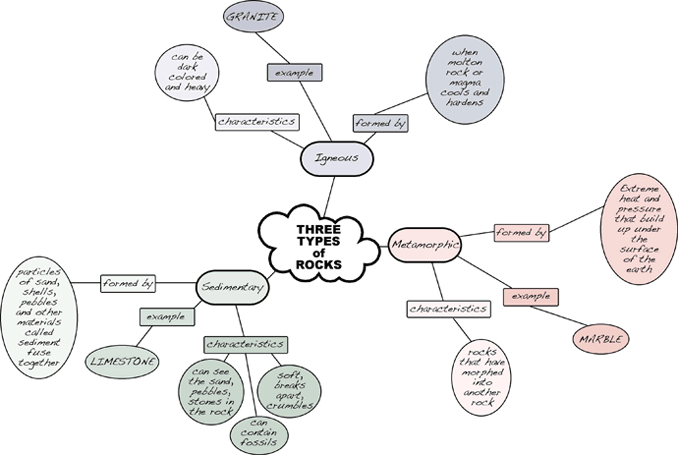
The central hub of the map reads “Three Types of Rocks.” From there, the map branches out in three separate directions: “Igneous,” “Sedimentary,” and “Metamorphic.” Each of these categories, in turn, branch into further detail, including “Formed By,” “Example,” and “Characteristics.”
For example, under “Sedimentary,” the example is “Limestone.” “Formed by” reads “particles of sand, shells, pebbles, and other materials fuse together.” The “Characteristics” of limestone include “can see the sand, pebbles, and stones in the rock,” “can contain fossils,” and “soft, breaks apart, crumbles.”
Prior to administering the unit test, she makes sure her EL students understand:
- How to respond to short answer and multiple choice questions
- The vocabulary and terminology
Because the bilingual teacher is not at school on the test day, Ms. Westerman lets her EL students use a bilingual dictionary and to ask her for clarification about terms they do not understand. In addition, her EL students are allowed extra time to complete their test.
