Secondary Transition: Student-Centered Transition Planning
This module will help users to better understand the benefits of student-centered transition planning, identify ways to involve students in collecting assessment information and developing goals, and be able to prepare students to actively participate in their own IEP meetings (est. completion time: 2 hours).
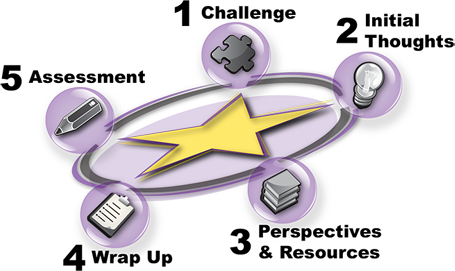
Work through the sections of this module in the order presented in the STAR graphic above.
Related to this module

Challenge
Review the movie below and then proceed to the Initial Thoughts section (time: 3:06).

Transcript: Challenge
For the seven years Mr. Longoria has taught special education at Central High School, he has seen many students make the transition to employment or further education. He always believed himself to be somebody who did student-centered planning just by having some of his students attend their individualized education program or IEP meetings. Recently, however, Mr. Longoria attended a training on student-centered transition planning, and he now recognizes his belief as a common misconception. He has become convinced that, with assistance, some of his students could take on a more prominent role in their IEP meetings and the overall planning process.
This said, Mr. Longoria is a bit skeptical that all of his students could handle this added responsibility. In particular, he wonders about two of his students, Donzaleigh and Jeremy.
Donzaleigh is an eleventh grader with a mild learning disability in reading and an articulation disorder. She has strong math and organizational skills and wants to be a fashion designer when she leaves school. Mr. Longoria knows that Donzaleigh does not like to initiate conversation or talk in front of groups because of her articulation disorder. Because of this, he anticipates that she would find addressing a group of adults in her IEP meeting an uncomfortable experience.
Jeremy is a ninth grader who has an intellectual disability. When he gets out of school, Jeremy wants to work with animals. Though he enjoys school, he struggles in most academic subjects. Jeremy loves socializing with his peers and teachers alike and seems unaware that he even has a disability that requires supports. Mr. Longoria knows that Jeremy has a difficult time staying focused and does not have much interest in talking about school subjects. He further wonders how Jeremy will react when the IEP team starts discussing his disability.
Mr. Longoria wonders whether Donzaleigh and Jeremy have the skills to be active participants in the transition planning process. He further begins to question what supports need to be in place to facilitate their participation.
Here is your Challenge:
What is student-centered transition planning?
What are some ways to involve students in student-centered transition planning?
How can teachers successfully implement student-centered transition planning?
Initial Thoughts
Jot down your Initial Thoughts about the Challenge:

What is student-centered transition planning?
What are some ways to involve students in student-centered transition planning?
How can teachers successfully implement student-centered transition planning?
When you are ready, proceed to the Perspectives & Resources section.
Perspectives & Resources

Objectives
By completing this module and the accompanying activities, the learner will be able to:
- Understand the benefits of student-centered transition planning
- Be able to identify ways to involve students in collecting assessment information and developing goals
- Be better equipped to prepare students to take a leadership role in their IEP meetings
- Be able to identify strategies to actively involve students in evaluating their progress towards meeting IEP goals
Standards
This IRIS Module aligns with the following licensure and program standards and topic areas. Click the arrows below to learn more.
CEC standards encompass a wide range of ethics, standards, and practices created to help guide those who have taken on the crucial role of educating students with disabilities.
- Standard 2: Learning Environments
- Standard 5: Instructional Planning and Strategies
- Standard 7: Collaboration
InTASC Model Core Teaching Standards are designed to help teachers of all grade levels and content areas to prepare their students either for college or for employment following graduation.
- Standard 10: Leadership and Collaboration
When you are ready, proceed to Page 1.
Page 1: Student Involvement in the IEP Process
 In the United States, the Individuals with Disabilities Education Act (IDEA) governs the education of students with disabilities. The law guarantees that each student—from infancy through high school graduation or age 21—will have an individualized education program (IEP)—a document or strategic plan outlining the student’s annual learning goals and objectives, as well as the supports and services required to achieve those goals. A kind of roadmap laying out a course for students to follow, IEPs are developed by a multidisciplinary group, referred to as the IEP team. This team meets at least once a year to review the student’s progress.
Individuals with Disabilities Education Act (IDEA)
glossary
individualized education program (IEP)
glossary
At a minimum, an IEP team should include the student (when appropriate); a parent or guardian; a special educator; a general educator; a school or district representative knowledgeable about specially designed instruction, the general education curriculum, and resource availability (e.g., a school administrator); a related services provider (when necessary); someone who can interpret the instructional implications of evaluation results (e.g., a special education teacher, a school psychologist); and other individuals based on the needs of the student in question. By the time the student reaches the age of 16 (although in some states as early as age 14), the IEP team should also include a transition component to address life after high school in the areas of education, training and employment, and independent living. At this point, additional IEP team members with expertise in these areas (e.g., a vocational rehabilitation counselor, an independent living coordinator) should be added. Because transitions are so personally defined—with postsecondary goals developed around a student’s interests, needs, and strengths—it is considered best practice to include and involve the student in this process.
Despite this, students with disabilities are often only minimally involved in the annual IEP process. Though these students are considered to be members of the IEP team, too often the adults in charge of coordinating the meeting do not plan those meetings with the student’s participation in mind, outside of their mere attendance. Meetings are held, decisions made, and progress discussed, but the student rarely presents her perspectives, or is otherwise not prepared or encouraged to take an active part in this critical process of life-planning.
The graphic below illustrates the findings from a large-scale study of more than 11,000 students, aged 14–22. Although 94.5% of students attend their IEP meetings, only 12.2% offer significant input. Ideally, as students’ progress toward graduation and planning for their future, they should become more actively involved in the transition planning process and as advocates for their interests, needs, and preferences.
Student Involvement in IEP Meetings
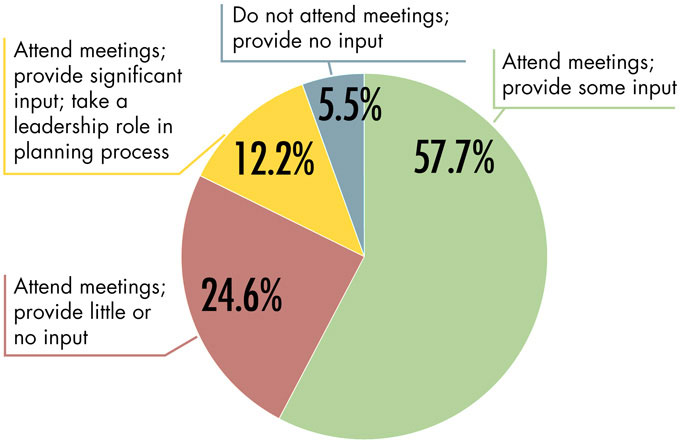
This pie chart is divided into four slices representing the involvement of students in IEP meetings. The largest slice is green. It is labeled 57.7 % represents students who attend meetings and provide some input. Next is pink slice of the pie chart at 24.6%. It represents students who attend but provide little to no input. The next slice of the pie chart is yellow at 12.2%. This slice shows the students who attend their meeting, provide significant input, and take a leadership role in planning process. The smallest slice is blue at 5.5%, representing students who do not attend meetings and who therefore provide no input.
Activity
Think back to when you were a junior in high school, looking forward to graduating the following year. Imagine that your family and teachers are holding a meeting plan your future: selecting your senior-year classes, your summer job, which college you will attend, your future career. Now, think about the following questions:
- How would you have felt about these people planning your future without asking you what you wanted?
- Would their choices have aligned with your goals and objectives for your life?
- Why would it be important for you to be included in the conversations about your future?
- What important skills do you think you would gain from being an active participant in the conversations?
- What type of environment would have helped you feel comfortable in actively participating in such a meeting? What factors would have made you feel welcome and encouraged to engage with the other members of the IEP team?
To ensure that student voices are heard and that the transition components of the IEP represent what they envision for their future, it is important that the IEP team take steps to actively involve students with disabilities in the planning of their own futures. Although active participation will look different for every student, overall the goal is for students to take on as much ownership as possible. The skills necessary for them to do so fall along a continuum and range from something as simple as the student feeling comfortable introducing herself in an IEP team to more complex activities such as discussing and developing goals. On the following pages, this module will offer more details about these skills, as well as an in-depth look at the transition planning process.
Page 2: Student-Centered Transition Planning
 One way educators can increase the involvement of students in the IEP process is by implementing student-centered transition planning, also sometimes referred to as student-focused planning. In student-centered transition planning, students are actively involved in planning, communicating, and evaluating the progress toward meeting their post-secondary goals. The work of the IEP team should take place in an atmosphere of consensus building in which student input is valued and supported and decisions are in the best interest of the student.
For Your Information
Student-centered transition planning in IEP meetings directly aligns with IDEA 2004, which requires:
- The involvement of students and parents along with general and special educators in the IEP planning process
- Student attendance in IEP meetings if postsecondary goals will be the focus of discussion
- Transition services that are based on student strengths, preferences, and interests
Educators can lay the groundwork for student-centered transition planning by involving students in their IEP meetings during their elementary and middle school years. In this way, students can become familiar with the format and topic of these meetings, while at the same time gaining an increasing awareness of their importance. For younger students, attending even a portion of the meeting can prove valuable. Student-centered transition planning is also an ideal context to build and refine a student’s self-determination skills—a set of behaviors that entails decision-making, goal setting, problem-solving, independent performance, self-evaluation, and self-advocacy.
Listen as Jim Martin, a national expert on student involvement in transition planning, explains how student-centered transition planning is an ideal context for teaching self-determination skills. Next, listen as Erik Carter, a national expert in secondary transition, discusses how preparing for and participating in transition planning meetings can enhance students’ self-determination skills.

Jim Martin, PhD
Director, Zarrow Center
Department of Educational Psychology
University of Oklahoma
(time: 1:45)


Erik Carter, PhD
Professor, Department of Special Education
Vanderbilt University
(time: 2:17)
Transcript: Jim Martin, PhD
Basically, people who are self-determined will know their interests, skills, and limits; will act on that information; will develop a plan; implement the plan; evaluate their process; change sections of the plan that need to be changed; and then take action on that. So that fits perfectly into what we do in special education in the whole IEP process. It’s a real natural fit with what we do in special education. We teach kids to apply those skills both through their IEP and then in a more directed way on particular goals that they want to obtain in their life, whether it be a school goal or a personal goal.
What we now know is that when kids get actively involved in their IEP meeting, their levels of self-determination increase. And we now know that when people are more self-determined, they do better both in school and better outside of school. Self-determination then becomes the engine that drives transition education practices. It is what we teach students to do when they’re in school. So many times, people just equate transition with employment, but way before kids are eligible to get a job or before they become old enough to have a job, there’s a lot of critical skills that they can learn in school and at home to prepare them not only for doing better in high school but also for life after high school. And a lot of that comes back to teaching them to be self-determined.
Transcript: Erik Carter, PhD
Every young person in our schools should be equipped to make important decisions about their future education, about their future careers, about their future lifestyles, and that’s just an important part of growing up and becoming more self-determined and assuming adult roles.
Self-determination gets defined and described in a whole variety of ways, but put simply it means having the capacity to steer one’s own life in ways and directions that ultimately improve your own quality of life. That capacity gets enhanced when students have the knowledge and skills across seven different areas: the ability to make choices, decision-making skills, problem-solving skills, goal-setting skills, self-advocacy, self-management, and self-awareness. And so as you hear those different skills, you can really see how the process of preparing for and participating in your own transition-planning meeting can really help you learn about these aspects of self-determination and to put them in practice. So in a meeting you’d have an opportunity to make choices about the courses that you take and the extra-curriculars that you’d be involved in.
Students have chances to make decisions about their future career path or their pursuit of college or not. They have to problem-solve a host of issues that can arise, such as a desired class or opportunity that is just not available or even disagreement with someone else about what’s the best decision for you. They learn to set short-term goals for their upcoming semester or school year, as well as identify when those goals have been met. And they have to learn to advocate for their support needs or for their own perspectives when someone else sees things a little bit differently.
It’s also important that students with disabilities have that chance to learn how to set their own goals and to identify paths towards reaching their goals and identifying the supports and services and relationships that they’ll need along the way. They have to self-manage or keep track of their own progress towards their goals, and all of that’s enhanced by having some level of awareness or knowledge about their own strengths and their needs and their interests and their preferences. Student-centered transition-planning meetings provide meaningful opportunities for students to set their short- and long-term goals, to become more aware of and to learn about their strengths and interests and preference and needs, to reflect on their progress over the past year, and then to communicate their need for specific opportunities or supports or linkages to others.
Research Shows
Students with disabilities who have strong self-determinations skills and who understand and participate in the development of their IEP have better academic and transition outcomes. In addition, students with disabilities who have learned self-determination skills experience better post-school employment outcomes, a higher quality of life, and greater independence.
(Konrad, Fowler, Walker, Test, & Wood, 2007; Shogren, Wehmeyer, Palmer, Rifenbark, & Little, 2015)
To further prepare students to take a more active role in the student-centered transition planning process (required at age 16, or as early as age 14 in some states), educators should teach students the skills they will need to:
- Use assessment information to develop goals
- Take a leadership role in IEP meetings
- Evaluate progress toward meeting IEP goals
Listen as Joy Ivester, from the Transition Alliance, discusses the importance of involving students in the transition planning process from an early age (time: 1:25).
Joy Godshall Ivester, MEd
Program Director, Transition Alliance of South Carolina
University of South Carolina Center for Disability Services
Transcript: Joy Ivester, MEd
Student-centered means local practitioners value the student voice, and the student’s going to be front-and-center in their own planning process. Individuals with disabilities should be involved in all aspects of policies, programs, and services related to the disability community. So we think that any time a group of professionals are sitting around a table planning for a student, the student should be there taking the pilots seat in the process. With getting students more involved in leading their IEPs, there’s nothing more critical than starting early. Students in the elementary grades should be involved in the transition-planning process, taught about the IEPs, and their purpose of planning. It’s never too early to begin working with students on self-determination skills. How can we justify planning for a student without having them in the driver’s seat? Ultimately, you have to ask the question would you want someone else planning your life for you? With regard to stakeholders and getting them on board, you have to start early. So it’s not an initiative or a program or something that you’re trying or working on students with beginning at age 14 or 16. We should expect all students to begin participating and gradually taking on that leadership role early in their educational careers. And for older youth and young adults, collaborative planning and training is critical so that everyone is speaking the same language and holding the high expectations for all students.
Although many teachers value the idea of student involvement in the transition planning process, they may find it challenging to actually make that involvement a reality. Educators are faced with persistent limitations in resources, information, and time, adding even one more thing to a teacher’s plate can prove significantly difficult. The table below details some of the common concerns teachers might experience, as well as some ways they might address those concerns.
| Common Concerns | Ideas To Address Concerns |
| Where do I begin? | Start small. Begin with one student or one piece of the transition planning process. |
| How can I fit this in with all of my other responsibilities? |
Figure out what works for your class. This may mean providing individualized or group instruction on the IEP process, including transition planning. Always present information in a way students can understand. Another option is to weave this process into your existing self-determination curriculum or general education curriculum. self-determination curriculum glossary |
| What if my students don’t wish to participate? | Help students to recognize the value in their involvement, but be prepared to be patient. Students with little or no experience in the IEP process might take some convincing. One way to accomplish this is by scaffolding the process and allowing them to begin with a manageable component, thus increasing their chances of early success. Students who experience success are more likely to feel empowered and more willing to take an active role in the process. |
| What about students with more complex disabilities? | Every student can participate at some level. It’s up to you to find a meaningful way for them to contribute, be it through the use of gestures, by showing pictures depicting their strengths and goals, or by activating a switch to begin a slide presentation. It’s usually as easy as adapting communication strategies already in place. |
| Will the meeting still be effective? | When students offer their input, IEP meetings focus on what’s important—a future that the students themselves are helping to define. Don’t worry. There will still be time to present your data and make your recommendations. In the meantime, you might be surprised by the new, more positive tone of your meetings. |
| What if parents or my administrator are not onboard? | Gaining support from other members of the IEP team is important, but first you may find it necessary to show them the value of this change. Start by communicating the benefits of the process and of allowing students to make small contributions (e.g., make introductions or share assessment results in the IEP meeting). Then build from there. |
Erik Carter describes student-centered transition planning. Next, he provides several reasons why students are often not involved in their own transition planning meetings.
Erik Carter, PhD
Professor, Department of Special Education
Vanderbilt University
Transcript: Erik Carter, PhD (audio #1)
Student-centered transition planning places the goals and aspirations and the needs and strengths of the student with the disability right at the forefront of planning efforts and their decisions about their future. And I think the most prominent voice heard in planning, at least for younger children, whether that’s at an IEP meeting or other planning meetings, are usually those of teachers or therapists or parents or even administrators. That shifts during the transition period, because the future that we’re planning for is the student’s future, and so they should really have the loudest voice in that discussion. And so best practices would tell us that all of transition planning should be student-centered, but we add that phrase “student-centered” just as an explicit reminder of where our focus should be fixed.
In some ways, I think student-centered transition planning is sort of a commitment, a philosophy of thinking about where do we place the primary accent that we’re building our programs and experiences around students, not fitting students into existing programs and experiences. And so that student-centered perspective is one we’re called to adopt, and we achieve that through things like student-led transition-planning meetings. That’s a way of making sure the student really is at the center by them having an active and explicit role in leading their own transition meeting.
Transcript: Erik Carter, PhD (audio #2)
The involvement of students either being present at their own planning meeting to actually being deeply involved varies widely from state to state, from district to district, from school to school. It’s very uneven. I think part of it’s an expectation issue. I think a lot of teachers and parents may wonder what a student would really bring to that conversation. They wonder whether they’ll be able to contribute in meaningful ways, and so part of our efforts need to be on raising those expectations that a student would have something important to contribute to this particular area of planning, even though it will take a little bit of work to prepare the student to do that. So I think expectations is one.
Opportunity is another. I think the way we do meetings and when we choose to meet and the logistics of those sometimes squeeze out student involvement. We think our role is done when we invite the student, rather than really encouraging their presence and their participation. I think preparation is also a reason why it doesn’t happen very often, and we struggle to find the time during a school day to prepare students to be part of their own transition-planning meeting. And so when they do come, they have little involvement, and they make few contributions, and then we chalk that up to either their inability to do so or a mismatch between their presence in the meeting when really it’s that they weren’t really well prepared to be part of that meeting. If you think back to the first time as a teacher you ever went to a IEP meeting, how uncertain you were about what was going to happen. Maybe you practiced what you were going to say and what you were going to share, and students need that same kind of preparation and practice, as well. I think at the end of the day, we let the busyness of our school day and all the competing priorities say this is not the most important thing to do, and at the end of the day it may be one of the most important things, because the students aren’t aware of their own transition plans and aren’t fluent in those and didn’t have a voice in those. Then all the other busyness that we’re invested in is not well aimed and well-focused in moving the student forward.
Revisit the Challenge
Donzaleigh
 Though Donzaleigh has attended her IEP meetings for the three years since her transition to high school, Mr. Longoria has noticed that she has never talks about wanting to be a fashion designer. In fact, Donzaleigh generally simply listens to what others think she should do without offering any disagreement. Because Donzaleigh is so good at math, her grandmother, who is her guardian, thinks that she should find an office job—for example, in data entry—that does not require significant interaction with co-workers. Currently, Donzaleigh works at a fabric store after school, an experience she believes might help her learn more about fashion design.
Jeremy
 His freshman year will be the first time Jeremy will attend his IEP meeting. Although he is very talkative and social, Jeremy is often off-topic in his conversations, nor does he react well to corrective feedback. Mr. Longoria wants to make sure that Jeremy can contribute to the process in a positive way. He also knows that Jeremy needs help to understand his disability and to talk about the supports he needs.
Page 3: Developing Goals
The ability to use their assessment information to develop goals is one of the most important skills students will need if they are to become more active participants in the transition planning process. As such, educators should help their students to understand how assessment results inform their future goals related to work, education and training, and independent living. More, transition goals are more meaningful when students have a hand in creating them, a level of involvement that leads to a deeper commitment to bringing those goals to attainment.
Listen now as Erik Carter briefly discusses how post-school transition goals differ from, but should relate to, annual IEP goals (time: 1:05).
Erik Carter, PhD
Professor, Department of Special Education
Vanderbilt University
Transcript: Erik Carter, PhD
Annual IEP goals and transition goals are different in a number of ways. One is primarily their time horizon. Post-secondary goals are really those that focus on life after graduation, and they’re also outcome-focused. What is it that the student will do in the early years after leaving high school? Where will they work, where will they live, where will they go to school? They address areas like future training, future education, and future employment and future independent living, and they also are required to be based on age-appropriate transition assessments, which is a little bit different than the requirements for annual goals. Annual goals have a much shorter time horizon, and they’re really focused on what happens in the upcoming school year. They have a shorter time-focus.
If you’ve done a transition plan well, you should have annual IEP goals that link to and lead to those post-school transition goals. They’re connected in that way, that each year of progress you make on an annual goal should be moving you closer towards attaining that post-school goal or preparing for that post-school goal.
Transition Assessments
Transition assessments provide information about the student’s present strengths, needs, preferences, and interests. These assessments take measure of the student in environments to which she or he will soon transition, for example a college or university campus or an independent living facility. Ideally, assessments should be completed by multiple informants (e.g., teachers, parents, the student herself) and in an ongoing fashion so as to reflect any changes as well as to identify what skills the student will require to be successful in the subsequent environment. Whether formal, informal, or observational, these assessment results inform the post-secondary goals related to work, education, living, and social activities.
Listen as Jim Martin discusses the importance of transition assessments in relation to developing goals (time: 2:06).
Jim Martin, PhD
Director, Zarrow Center
Department of Educational Psychology
University of Oklahoma
Transcript: Jim Martin, PhD
I think the biggest innovation that happened with IDEA came about with the inclusion of transition assessments. Transition assessments have really helped get transition education more focused. We have a battery of transition assessments we have to do, and one of them has to be a formal assessment, meaning that it’s a standardized assessment that has adequate psychometric properties that we know is a good assessment to help students plan for their life after high school. That sets the tone and gets the boat going in the right direction. But the engine that really drives the motor to get the boat going are the annual transition goals. And we now know that there’s a set of generalizable behaviors. They’re non-academic skills that when students learn these behaviors it increases their likelihood of post-secondary education or post-secondary employment. So as we assess students we need to focus on assessments that will look at these generalizable, non-academic behaviors, establish our strengths and needs using those assessments, and then based on the needs develop annual transition goals to ensure that we teach students those generalizable non-academic behaviors, like student involvement in their IEP meetings, disability awareness, interacting with others, knowledge of strengths or limitations. When they learn those generalizable, critical, non-academic skills, it will help them attain whatever their ultimate goals are. That’s probably the most important thing we can do in transition, is to teach kids those generalizable non-academic skills.
For more on transition assessments, see the IRIS Module:
For Your Information
There are many options available for teachers in search of transition assessment tools as well as self-determination assessments and checklists.
Assessment Tools
Northeast Indiana Cadre of Transition Leaders Transition Assessment Matrix
https://instrc.indiana.edu/transition-resources/transition-matrix.html
Developed by the Indiana Northeast Cadre of Transition Leaders and the Indiana Secondary Transition Resource Center (INSTRC), this online tool simplifies the process of identifying appropriate assessments by allowing teachers to select specific variables, such as “Domain,” “Grade Level,” and “Disability Area(s).” Users can then select and either save or print any of a number of assessments that match their criteria.
National Technical Assistance Center on Transition
https://transitionta.org/wp-content/uploads/docs/TransitionAssessmentToolkit_Updated_2023b.pdf
This document by the National Technical Assistance Center on Transition is packed with information related to assessment. Readers will find an overview of transition assessments, a guide for selecting assessments, sample assessment tools, and more.
Self-Determination Assessments and Checklists
The Arc Self-Determination Scale
https://thearc.org/wp-content/uploads/forchapters/The%20Arc%27s%20Self-Determination%20Scale%20-%20Adolescent%20version%20REV2013.pdf
Developed by Wehmeyer and Kelchner, this “adolescent version” of the Arc’s Self-Determination Scale is designed to help students and teachers alike to identify areas of strength and necessary support to help ensure successful transition for youth into life after secondary education. Divided into four sections, the scale incudes detailed questions related to autonomy, self-regulation, psychological empowerment, and self-realization. A scoring rubric is also included.
The AIR Self-Determination Scale
https://www.ou.edu/education/zarrow/resources/assessments
Produced by the American Institutes for Research (AIR) in collaboration with Columbia University’s Teachers College, the AIR Self-Determination Assessments are designed to measure a student’s knowledge, abilities, and perceptions, as well as her or his opportunities to make full use of those characteristics in real-world scenarios. Visitors here will find downloadable versions of the assessments suitable for teachers and students in English, Spanish, and French.
I’m Determined Self-Determination Checklist
https://www.imdetermined.org/wp-content/uploads/2017/10/selfdeterminationcheckliststudentself-assessment.pdf
How well do students know themselves, their goals, and what services and supports they might need to help them attain those goals? This assessment checklist is designed to help students and educators begin to form some answers to those questions, asking students to supply information related to self-determination, their own goals, and their rights under IDEA and ADA.
Personal Preference Indicators Planning Guide
https://www.ou.edu/content/dam/Education/documents/personal-preference-indicator.pdf
Created specifically for those who work with students with disabilities, this list of questions and prompts is intended for use during “informal talks” that can form the basis of detailed future planning. Among the subjects included here are social and emotional indicators, questions about the student’s “favorites” and personal preferences, physical indicators and general health, and role indicators, among much else.
Self-Determination Observation Checklist
https://instrc.indiana.edu/pdf/resources/PERC_SelfAdvchecklist.pdf
The Self-Determination Observation Checklist will help teachers to measure three characteristics related to self-determination: planning, communicating, and behaving independently. A behavioral instrument, the resource asks teachers to observe student activity in class and then complete a checklist to assess their relative strengths in each of the three areas.
Goals
| Formal Transition Assessments | Informal Transition Assessments |
|
|
Once the results of the transition assessments are available, the teacher and student should sit down for a review. Though the relative depth of this review process will depend on the individual student, it is nevertheless important to show the student the source of your information about her strengths, weaknesses, and needs. The teacher and student can then use these results to brainstorm possible transition goals prior to the IEP meeting. Together, they can identify services, supports, and activities the student might need in order to meet the goals.
The boxes below illustrate how transition assessment data can be used to develop goals. For each student, the sources of assessment data, the assessment outcomes, and the potential goals are described.
Revisit the Challenge: Donzaleigh
Sources and types of assessment data
| Donzaleigh | Interest inventory, career aptitude test, interview |
| Teacher | Observation in classroom, situational assessment in the work environment, student-conducted interview with teacher |
| Guardian | Interview conducted by Mr. Longoria, student-conducted interview |
| Employer | Observation in work setting |
Assessment outcomes
- Strengths: Organized, follows directions well, dependable (e.g., on time to work, gives boss notice if she has to be out), performs cashier responsibilities accurately (e.g., balances out register at end of shift), pays attention to details, works well independently, completes tasks, strong auditory learner
- Areas to address: Difficulty initiating conversation with customers (e.g., asking what they need, saying thank you), self-conscious about her speech due to articulation difficulties, difficulty with social interactions, struggles with written directions
- Mr. Longoria and Donzaleigh meet to review her transition assessment results. They brainstorm some goals for Donzaleigh’s upcoming IEP meeting. Mr. Longoria points out that if Donzaleigh wants to be a fashion designer, she will need to be able to communicate with customers. With this in mind, they determine that an appropriate goal to support her aspirations to be a fashion designer would be for her to work on her communication skills.
Potential transition goal
Donzaleigh will initiate communication with customers (e.g., asking them whether she can help them, thanking them when they check out) at least 80% of the time.
Revisit the Challenge: Jeremy
Sources and types of assessment data
| Jeremy | Interest inventory, interview |
| Teacher | Classroom observation |
| Parents | Interview |
Assessment outcomes
- Strengths: Likes to be around people, loves animals, comfortable in a variety of environments, likes school, strong computer skills
- Areas to address: Self-management skills, inappropriate interactions, turning in assignments on time, responding well to feedback, off-task behavior
- Mr. Longoria and Jeremy meet to review his transition assessment results. Because Jeremy is a ninth grader and just beginning to explore options related to post-school employment working with animals, Jeremy and Mr. Longoria decide to write a goal to allow Jeremy to build on this area of interest. Mr. Longoria pointed out to Jeremy that in order to be successful in this type of environment, he must be able to attend to the animals and carry out his responsibilities in a timely manner.
Potential transition goal
Jeremy will visit a minimum of six different animal-related work environments throughout the year (e.g., a veterinarian office, a pet shop, an animal shelter, a zoo). After each visit, he will create a list of his likes or dislikes about that environment.
Involving Students in the Assessment Process
Because the purpose behind transition assessments is not always immediately obvious to the student, it is beneficial for the teacher to help them to make connections between the information yielded by those assessment and the goals the student wishes to develop. The tips below offer some tips for how teachers can involve students more deeply in the transition-assessment process.
Taking the time to introduce a student to new environments (e.g., a college campus) and activities (e.g., a cooking class) can help her to build a better understanding of her preferences and strengths. These experiences will sometimes confirm the student’s interests and sometimes they will change her mind. For example, a student who initially is interested in training as a veterinarian assistant might realize such a career is not for her following a visit to a local vet’s office. Reflect with the student on what aspects of the experience they enjoyed or found interesting and which they did not. Share this information with the IEP team.
Be sure to discuss the assessment plan with the student in a way that is appropriate for his level of understanding. Let the student know what areas you plan to assess and ask whether there are others he might wish to address.
What are the student’s preferences, interests, and future goals? Ask her to make a list of these and to practice sharing them with others. Because interviews are a type of informal assessment, teachers can be flexible with question design and can individualize them for each student.
Ask the student to interview his family members, general education teachers, and peers to learn more about what others perceive as his strengths, needs, preferences, and interests. The student can compare his answers to those of others from the interviews he has conducted and share what he has learned at the IEP meeting. Differences in perspectives between these interview responses are a great place to focus discussions during the IEP meeting.
Erik Carter talks about the overall purpose of transition assessments and why it’s important that students be involved. Next, Kelly Smoak, a high school special education teacher, describes how she uses interest inventories in her classroom.
Erik Carter, PhD
Professor, Department of Special Education
Vanderbilt University
(time: 2:26)

Kelly Smoak
Teacher, Special Education Resource
West Ashley High School
South Carolina
(time: 1:33)
Transcript: Erik Carter, PhD
Transition assessments tend to be much less formal than other assessment processes throughout a student’s special education career, and they tend to include less often a battery of standardized tests. Instead, what you’re really trying to do is identify what a student’s interests and strengths and preferences and needs are. Given that focus, it’s really prudent to involve the student in that process. It’s very difficult to speak to someone’s interests and preferences if they weren’t actively involved in aspects of exploring what those interests and preferences might be and giving feedback and input into that assessment process.
There are also transition-planning tools out there that have a specific place for students in that process. One that I used widely as a transition teacher was called the Transition Planning Inventory. A variety of other tools have the same approach, but essentially there’s a version that’s completed by the teacher, there’s a version completed by parents or family members, and there’s a version of that tool that’s also completed by the students themselves. That gives the student a chance to have input on their own perspectives, on their needs and strengths in different domains around transition. It gives them a chance to sharpen their ability to really self-evaluate effectively, especially when you compare their assessment perspectives to those of teachers and parents. We would use these different approaches where we’d ask the student and the parents and my team to complete that assessment. We’d compile all that information in advance of the meeting, and we’d see places where everyone was in great agreement about strengths, and needs and areas where we had very different perspectives. Often it was the student who had overestimated their abilities or had aspirations that were a bit higher than anyone else might have had. And so that would become a context for us to talk about, “Why are there differences of opinion? Why are you seeing the student in a different way than we do?” and then preparing the student to be able to share their perspective at the upcoming meeting.
The role of school psychologists and others around assessment doesn’t change as students are involved in IEP meetings in middle school and high school, but there’s added focus on planning for life after high school. It means we have to think beyond some of the traditional assessments and bring in perspectives of different people. The student’s perspectives becomes really important in those areas. It’s not intended to replace the assessments that would already be part of the planning process but to round them out and add a different voice and different vantage point to those, as well.
Transcript: Kelly Smoak
When we are in class, we do a number of assessments, through interest inventories, inventories that we have, pencil and paper we pass out in the classroom. We may also do some assessments online. Gathering that information, we come back after it’s done the next class period and really go over it with the kids independently, maybe in a group setting with a couple of students, and they can share their information with one another, gives them an opportunity to discuss what they like with their peers or what they found out about themselves with their peers. It also allows me to walk around and engage with them and find out how they’re assessing themselves.
They have Google Docs, and we have a bank of all of their information. It has a copy of their IEP. Anything that we do that is related to building on that IEP, we have them save it in that file so they can pull that back up when it’s time for the IEP, to prepare for it. I’ll pull them aside independently, and I’ll have them pull that up and say, “Let’s go back and look at what your results were from your various assessments throughout the year. Let’s see what your interests are,” and then it’s more of an independent time, just a casual conversation with the student, and that’s when we begin to talk about how that fits into the IEP.
Page 4: Taking a Leadership Role in IEP Meetings
Yet another way educators can involve a student more deeply in the transition planning process is to offer her a leadership role in the IEP meetings. Doing so does not mean that the student will assume full control, nor does it imply that parents and teachers will no longer be able to offer their input. Rather, it means that the student will be allowed to take charge of one or more components of the IEP meeting, for example by introducing the IEP team members or by offering a review of her current performance levels. This type of encouragement takes on additional importance when you recall that students are often not active participants in their IEP meetings or in planning their own futures. In fact, as is illustrated in the graphic below, the average middle or high school student speaks only 3% of the time during an IEP meeting.
Percentage of Speaking Time by Role
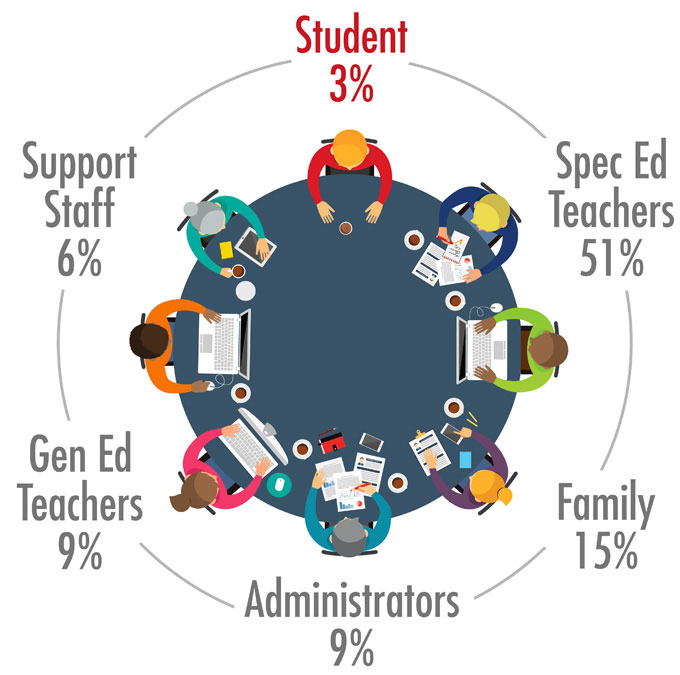
This graphic titled the “Percentage of Speaking Time by Role” depicts the percentage of time the various members of the IEP team speak during a typical meeting. The graphic represents a round table with eight people seated with various items in front of them like laptop computers, pens, and coffee cups. Around the outer circle, the role of each of the eight people is indicated, as is the percentage of time each of them spends speaking during the meeting. The roles and percentages are: Students 3%, Special Educators 51%, Family 15%, Administrators 9%, Gen Ed Teachers 9%, and Support Staff 6%.
Note: Although these data were collected over a decade ago, most experts agree that little has changed. Not shown in the graphic: 2% no conversation occurring, 5% multiple conversations occurring at the same time.
When they take on a leadership role in their IEP meetings, students receive real-world opportunities to build self-determination skills that will benefit them far beyond high school into further education or employment. When students develop strong self-determination skills, they are more likely to feel capable of taking control of planning their own lives.
Research Shows
As with their peers, students with significant disabilities who lead their own IEP meetings develop stronger self-determination skills and acquire greater knowledge about post-secondary transition.
To increase students’ level of participation, teachers should familiarize them with the IEP process as well as what they can expect from a typical IEP meeting. Teachers must also make certain that their students are equipped with the tools and supports they will need to take on a leadership role. As always, information should be tailored to meet the needs of the individual students. Click on the headers below to learn more about how teachers can prepare students to lead portions of their IEP meetings.
Before a student can assume any leadership role in the IEP meeting, she first must have a general understanding of both her disability and the IEP process itself. Teachers can help the student to gain this type of understanding by:
- Discussing the student’s disability and how it affects her performance
- Introducing students to applicable laws related to transition (e.g., IDEA, Americans with Disabilities Act)
Americans with Disabilities Act (ADA)
glossary
- Providing a basic overview of what is typically discussed during an IEP meeting
- Defining and explaining applicable terms such as IEP, transition, career, and college in language the student can understand
If she is to effectively lead a component of the IEP meeting, a student must first be familiar with the content of the current IEP. To help familiarize the student with the IEP, the teacher and the student together can:
- Review and discuss each section of the IEP
- Discuss which supports and services are beneficial
- Highlight areas of the IEP the student disagrees with or has questions about
To promote student ownership of the IEP meeting, teachers can encourage the student to present assessment data and potential goals. To prepare the student to present this information, the teacher and the student can:
- Review and discuss the assessment data and proposed goals
- Identify how the student can present assessment results using supports that are commensurate with her abilities (e.g., picture cards, a verbal description, a slide presentation)
The level of participation the student will take on should be determined with the student’s strengths, preferences, and experiences in mind. Teachers, in collaboration with the student, should identify the components of the IEP meeting that the student will lead. Some common components that students can take ownership of include:
- Introducing herself or the other team members
- Explaining why the meeting is taking place
- Sharing assessment information
- Talking about strengths, needs, and interests
- Asking questions to clarify information not understood
- Self-advocating for her own interests
- Identifying potential post-secondary goals and supports
- Adjourning the meeting
Once the teacher and student have identified which components the student will direct, the teacher must teach the student the skills necessary to do so successfully. As when teaching any new skill, systematic and consistent approaches tend to work best, although the frequency and intensity of instructional time can vary based on the student’s needs. Skills can be taught in a variety of formats (e.g., in groups, individually) and the frequency of the sessions can vary (e.g., once a week, twice weekly).
Now that the teacher and student have agreed upon which components the student will lead, the teacher should provide opportunities for the student to rehearse what she will say during the meeting. Teachers can make this preparation even more effective by:
- Making the time to practice sections the student will present at the meeting
- Modeling or arranging opportunities for the student to role-play with other students who have previous experience leading their IEP meetings
- Offering corrective feedback and recommendations based on the student’s performance
- Video-taping the student or another student presenting portions of the IEP meeting and allowing the student to watch it while the teacher provides feedback
Teachers should understand that it will take time for students to master the skills they need to lead components of their IEP meetings. They should be persistent and feel confident that their efforts are leading to better outcomes. Teaching the student about the IEP process, selecting which sections she will lead, and providing opportunities for practice are all necessary foundational pieces to helping prepare a student to assume leadership responsibilities. For some students, this might be enough for them to take the lead, whereas for others (e.g., those who are nervous, those with communication challenges) even more supports may be required. As students learn the skills, teachers can offer coaching and support prior to and as needed during the IEP meeting. Forms of support might include:
- Scripts for the student to follow during the meeting
- Picture cards to help the student introduce the sections of the IEP
- Agendas or advance organizers to follow during the meeting
- Technology to support the student’s participation
- Slide presentations to highlight important talking points
- Pre-recorded audio of the student presenting a component of the IEP meeting (e.g., talking about strengths, preferences)
First, Erik Carter discusses some of the ways that teachers can make transition planning more student-centered. Next, he offers greater detail about how to prepare students to take an active role in their transition-planning meetings.
Erik Carter, PhD
Professor, Department of Special Education
Vanderbilt University
Transcript: Erik Carter, PhD (audio #1)
For a teacher who really wants to make their transition planning process much more student-centered, I think the first step is really to make an investment in the preparation of their students and find time within the school day to prepare the students for these kind of meetings. I mean, very few students when even asked about the prospect of coming to a meeting filled with teachers and staff and others are going to probably be excited about that idea. What adolescent would feel really comfortable and confident in that kind of setting? So really preparing students so they understand the purpose of a meeting, the value of their presence and voice in that process, and understanding of the kind of things that would be shared, what their role would be in sharing some of that information and what the roles of others who are going to be invited to that meeting are, it’s really an important part of that preparation.
And I think a second thing for teachers is to think through what kind of process would make sense for students to have that active role in the planning meeting. There are a variety of ways students can be involved in that meeting, everything from having a list of steps that they would work through as part of that process from welcoming everyone to the meeting, making introductions, stating the purpose of that meeting, sharing the progress that they’ve made over the past year, and sharing some of their goals for the upcoming year. That step-by-step process needs to be outlined for students, and deciding what makes the most sense for your students in the context of the meeting is really important.
We encourage teachers to also think about what happens after the meeting. A student-centered planning meeting lasts an hour or two a year, and probably the place where students can have the most benefit and impact is what happens between those meetings. Looking for ways to encourage students’ continued involvement in their own transition plan is a way of making that continue to be student-centered, whether that’s having them self-monitor and self-evaluate their progress and keep track of that over the course of the school year, whether that’s having them share back their progress with team members at various points throughout the school year, or even sharing some of the lessons they’ve learned about having that leadership role with other students who’ve not yet had their transition planning. All those are ways that teachers can prepare and implement and follow-up on this whole idea of student-centered planning meetings.
One of the things that I want to emphasize is that the investment that we’re making of teachers in preparing students for this once-a-year planning meeting really does have a long-term ripple effect on students for the rest of their lives after they’ve exited school. They’re going to be part of these kinds of planning meetings, and the degree to which they’re prepared to contribute to those, to be able to advocate for what they need, communicate the supports and opportunities and linkages that they need to support them is going to be really important for living well long after graduation. So it’s easy for us to think in the very short term, wow, this requires my time and investment that we may struggle to make right now. That investment’s going to have a much longer term impact on students even after the meeting’s done and after they have graduated, so it’s worthwhile.
Transcript: Erik Carter, PhD (audio #2)
It definitely takes time to prepare students for these roles. I would emphasize that it’s not without benefits. It certainly has payoffs. We know that youth who are more actively involved in their own transition planning are ultimately more motivated to work towards those goals and ultimately accomplish those goals. But they have to be equipped with the skills and the knowledge and the attitudes to participate meaningfully and effectively in those kinds of planning meetings.
One approach, I think, is to simply draw upon the growing number of existing programs and curriculum materials that are already out there that have already been designed to equip students in exactly this way, a number of them that offer fairly structured approaches, things like the Self-Directed IEP, the Who’s Future Is It Anyway? curriculum, Take Charge for the Future, Next Steps, and a number of others that have already been evaluated students with disabilities and really lay out a step-by-step what’s involved in leading an IEP meeting. I think incorporating out of those curricula into your class or drawing upon components that you know would be really helpful for a particular student can at least make the planning aspect of that much more efficient for you as a teacher.
There’s also ways that you can involve students in things like role-playing as a group for an upcoming transition planning meeting followed by a time of discussion and reflection on how that went. You might have students who have either graduated or who are a little further along in their transition process share with younger students about their experiences leading their own transition planning meetings, or you could even connect students to any number of community organizations or self-advocacy groups that also gives students opportunities to build those self-advocacy skills and skills they would need to ultimately lead their own planning meetings.
To learn more about involving students in the overall planning for their transitions and preparing them to be active participants in their IEP meetings, we encourage you to listen to Kelly Smoak in the following IRIS Interview:
For Your Information
A variety of resources are available for teachers who wish to prepare their students to assume more leadership responsibilities in their own meetings. Some recommended resources are readily available at the Zarrow Center for Learning Enrichment.
Revisit the Challenge: Donzaleigh
Before the IEP meeting: Mr. Longoria knows that Donzaleigh, a high school junior, needs to practice speaking for herself, a skill she will need when she gets out of school and finds a job. One way he can help her with this is to prepare her to assume more responsibilities in her IEP meetings. With this goal in mind, they meet individually near the end of class once a week for a couple of months to:
- Discuss disability law, the purpose of the IEP, and how leading portions of the IEP meeting provides practice speaking in front of others about her disability and her interests
- Determine what parts of the meeting she is comfortable leading. (Donzaleigh decides to introduce the team members and share her assessment information.)
- Practice conducting introductions and presenting assessment information
During the IEP meeting: Donzaleigh led the parts of the meeting she had practiced, while Mr. Longoria provided needed support (e.g., verbal prompts, an occasional thumbs up). He also encouraged her to speak up about her interest in pursuing a job in fashion design after high school. The team agreed that the goal Donzaleigh proposed would be an important one to include in her IEP.
Revisit the Challenge: Jeremy
Before the IEP meeting: Because several ninth graders, including Jeremy, have never attended an IEP meeting, Mr. Longoria conducts:
- Group meetings for six weeks with these students during the regular school day to provide a basic overview of what an IEP meeting is and what is typically discussed during one
- Individual meetings with each student to talk about his or her current IEP, what supports and services might be needed, and what parts of the meeting he or she is comfortable leading
For his first IEP meeting, Jeremy decides to introduce himself and the other team members, as well as to share his interests. He practices these introductions during the group meetings, and he works individually with Mr. Longoria to create a slide presentation about his interest in working with animals.
During the IEP meeting: Jeremy introduces himself and the other members of the team. He presents his slide show. Mr. Longoria makes certain that the team members are addressing Jeremy and he helps Jeremy respond to their questions. Mr. Longoria also provides whatever support is needed to help Jeremy remain on-task.
Page 5: Evaluating Progress Towards Goals
 Another way students become more active participants in the transition planning process is by monitoring and evaluating their progress toward their IEP goals. Though, again, this responsibility should only be assigned with a given student’s individual needs and abilities in mind, typically students can accomplish this task in a relatively simple and straightforward manner. By participating in this evaluation process, students can:
- Learn to set appropriate goals
- Monitor their level of achievement
- Make decisions based on their performance
Research Shows
Though self-determination is an important component of goal attainment, students who receive special education services typically possess fewer self-determination and goal-attainment skills than do their peers without disabilities. However, when taught the relevant skills, students with disabilities who are self-determined set goals and take action to attain those goals by developing a plan, acting on that plan, evaluating their progress, and making adjustments as needed.
Before students can monitor and evaluate their progress toward meeting their goals, teachers must first break down the long-term transition goals developed during the IEP meeting into more manageable short-term goals. The number and type of goals to be monitored should be determined by the student’s strengths, abilities, and interests. Teachers can help students to monitor progress toward achieving their goals with the help of an instructional planning tool such as Take Action, developed by the Zarrow Center. The table below shows how Donzaleigh and her teacher use the Take Action tool to help her achieve her long-term goal: Donzaleigh will initiate communication with customers (e.g., asking whether she can help them, thanking them when they check out) at least 80% of the time.
| Take-Action Components | Descriptions | Lead-In Statements | Donzaleigh’s Examples |
| Short-term Goal | Every long-term goal should be divided into manageable tasks and activities that can be completed within a few weeks. This will help ensure that students stay motivated through frequent small successes. | One thing I need to do to meet my goal is… | …to learn new strategies to talk to customers at the fabric store. |
| Objective | The objective describes what the student wants to achieve for the week and specifies the frequency with which an activity or a task must be completed. | I’ll be happy with my progress this week if I… | …initiate conversations with three customers at my job placement. |
| Motivation | Motivation is what drives the student to achieve the long-term goal. Motivation should be maintained so that the student remains engaged until the goal is mastered. | I want to do this because… | …I want to get a job in the fashion industry. |
| Strategy | A strategy is the method or methods the student uses to meet the objective. | I will use strategies such as.… | …watching my co-workers interact with customers and viewing customer-service videos. |
| Schedule | The schedule outlines the specific days and times the student will implement the strategy. | I will do this on… | … Tuesday and Thursday afternoons when I work. |
| Support | A support is an individual accommodation or modification that will help the student meet the short-term goal. | I will need… | …my co-workers to allow me to shadow them when they are interacting with customers and my supervisor to provide opportunities to practice. |
| Feedback | Feedback is information about a student’s performance, which might be provided visually, orally, or in writing. | I will know how I’m doing by… | …meeting with my supervisor each week. |
Activity
Recall that Jeremy is a ninth-grade student whose long-term goal is:
Jeremy will visit a minimum of six different animal-related work environments throughout the year (e.g., a veterinarian office, a pet shop, an animal shelter, a zoo). After each visit, he will create a list of his likes or dislikes about that environment.
The interactive table below breaks down Jeremy’s short-term goal. Help him complete his transition planning tool by filling in the blanks.
| Take-Action Components | Lead-In Statements | Jeremy’s Examples |
| Short-term Goal | One thing I need to do to meet my goal is… | …identify three places related to working with animals to visit. |
| Objective | I’ll be happy with my progress this week if I… | |
| Motivation | I want to do this because… | |
| Strategy | I will use strategies such as.… | |
| Schedule | I will do this on… | |
| Support | I will need… | |
| Feedback | I will know how I’m doing by… | |
There are multiple responses for this activity. Below are some examples of appropriate responses.
| Take-Action Components | Lead-In Statements | Jeremy’s Examples |
| Short-term Goal | One thing I need to do to meet my goal is… | …identify three places related to working with animals to visit. |
| Objective | I’ll be happy with my progress this week if I… | …spend an hour and a half investigating different work options (e.g., working as a zoo keeper, a vet, a dog groomer). |
| Motivation | I want to do this because… | …I want to get a summer job working with animals. |
| Strategy | I will use strategies such as.… | …using the Internet to identify places to visit and reading descriptions about these places. |
| Schedule | I will do this on… | …Monday, Wednesday, and Friday for 30 minutes during Mr. Longoria’s class. |
| Support | I will need… | …time and access to the computer to search for places to visit and Mr. Longoria’s help to narrow my search for places close by. |
| Feedback | I will know how I’m doing by… | …checking with Mr. Longoria on places I identify. |
At pre-determined intervals (e.g., weekly, every few weeks), the teacher and student should meet to discuss how much progress he has made toward meeting his short-term goal. If the student meets the short-term goal, it is time to move on to the next. If the student did not meet the goal, the student and teacher should determine why. This might be because the student was sick, the necessary supports were not in place, or the original objective was unrealistic. Whatever the case, once the teacher and student have figured out why the goal was not met, they can brainstorm what to do differently during their next attempt.
For example, Donzaleigh and Mr. Longoria meet to discuss her progress. Donzaleigh reports that, because her co-worker was out sick for part of the week, she was only able to shadow her for one day, less than originally planned. With this in mind, they decide to give it another week so that Donzaleigh will have more time to shadow her co-worker. They further discuss other strategies to help her meet her short-term goal, such as role-playing with peers.
The student will work on a series of short-term goals, one building on the next, until she eventually achieves the long-term goal, or the team recognizes that the long-term goal needs to be revised. The information students collect throughout the evaluation process can be used to create visual displays of progress for IEP meetings as well as to design new transition goals. Student involvement in evaluating transition goals will help make the IEP meetings and transition process meaningful for students, even as it builds valuable skills they can apply to future school and life experiences like finding a place to live or buying a car.
Did You Know?
Teachers should allow students to make some decisions on their own, even if teachers feel that those decisions will not necessarily help them to meet their goals. Learning from mistakes is part of the process and will help students to develop their problem-solving and decision-making skills.
Page 6: Engaging Team Members
It is not only the teacher and student who must prepare for student-centered transition planning. Other members of the IEP team must also understand the ways in which a meeting with active student participation will differ from the more typical, teacher-led variety. If this type of IEP meeting is to prove successful, IEP team members need to make certain that they:
- Give students an equal voice during the meeting
- Direct questions to and request feedback directly from the student
- Focus on the student’s strengths rather than her limitations
- Use easy-to-understand language
- Maintain a positive tone
To further ensure the success of a student-centered planning meeting, the teacher should meet with the other members beforehand and describe how their participation might differ from what they may have come to expect. This is also a good opportunity to gain the support of the other members as well as to establish expectations. Some tips suited for individual members of typical IEP teams can be found below.
Administrators
 Before student-centered transition planning is implemented, the teacher should meet with the administrator to win her buy-in and support. During this meeting, the educator can:
- Explain the process and what it entails
- Describe the time and resources needed to accomplish the process effectively
- Let the administrator know that, at least until a streamlined system is developed, meetings may last longer than expected; plan accordingly
- Explain the research base and the benefits of this type of planning (e.g., improved self-determination skills, better educational and employment outcomes)
- Remind the administrator that student attendance is mandated by IDEA
Families
 Families are equally important members of the IEP team. Because they will support the student long after she exits the school system, it is critical to include their opinions and feedback in all transition conversations. In typical IEP meetings, parents often act as the voice of their child. In student-centered planning, that responsibility is placed more greatly on the student herself. Some families may find relinquishing that role to be difficult. To help families make the transition to a student-centered planning process, teachers can encourage them to:
- Consider the benefits to the student (e.g., increased autonomy, gaining valuable insight into strengths, weaknesses, and support needs; increased self-determination skills)
- Recognize the benefits for themselves (e.g., improved parent expectations and parent-child communication)
- Begin talking to their child early about her interests, abilities, future goals, and the importance of the IEP process
- Allow their child to voice her opinions, and explore her own interests and preferences
- Schedule time before or after the meeting to talk about any sensitive topics that might be inappropriate to discuss during the meeting
- Prepare families for the student’s role by providing an agenda or outline of the meeting
For Your Information
Although school personnel should encourage family engagement, they must remember the primary goal of the student-centered process: for students to assume more responsibilities and make more decisions regarding their future, especially as they approach the age of majority, in most states at age 18. At this age, students are considered adults and legal rights are transferred to them. These rights include the responsibilities of making decisions in the IEP meeting, as well as other informed decisions (e.g., medical treatment, financial arrangements, housing needs). A student served under IDEA ’04 must be notified of this transfer of rights by the IEP team a year prior to reaching the age of majority. Parents should also be notified as they will need to think about their child’s needs and abilities in order to plan appropriately if their child is not able to make informed decisions on her own.
General Educators and Other Support Professionals
 The role of general educators and other school professionals—for example, the speech language pathologist, school psychologist, school transportation provider, and nurse—should be relatively unchanged in a student-led IEP. When discussing student-centered planning with these professionals, the teacher can:
- Explain the benefits of the process and what it entails
- Inform them that, at first, meetings might last longer than is typically the case
- Assure them that they will still have time to share feedback about student progress and successes and participate in discussion about goals and supports
- Explain the importance of establishing a positive tone and using terms that the student will understand
- Point out that the student will present her comments and opinions and should be heard and respected when doing so
- Remind them to make certain that their conversations include the student
- Share an agenda or outline of the meeting
Erik Carter emphasizes how student-centered transition planning benefits students and educators. Next, Kelly Smoak talks about how building relationships can promote buy-in and support for the student-centered transition planning process.
Erik Carter, PhD
Professor, Department of Special Education
Vanderbilt University
(time: 2:02)
Kelly Smoak
Teacher, Special Education Resource
West Ashley High School
South Carolina
(time: 1:42)
Transcript: Erik Carter, PhD
I would emphasize that student-centered transition planning is a both a philosophy, a value we commit to, but it’s also an effective practice. It’s a core principle of good transition and one that we’re asked to do if we’re called to implement the best as what we know works. What I mean by that is it’s more than just a philosophy that has kind of an intuitive appeal, it’s actually a practice that has a positive impact on students. And I think that’s really part of engaging the team in supporting this approach to transition planning and getting their buy-in.
There’s some real benefits to this. When we involve the student actively in the process, it actually ensures the plan reflects their interests and their preferences and their needs.
But it also ends up increasing their buy-in and their motivation to work towards those goals. I think for the team, it also helps the team see the plan as linked to a real person and perhaps to come to see the student in a different way when they’re there actually sharing their goals firsthand and their needs and their strengths in that area. What we’ve also learned is that it changes the nature of the conversation that’s happening at the transition-planning meeting because we tend to talk about students differently when they’re there. We think about their future differently when we hear why that future matters to them. We come to talk about them and view them as more capable and competent and more self-determined when we hear them talk about their vision for a good life. And I think all of that leads to us being able to move forward much more confidently as an IEP team when we know that we as a team and the student are aligned in that vision.
Certainly, there’s aspects of this that takes some more time and intentionality, but it also produces a plan that’s much more relevant and has more clarity and more personal investment. So whatever additional time it takes, it has a payoff that’s really important to understand, and I think that’s part of convincing the team that this new way of thinking about the planning process is actually one that’s not only better for the team but ultimately better for the student.
Transcript: Kelly Smoak
I know that it is fearful for some, and they may have some concerns, but one of the greatest things to help with that is building that relationship with that student and the team members. When that relationship is built, and they feel comfortable conversing with the administrator, with the other teachers, the gen ed teachers, the guidance counselors then there’s a buy-in, not just from that student but from the other team members. They’re invested in that child.
When you’re building relationships with the team members, when they come to the meeting, it’s not just a student, but it’s their life, and it’s someone that they’ve engaged with and know that, oh, yeah, you did really well on that test last week, or I saw you do a great job in that game, or I heard about your interview. How did it go? There’s more of a dialog, and there’s more of a relationship there. When we value people through relationships and getting to know them then we understand, and we want to spend time on that person and hear their voice, and we want what’s best for them. When the student starts to speak and starts to take charge of their IEP by talking about their interests and their present levels and where they are and where they want to go, it’s just natural, and I don’t see it as a laborious activity that’s going to add extra time to the meeting.
Page 7: Implementing Student-Centered Transition Planning
The successful implementation of any type of significant change, such as student-centered planning, requires a systematic process. This process often begins when the teacher becomes informed about the student-centered transition planning process. Once the teacher acquires this knowledge, he needs to share it with the other members of the team. This is also an opportunity to build their buy-in and support for the new process. Next, the teacher needs to make a plan to implement the three major components of student-centered planning which entail ensuring the student is:
- Using assessment information to develop goals
- Taking a leadership role in IEP meetings
- Evaluating progress toward meeting IEP goals
The teacher can use the table below as a starting point to determine what pieces of these three components he is currently implementing. It can also serve as a guide to determine how to improve student participation in areas of transition assessment and goal development, leading IEP meetings, and evaluating goals. Teachers can modify the table as needed throughout the implementation process.
| Implementing Student-Centered Transition Planning | |||
| Transition Assessment and Developing Goals | Always | Sometimes | Never |
| I discuss transition assessment and its purpose with my students. | |||
| I allow my students to complete self-assessments at their level of communication. | |||
| I regularly assess student interests, preferences, strengths, and needs. | |||
| I work with my students to develop IEP goals based on assessment results. | |||
| I encourage my students to talk with others to get their input. | |||
| Leading IEP Meetings | |||
| I make sure my students attend their IEP meetings. | |||
| I encourage students to invite team members to the IEP meetings. | |||
| I provide instruction on the terms commonly used in IEP meetings. | |||
| I encourage students to share their interests, strengths, preferences, and goals in their IEP meetings. | |||
| I help students identify the supports, modifications, and accommodations that are beneficial to them. | |||
| Evaluating Goals | |||
| I support students when making choices about their high school program of studies and extracurricular activities. | |||
| I teach students how to evaluate their progress toward meeting IEP goals. | |||
| I work with students to develop ways to visually represent their progress (e.g., graphs, charts). | |||
| I teach self-determination skills to my students. | |||
Implementing student-centered planning is an ongoing process, one that takes years to refine. Teachers should start small and build on their successes. Using the table above, teachers can identify areas they might already be covering and further identify what they want to work on next.
Jim Martin and Kelly Smoak discuss simple ways that teachers can encourage and prepare students to be actively involved in the transition planning process.
Jim Martin, PhD
Director, Zarrow Center
Department of Educational Psychology
University of Oklahoma
(time: 1:02)
Kelly Smoak
Teacher, Special Education Resource
West Ashley High School
South Carolina
(time: 2:09)
Transcript: Jim Martin, PhD
Expect them to be there. Expect them to participate. The biggest facilitator we found to this whole process are teacher expectations. Teachers expect their students to become actively engaged and be there, provide them the opportunities, and then make it a celebration of kids’ education and not just a rap sheet of all things they’re not doing well. Some teachers will help students prepare invitations for their meeting. They’ll go to one of the websites where you prepare an invitation, and they’ll go to their English teacher and say, “Madam English teacher, my IEP meeting is a couple of weeks from now. Here’s an invitation to attend. I sure hope you can be there,” and they’ll give it to their parents. They might give it to one of their best friends to attend, or the boyfriend or a girlfriend to attend, if parents approve of that, of course. Some teachers encourage students to get dressed up. They’ll bake cookies. They’ll make it a celebration of the kid’s education. And then it becomes something that they want to attend.
Transcript: Kelly Smoak
For someone that wants to start the process, start with small steps. It may be overwhelming to think, “Oh, I need to have all of my kids running all of their IEP meetings this year.” That can be a daunting thought, but start small through activities in the classroom. That can be something as simple as having the kids know who their supports are, listing them out on paper, and meeting those people so that they know who those members of the team are. Who’s going to be at my IEP meeting? Who is helping me through this process? Build that relationship. Then taking it a step further and beginning to break down the IEP for the students that can be very simple.
You can take an entire unit on it. You can spend time on it throughout the entire year. You can choose to build that into your day in many different ways, whether it be a 15-minute segment of your class period or whether it be a whole day that you devote, a whole class period that you devote to the IEP, but breaking it down and teaching the students the different parts of the IEP and what they mean and why do we have them, why do we have accommodations, what are accommodations, so that the students can begin to understand them, know what they mean, and then start to have a voice as to whether they really need that accommodation or not. Is it something that’s helping them or is it not? That’s just one aspect of the IEP. Their present levels, what does that mean, what does that look like, where am I currently, and being able to see that and verbalize that can be a part of your class. Students that have that opportunity begin to understand the IEP is not just a document that their parent comes and signs once a year, but it is a part of their life, and it will help them get to the next phase successfully.
Page 8: References, Additional Resources, and Credits
To cite this module, please use the following:
The IRIS Center. (2017). Secondary transition: Student-centered planning. Retrieved from https://iris.peabody.vanderbilt.edu/module/tran-scp/
Note: The references in this section reflect the source material used to construct this module. The links to these references are not updated.
Agran, M., & Hughes, C. (2008). Asking student input: Students’ opinion regarding their Individualized Education Program involvement. Career Development for Exceptional Individuals, 31, 69–76.
Carter, E. W., Lane, K. L., Pierson, M. R., & Stang, K. K. (2008). Promoting self-determination for transition-age youth: Views of high school general and special educators. Exceptional Children, 75(1), 55–70.
Carter, E. W., & Lunsford, L. B. (2005). Meaningful work: Improving employment outcomes for transition-age youth with emotional and behavioral disorders. Preventing School Failure, 49(2), 63–69.
Collier, M. L., Griffin, M. M., & Wei, Y. (2014). Facilitating student involvement in transition assessment: A pilot study of the Student Transition Questionnaire. Career Development and Transition for Exceptional Individuals.
Eisenman, L., Chamberlin, M., & McGahee-Kovac, M. (2005). A teacher inquiry group on student-led IEPs: Starting small to make a difference. Teacher Education and Special Education, 28, 195–206.
Field, S., & Hoffman, A. (2007). Self-determination in secondary transition assessment. Assessment for Effective Intervention, 32, 181–190.
Field, S., Martin, J., Miller, R., Ward, M., & Wehmeyer, M. (1998). Self-determination for persons with disabilities: A position statement of the Division on Career Development and Transition. Career Development for Exceptional Individuals, 21, 113–128.
Hawbaker, B. W. (2007). Student-Led IEP Meetings: Planning and Implementation Strategies. TEACHING Exceptional Children Plus, 3(5), Article4. Retrieved from http://e.scholarship.bc.edu/education/tecplus/vol3/iss5/art4
Hughes, C., & Carter, E. W. (2011). Transition supports: Equipping youth for adult life. Journal of Vocational Rehabilitation, 35, 177–180.
Kellems, R. O., & Morningstar, M. E. (2010). Tips for transition. TEACHING Exceptional Children, 43(2), 60–68.
Kohler, P. D., & Field, S. (2003). Transition-focused education: Foundation for the future. The Journal of Special Education, 37, 174–183.
Martin, J. E., Marshall, L. H., & Sale, P. (2004). A 3-year study of middle, junior high, and high school IEP meetings. Exceptional Children, 70, 285–297.
Martin, J. D., Martin, J. E., & Osmani, K. J. (2013). Teaching students to attain annual transition goals using the take action goal attainment lessons. Career Development and Transition for Exceptional Individuals, 37(2), 72–83.
Martin, J. E., & Williams-Diehm, K. (2013). Student engagement and leadership of the transition planning process. Career Development and Transition for Exceptional Individuals, 36(1), 43–50.
Mason, C. Y., McGahee-Kovac, M., & Johnson, L. (2004). How to help students lead their IEP meetings. Teaching Exceptional Children, 36(3), 18–24.
Mason, C. Y., McGahee-Kovac, M., Johnson, L., & Stillerman, S. (2002). Implementing student-led IEPs: Student participation and student and teacher reactions. Career Development for Exceptional Individuals, 25(2), 171–192.
Mazzotti, V. L., Rowe, D. A., Cameto, R., Test, D. W., & Morningstar, M. E. (2013). Identifying and promoting transition evidence-based practices and predictors of success: A position paper of the Division on Career Development and Transition. Career Development and Transition for Exceptional Individuals, 36(3), 140–151.
Myers, A., & Eisenman, L. (2005). Student-led IEPs: Take the first step. Teaching Exceptional Children, 37(4), 52–58.
Pierson, M. R., Carter, E. W., Lane, K. L., & Glaeser, B. C. (2008). Factors influencing the self-determination of transition-age youth with high-incidence disabilities. Career Development for Exceptional Individuals, 31(2), 115–125.
Shogren, K. A., Wehmeyerm M. L., Palmer, S. B., Rifenbark, G. G., & Little, T. D. (2015). Relationships between self-determination and postschool outcomes for youth with disabilities. The Journal of Special Education, 48(4), 256–267.
Sitlington, P. L., Neubert, D. A., & Leconte, P. J. (1997). Transition assessment: The position of the Division on Career Development and Transition. Career Development for Exceptional Individuals, 20, 69–79.
Swedeen, B. L., Carter, E. W., & Molfenter, N. (2010). Getting everyone involved: Identifying transition opportunities for youth with severe disabilities. TEACHING Exceptional Children, 43(2), 38–49.
Szidon, K., Ruppar, A., & Smith, L. (2015). Five steps for developing effective transition plans for high school students with autism spectrum disorder. TEACHING Exceptional Children, 47(3), 147–152.
Test, D. W., Fowler, C., & Kohler, P. (2010, rev. 2016). Evidence-based practices and predictors in secondary transition: What we know and what we still need to know. NTACT document. Retrieved from http://transitionta.org/system/files/effectivepractices/EBPP_Exec_Summary_2016_12_13_16.pdf
Test, D. W., Mazzotti, V. L., Mustian, A. L., Fowler, C. H., Kortering, L., & Kohler, P. (2009). Evidence-based secondary transition predictors for improving postschool outcomes for students with disabilities. Career Development for Exceptional Individuals, 32(3), 160–181.
Trainor, A. A., Morningstar, M., Murray, A., & Kim, H. (2013). Social capital during the postsecondary transition for young adults with high incidence disabilities. The Prevention Researcher, 20(2), 7–10.
Van Dycke, J. L., Martin, J. E., & Lovett, D. L. (2006). Why is this cake on fire? Inviting students into the IEP process. Teaching Exceptional Children, 38(3), 42–47.
Wehmeyer, M. L., & Palmer, S. B. (2003). Adult outcomes for students with cognitive disabilities three-years after high school: The impact of self-determination. Education and Training in Developmental Disabilities, 38, 131–144.
Wehmeyer, M. L., & Schwartz, M. (1998). The relationship between self-determination and quality of life for adults with mental retardation. Education and training in mental retardation and developmental disabilities, 33(1), 3–12.
Articles
Konrad, M. (2008). 20 ways to involve students in the IEP process. Intervention in School and Clinic, 43(4), 236–239.
Twenty simple steps to better and more fully involve students in their own IEP processes are presented here, with those steps helpfully grouped into five major stages that cover everything from “Stage 1: Developing Background Knowledge” to “Stage 5: Implementing the IEP.”
Konrad, M., Trela, K., & Test, D. (2006). Using IEP goals and objectives to teach paragraph writing to high school students with physical and cognitive disabilities. Education & Training in Developmental Disabilities, 41(2), 111–124.
This study overviews the effectiveness of GO 4 IT…NOW!, a self-regulated writing strategy designed to help students with disabilities to write better paragraphs. Results show that tying the strategy to the task of students writing their own IEP goals resulted in improved content and quality scores of those statements. Thoughts on implications for further research and practice are included.
Morgan, R. L., Kupferman, S., Jex, E., Preece, H., & Williams, S. (2017). Promoting student transition planning by using a self-directed summary of performance. TEACHING Exceptional Children, 50(2), 66–73. https://journals.sagepub.com/doi/10.1177/0040059917734383
Educators and school leaders are increasingly recognizing the importance of encouraging student participation in their own transition processes, and this is doubly true for students with disabilities, who face unique challenges following high school. In this article, the authors overview the process of creating effective summary of performance documents (SOP), with guidance on including student background information, post-secondary goals, and skills and abilities, among much else.
Uphold, N. M., Walker, A. R., & Test, D. W. (2007). Resources for involving students in their IEP process. TEACHING Exceptional Children, 3(4). Retrieved from https://files.eric.ed.gov/fulltext/EJ967452.pdf
The authors of this article address a gap in the availability of resources to improve student self-determination. Included here is a variety of “no-cost” guides, templates, toolkits, and more designed to better prepare students for their eventual transition from postsecondary education.
Online Resources
Cameto, R., Levine, P., & Wagner, M. (2004). National Longitudinal Transition Study 2: Transition planning for students with disabilities. Menlo Park, CA: SRI International. Retrieved from https://files.eric.ed.gov/fulltext/ED496547.pdf
Developed in cooperation with the U.S. Department of Education’s Office of Special Education Programs (OSEP), this report “examines efforts to prepare youth with disabilities for the transition from secondary school to adulthood. It highlights the transition planning process undertaken during high school with and for youth with disabilities as they prepare for life after school.” The resource includes demographic information related to the transition process, notes on student transition goals, tips for increasing family participation, and much more.
Center for Parent Information and Resources. (2018). Students Get Involved!. Retrieved from https://www.parentcenterhub.org/student-involvement/
Center for Parent Information and Resources. Students Get Involved! This website provides links and information to help improve the participation of students in their IEP process. On hand here is a discussion with Jim Martin on student involvement in IEPs, links regarding person-centered planning, and links for students.
I’m Determined, Virginia Department of Education. (n.d.). Module four: Students determined to take control of their education and their lives. Retrieved from https://www.imdetermined.org/about/history/module-four-students-determined-take-control-education-and-lives/
This online module from the Virginia Department of Education’s I’m Determined program includes “ideas, videos and resources to help to get your student involved in leading his own IEP.” Readers will find a student-led IEP PowerPoint presentation, video clips showing students taking a lead role in their IEP meetings, sample portfolio templates, and links to other resources and information.
Newman, L., Wagner, M., Knokey, A.-M., Marder, C., Nagle, K., Shaver, D., Wei, X., with Cameto, R., Contreras, E., Ferguson, K., Greene, S., and Schwarting, M. (2011). The post-high school outcomes of young adults with disabilities up to 8 years after high school. A Report from the National Longitudinal Transition Study-2. Menlo Park, CA: SRI International. Retrieved from https://ies.ed.gov/ncser/pubs/20113005/pdf/20113005.pdf
This book-length report on the results of this comprehensive study covers everything from an overview of the research and methods itself, statistics about young people with disability in education and employment, community engagement, social life, and much, much more.
Pacer Center. (n.d.). National Parent Center on Transition and Employment. Retrieved from https://www.pacer.org/transition/
PACER is a parent training and information center for families and youth with disabilities. Included is information for families and professionals on disability-related topics such as education, vocational training, transition and employment, and other services for students with disabilities.
Rutland Middle School. (n.d.). Student led IEPs in practice. Retrieved from https://www.gadoe.org/Curriculum-Instruction-and-Assessment/Special-Education-Services/Documents/Student%20Led%20IEPs%20ppt.pdf
This slide presentation developed by a middle school in Macon, Georgia, offers tips and information on IEP meetings led by its teachers, including accommodations for students with specific disabilities, examples and non-examples of the IEP process itself, and observations about how the IEP process changed the teachers’ own attitudes and perceptions.
Sawyer, S., & the California Transition Alliance. (2013). Secondary transition planning: The basics. Retrieved from http://www.catransitionalliance.org/docs/49-TransitionPlanningTheBasics2015_1029201590719.pdf
Developed by the California Transition Alliance, this helpful overview of the transition process includes a terminology guide, statistics from research into student transition, notes on effective ways to follow up with students after they transition out of secondary education, and more.
Technical Assistance Partnership for Transition at Cornell University. (2021) Student-directed individualized educational program (IEP) for families. New York State Education Department Office of Special Education Educational Partnership. Retrieved from https://osepartnership.org/pd/T211-Student-Directed-IEP-for-Families-508.pdf
This presentation gives an overview of student-led IEPs, including what they are/their components, why they are important, and ways to promote them.
U.S. Department of Education, Office of Special Education and Rehabilitative Services. (2020). A transition guide to postsecondary education and employment for students and youth with disabilities. Washington, DC. Retrieved from https://sites.ed.gov/idea/idea-files/policy-guidance-transition-guide-postsecondary-education-employment-students-youth-disabilities-august-2020/
This informative resources includes an overview of the secondary transition services and requirements outlined in the Individuals with Disabilities Education Act (IDEA) and the Rehabilitation Act of 1973. Readers will find details and information about student-led planning, employment training options, and programs to help prepare students with disabilities for a successful transition to life after secondary school, among much else.
Wisconsin Department of Public Instruction. (2013). Opening doors to self-determination skills: Planning for life after high school. Retrieved from https://witig.org/wp-content/uploads/2020/02//postsecondary-education-english-fillable_1409758548.pdf
Created by the Wisconsin Department of Public Instruction, this resource offers information for students and their families, teachers, counselors, and transition coordinators alike. Included are a transition planning timeline, some suggested questions to ask during IEP meetings, and a postsecondary education exploration worksheet.
Websites
I’m Determined, Virginia Department of Education https://www.imdetermined.org/
Visitors to the Virginia Department of Education’s I’m Determined site will find resources and information for teachers, students, and parents, including an extensive film archive, podcasts, and self-determination toolkits and resources students and their families alike.
National Center on Secondary Education and Transition (NCSET) http://www.ncset.org/
The online home of the National Center on Secondary Education and Transition “offers technical assistance, and disseminates information related to secondary education and transition for youth with disabilities in order to create opportunities for youth to achieve successful futures.” Visitors here will find resources on IEPs and transition planning, student self-determination skills, and career guidance and job-seeking.
National Technical Assistance Center on Transition (NTACT) https://transitionta.org/
Dedicated to assisting state and local education agencies to facilitate greater and more efficient secondary transition, NTAC offers visitors to its online home a wide variety of resources and information, including transition planning resources, practice guides and data tools, practices and programs to increase the likelihood post-school success, among much else.
TennesseeWorks https://www.tennesseeworks.org/
A collaboration with Vanderbilt University’s Kennedy Center, TennesseeWorks seeks “to increase the number of young people with intellectual and developmental disabilities (IDD) who are employed in the state.” On hand here are a wide variety of resources for young people, their families, prospective employers, and teachers. Resources include statistics on young people with disabilities and employment and an overview of federal, state, and local laws.
Content Experts:Erik Carter Module Developers:Amy Harris Module Production Team:Editor: Expert Reviewers: IRIS Center Reviewers: Transcriptions: |
Media Specialist/Technical Support: Web master: Media:Audio Engineer: Photos/Graphics: Photos of module experts are courtesy themselves. All other media and images are courtesy the IRIS Center. Video Expert Interviews: |
When you are ready, proceed to the Wrap Up section.
Wrap Up
 Even though they are officially considered member of their IEP teams, many students with disabilities nevertheless have little involvement in the annual IEP process. One way teachers can increase their participation is to implement student-centered transition planning, a process whereby students take an active role in planning, communicating, and evaluating their progress toward meeting post-secondary goals. In order to prepare students to take a more active role in the student-centered transition planning process (required at age 16, or as early as age 14 in some states), educators should teach them the skills needed to:
- Use assessment information to develop goals
- Take leadership roles in their IEP meetings
- Evaluate progress toward meeting their IEP goals
To successfully implement student-centered transition planning, teachers should help administrators, parents, and other IEP team members to recognize its importance, select a small number of students or portions of the IEP to begin with, determine the appropriate level of participation for each student, and set aside time to instruct students on ways to be actively involved in the planning process. As with the implementation of any new process, teachers and other professionals should keep in mind that change takes time and success requires systematic planning and evaluation.
Revisiting Initial Thoughts
Think back to your initial responses to the following questions. After working through the resources in this module, do you still agree with your Initial Thoughts? If not, what aspects of your answers would you change?
What is student-centered transition planning?
What are some ways to involve students in student-centered transition planning?
How can teachers successfully implement student-centered transition planning?
When you are ready, proceed to the Assessment section.
Assessment
Take some time now to answer the following questions. Please note that the IRIS Center does not collect your Assessment responses. If this is a course assignment, turn it in using your professor’s preferred method. If you have trouble answering any of the questions, go back and review the Perspectives & Resources pages in this module.
- What is student-centered transition planning and why is it important?
- What are self-determination skills, and why is student-centered transition planning an ideal context to help a student build and refine them?
- Identify and briefly describe the three types of skills educators need to teach students to prepare them to take an active role in the transition planning process.
- Mr. Longoria was pleased with how Donzaleigh and Jeremy became more active participants in preparing for and leading parts of their IEP meetings. He would like to involve more of his students in this type of process. His school has typically followed a fairly traditional approach, as indicated by the first column. Use the second column to identify how they can make the meetings more student centered.
Traditional Student-Centered Team members state their names and their roles Special educator states purpose of the meeting Psychologist and/ or special education teacher collects and shares assessment information Individuals (e.g., teachers, parents) report on the student’s strengths and needs; student rarely attends or participates in the meeting Professionals develop goals Professionals do most of the talking Professional closes the meeting - Imagine you work in a district that uses a traditional approach such as the one described in the table above. You want to implement student-centered transition planning with all of your students. List at least three ways you could get team members on board.