Accommodations: Instructional and Testing Supports for Students with Disabilities
Assessment
Take some time now to answer the following questions. Please note that the IRIS Center does not collect your Assessment responses. If this is a course assignment, you should turn them in to your professor using whatever method he or she requires. If you have trouble answering any of the questions, go back and review the Perspectives & Resources pages in this module.
- What are accommodations? How do they differ from modifications and instructional strategies or interventions?
- List the four accommodations categories. For each, give an example of an accommodation and describe how it could support a student with a disability.
- View the video below of Quinn using his braille electronic notetaker. Identify how the note-taker is being used to help Quinn achieve his learning goals given the barrier(s) related to his disability (time: 3:01).
Quinn: This braille electronic note-taker is called a PAC Mate. And what I usually do on the PAC Mate is homework and classwork and usually doing, like, notes when I’m in class. The way it’s set up is kind of like a laptop, really, with a braille screen. And I can get on the Internet and save books and listen to books on here. I can do, like, if a teacher, if I wasn’t at school a certain day and I have some work to do, my teacher can email to my…I can download to my PAC Mate, and I can print it out and turn it in. It does a certain amount of things, and I can open a file.
[Pac Mate speaks as Quinn moves through its menus.]
And the screen is…it shows up in braille, and I it shows up, like, by line and sentences. And, like, if I’m reading, I can down-arrow to go to the next line, or I can use the little wheel to read each line, or if I didn’t want to do either I could just have it…I can listen to it and it would…the braille would follow along with the computer as it talks. This is live.
[Pac Mate speaks.]
Quinn: So I guess I’ll give a demonstration on it.
[Pac Mate speaks.]
Quinn: So as it’s reading, the braille is following along, and that’s how I do documents that are sent to me. Another way I can get documents is if I’m in class and, you know, I miss something, like if I didn’t quite understand something, and I wanted the teacher to send me some examples, like if she wrote down a few examples, and I can use a regular thumb-drive and sync it to my PAC Mate. Plug it into the back of here, and I can receive it. I can receive documents that way. I guess that’s it.
 Thirteen-year-old Senada has a learning disability. She is struggling in Mrs. Watkins eighth-grade science class. Although she understands grade-level content, she reads at a third-grade level and has difficulty identifying key ideas during lectures and independent reading. She also has difficulty organizing her ideas when writing. Mrs. Watkins typically:
- Lectures using PowerPoint presentations while students take notes
- Requires her students to read the textbook and provide written responses to the questions
- Requires students to conduct lab experiments by following written procedures
- Requires students to write up the results of their lab
- Assesses her students using written tests
Based on what you know about Mrs. Watkins class:
- List at least three areas where Senada might experience difficulty.
- List at least three accommodations that could be used to address the barriers related to Senada’s disability. Include the accommodations category and explain how these accommodations might help Senada access and demonstrate her learning.
- Based on the accommodations recommended above, what tips might be helpful for Mrs. Watkins to ensure that Senada receives the maximum benefit from her required accommodations?
- Sam has ADHD. Although he is a motivated student, he struggles to recall information that he reads or hears in class. To address this barrier, Mr. Washington supplies graphic organizers for Sam to use during class and for independent reading. The expectation is that Sam will be able to recall more information on quizzes and tests and that his scores will improve. Review Sam’s data before and after Mr. Washington implemented the accommodation.
- Calculate Sam’s accuracy.
Sam’s Baseline Data
| Date | Number of Items Correct |
Total Number of Items |
Accuracy |
| 10/12 | 9 | 20 | |
| 10/19 | 6 | 20 | |
| 10/22 | 7 | 12 | |
| 10/27 | 3 | 10 | |
| 10/29 | 10 | 25 |
Sam’s Implementation Data
| Date | Number of Items Correct |
Total Number of Items |
Accuracy |
| 11/12 | 13 | 20 | |
| 11/16 | 6 | 10 | |
| 11/19 | 15 | 20 | |
| 11/22 | 8 | 10 | |
| 11/26 | 15 | 20 |
- Click here to print Sam’s graph, then graph Sam’s baseline data and his implementation data.
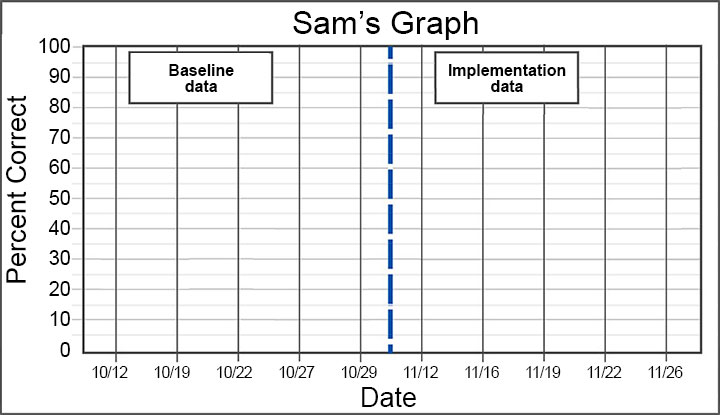
- Based on the data, would you recommend that Sam’s teacher continue providing the accommodation? Justify your answer?
