What can teachers do to make the classroom environment more conducive to children’s learning and development?
Page 3: Social Environment
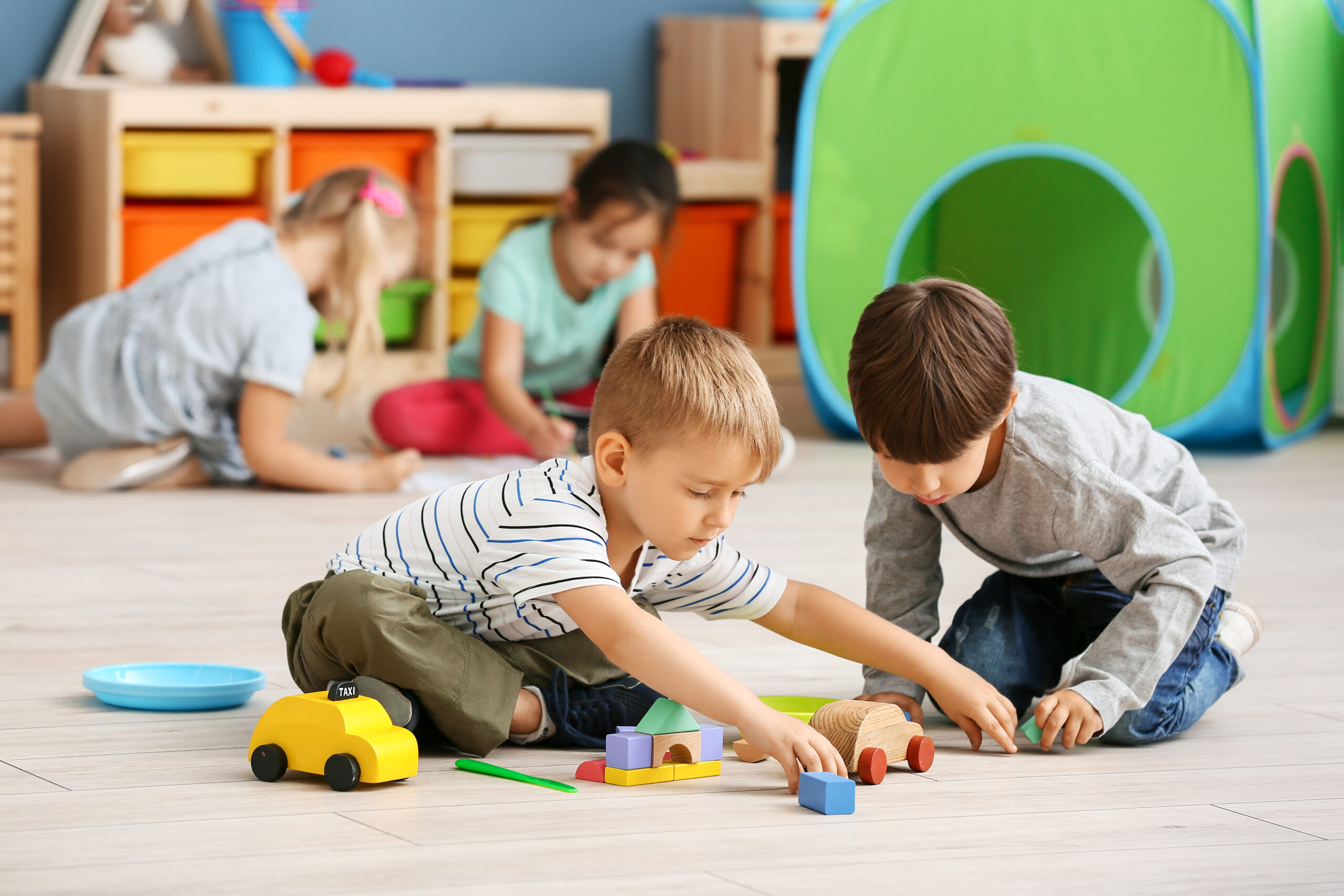 The term social environment refers to how a classroom environment influences or supports the interactions that occur among young children, teachers, and family members. A well-designed social environment helps foster positive peer relationships, creates positive interactions between adults and children, and provides opportunities for adults to support children to achieve their social goals. To create a classroom environment that supports positive social interactions, teachers need to plan activities that take the following aspects into consideration.
Children should spend time every day in different kinds of groups. Groups of various sizes foster different opportunities for social interaction and learning. Activities suited to large groups include opening group circle time, story time, mealtimes, and outside time. Small groups allow more time for interaction with individual children and are ideal for teaching new skills and providing feedback. Additionally, small groups offer more opportunities for children to practice their language skills and for teachers to facilitate children’s communication development.
Groups can either be made up of children with similar skills and abilities (i.e., homogenous groups) or mixed abilities (i.e., heterogeneous groups). Homogenous groups are ideal for teaching targeted skills or skills that meet the particular needs of a subset of children. Conversely, groups that include children with varied skills and abilities provide opportunities for all children to learn positive social skills and communication skills from their peers. In this way, all children contribute to the classroom while also receiving the support they need to interact with their peers and teachers in meaningful ways.
When considering group size and composition, teachers should:
- Make sure children have opportunities to get to know each other and engage when in groups, including snack and mealtimes, to promote interactions.
- Create activities that require children to work together and share materials.
- Provide visual supports to promote social interaction and independence. Some children might not interact with their peers because they might not know what to do or how to do it.
- Model, encourage, and teach positive social interaction skills.
- Model, encourage, and teach problem-solving skills.
- Consider limiting the number of children allowed in a given area at one time.
A learning environment’s daily routine should include both teacher-directed and child-initiated activities. Teacher-directed activities are those that the teacher plans and leads, such as story time or a small-group learning activity. Generally, a child-initiated activity is one that allows children to follow their interests and explore their passions. When planning activities for the social environment, teachers should:
- Take note of children’s preferred activities when they have the opportunity to choose their own. Doing so can help teachers identify the children’s areas of strengths and interests.
- Recognize that children might demonstrate challenging behavior during teacher-led activities that they find difficult, uninteresting, or overwhelming. Teachers can use their knowledge of children’s preferred activities and materials and embed them in activities that might be more challenging. For example, if a child loves trains but does not like to use any writing materials, provide a model train at the writing center to encourage the child to draw a train using preferred writing materials.
- Assign classroom jobs or responsibilities (e.g., plant water helper, animal feeder, lunch cart pusher, table setter) to help children feel a sense of belonging.
- Make sure that every child has frequent opportunities to answer questions, make choices, or offer comments in a verbal or non-verbal way. For example, children can indicate their song choice during group time in different ways (e.g., speaking, pointing).
Activities, games, and toys that require two or more children to participate have been shown to promote social interaction. Additionally, different types of materials promote different types of play and social interaction. For example, a board game might lend itself to a couple of children, a home-living area might be more appropriate for a small group, and a game of Duck, Duck, Goose requires a large group. When thinking about what materials and activities should be included in their classrooms, teachers should:
- Limit the amount of materials so that children must share to promote social interaction, but avoid being overly restrictive to the point that children argue over them.
- Plan projects that can be done as groups or in pairs. For example, teachers can give two children one large piece of paper to create a collage.
- Provide toys—such as dolls and building blocks—that are likely to encourage social interaction.
Including Families
Another important aspect of designing the social environment is to build rapport through frequent, open, and honest communication with families and by making families and those important to them feel welcome. Family members can include a child’s immediate family, extended family, and others in the community or neighborhood that are important in the family’s life. Family members can share information about the strategies they use in their homes and their values and beliefs to promote social interaction. Teachers should listen to and incorporate parents’ beliefs as appropriate into their instructional practices, including suggestions about how to encourage and guide children.
More specifically, when they partner with families to design the social environment, teachers should:
- Offer opportunities for family members (including immediate family, extended family, and community members) to volunteer in the classroom
- Provide opportunities for families to meet and connect with each other
- Invite families to bring materials and share activities from their home that reflect their backgrounds and experiences
- Collaborate with families to support the development of their child’s social skills at home
- Include families in brainstorming and planning activities to meet a child’s individual needs
Including Children with Disabilities
Teachers also must ensure that young children with disabilities have opportunities across the day to interact with peers and adults alike. Some children with disabilities might need extra support to participate in the social environment. For these children, teachers might need to:
- Teach concepts of friendship (e.g., reciprocity, managing interactions) and friendship skills, including how to ask a friend to play, share materials, and give compliments. Teachers also need to provide them the time and support within play activities to create these important relationships.
- Teach how to recognize emotions and express them in ways that are socially appropriate. Children who do not learn to use emotional language have a hard time labeling and understanding their own feelings, as well as accurately identifying how others feel. Songs (e.g., “If You’re Happy and You Know It”), games, puppets, and activities can all be used to support children in learning about emotions.
- Embed opportunities to interact with peers throughout the day. One way teachers can do this is to supply cooperative-use toys and materials—those that naturally lend themselves to two or more children playing together (e.g., balls, wagons, a pair of telephones, board games).
- Use child preferences across the environment to promote social interaction. To do so, the teacher should know a child’s preferred playmates and be able to match the child with peers who share interests or other similarities. For example, a child with a communication delay who has difficulty being understood but enjoys the dramatic play area might be more likely to interact with a peer during that activity. The teacher can support this child’s social interaction by facilitating communication efforts with peers during this preferred activity.
Erica Roy discusses how she designs the classroom environment to encourage positive student interactions between young students with and without disabilities. Next, Ilene Schwartz discusses some of the ways that teachers can help young children with disabilities participate in the classroom social environment.

Erica Roy
Kindergarten teacher
(time: 2:41)

Ilene Schwartz, PhD
Professor Emeritus, Special Education
Former Director, Haring Center for Research
and Training in Inclusive Education
University of Washington
(time: 2:08)
Transcript: Erica Roy
I think when we focus on creating a positive and inclusive social environment, we help students develop respect and empathy for all people. When we encourage group activities and opportunities for students to interact and work together, it also helps them learn to communicate with one another and problem solve, and it also builds that sense of community that is so important for school and for feeling motivated to do your best and to feel successful in the space as well. I think if we don’t intentionally create a social environment that’s welcoming and inclusive, I think students can feel isolated or unsure of how to interact with one another, which can affect them in terms of like maybe they wouldn’t participate as much or might not feel as confident to do the things that they would otherwise do if they had that stronger, supportive social environment.
To design their classroom in a way that encourages student interaction, educators should be really intentional with the layout of their classroom. In my classroom, we have our tables in groups of four, which encourages daily collaboration. Whether they’re working together on a project or a math game, or even just saying good morning to one another, having them in groups of four facing one another creates a natural peer interaction.
I think in kindergarten, fostering positive interactions between students with and without disabilities starts with designing and creating an environment where all students feel valued and our differences are honored and celebrated. One thing I do is plan activities that encourage cooperation and teamwork. We also have a lot of social-emotional learning and conversations that discuss what makes us unique and how that is so valuable and important. I also use stories, role-playing, and discussions to teach my students about empathy and kindness so that they understand the importance of supporting all people that they come into contact with, including their classmates. No matter their abilities and no matter any differences, I really encourage peer support—whether it’s during independent tasks, I’ll have students helping one another, or even if it’s during playing times. Also, during reading times we do partner reading. Students are paired up, and they also switch partners so that they have an opportunity to work with all students in the classroom. It’s really been amazing to see the friendships that have grown this year.
Transcript: Ilene Schwartz, PhD
Visuals also help the social environment of a classroom because visuals can help provide a script for teachers to prompt the play of children with disabilities. Some teachers in infant-toddler programs, in preschool programs, have a hard time knowing how to promote play for children with disabilities. On those picture schedules that may show the process of feeding the baby or making a meal in the kitchen, there can be simple prompts written down for the adults so that they can support the play behavior of the children with disabilities.
Another strategy that teachers can use to ensure that children with disabilities can fully participate in all activities in the classroom is to ensure that every child in the classroom has a functional communication system. That may be the most important thing that a teacher does. Every child, regardless of their ability level, needs to have a way that they can express their wants and needs. And needs to have a way that they can protest appropriately. They can say, “Yes, I want to do that” or “No, I don’t want to do that.” “I want more crayons, and I don’t want any more stickers.” Children do that verbally. But for children who don’t have verbal communication, we need to make sure that they have some kind of system, whether it’s a sign system or a picture system or a symbol system or even gestures. What we know is that challenging behavior’s related to communication, and when children engage in challenging behavior, they’re trying to communicate something. So we need to ensure that every child has a way to communicate appropriately what they want to be doing, when they need help, when they’re done with an activity, when they need a break.
Research Shows
A study of preschool children indicates that all students, regardless of social and economic background, benefit from a high-quality social environment, which includes teachers’ positive interactions with children, responsiveness to children’s needs, and positive classroom management, among others. Positive outcomes associated with such an environment include increased academic and literacy skills.
(Mashburn, 2008)
For Your Information
To help prevent problem behavior during social interactions, teachers can:
- Enlist the children’s help in generating the rules for the different settings, activities, and routines.
- Teach and practice the rules for the different settings, activities, and routines.
- Acknowledge when children are following the various rules.
- Offer young children a break from a challenging activity when necessary and appropriate.
- Use scripted stories to assist children in understanding rules and to help address an individual child’s challenging behavior.
- Be proactive and teach social skills.
scripted story
glossary
Additional Considerations for Infants and Young Toddlers
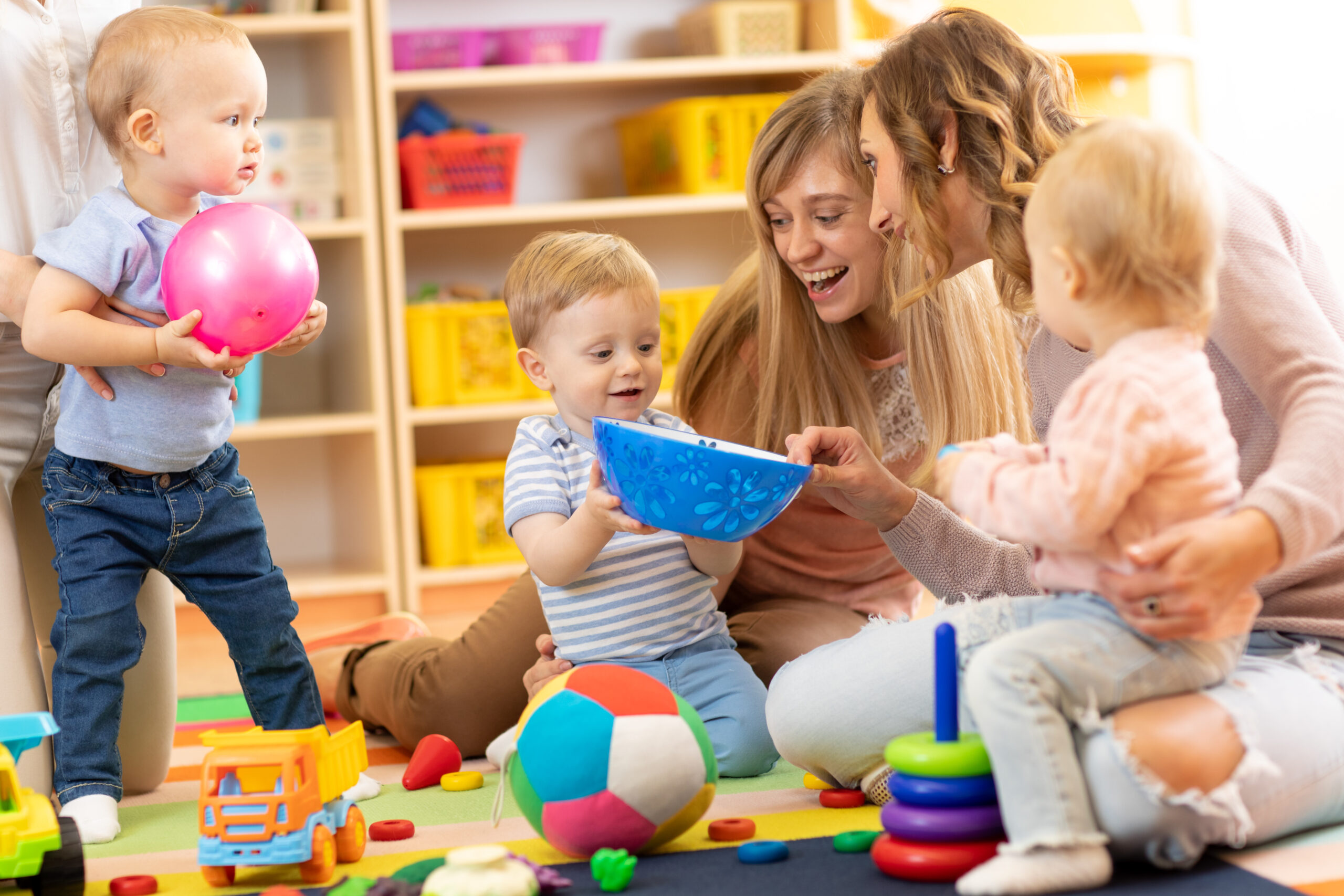 For infants and young toddlers, effective social environments involve responsive caregiving. Put simply, teachers acknowledge and respond promptly to infants’ and toddlers’ needs and provide comfort and support (e.g., holding infants, holding toddlers’ hands while walking, sitting close while reading). A more explicit example would be feeding a few young toddlers at one time while engaging and interacting with them. In contrast, in a social environment that is not well designed, the teacher might line up the children in high chairs and feed them in a mechanical fashion.
Listen as Rob Corso discusses one of the biggest challenges teachers face when working with infants and toddlers (time: 1:32).
Rob Corso, PhD
Executive Director, Pyramid Model Consortium
Vanderbilt University

Transcript: Rob Corso, PhD
One of the biggest challenges going into infant and toddler classrooms is when it is overly silent. Infants and toddlers learn language by hearing others speak. Infants and young toddlers learn receptive language before they can speak or before they’re verbal. They can certainly, before they verbalize, communicate by shaking their head or pointing to things. But to learn language, caregivers have to talk a lot. For some caregivers, it comes very natural to speak to young children, even though they know that the infant is not going to speak back to them. For others, I think it feels weird or awkward to talk to someone who’s not talking back. But it’s really paramount that children are able to be in language-rich environments with nurturing and interactive teachers. Really, it’s not that it’s hard to do—just restate what the child is doing or what you’re doing in some way that feels natural to you. It’s not always while you’re playing with the child. You can talk as you prepare lunch or as you’re changing a diaper, but this is really how children learn language and make meaning of words and eventually learn how to speak. So one of the greatest challenges I see in infant and toddler classrooms is social environment being devoid of language. It’s really critical that teachers of infants and young toddlers really surround them with language.

This toolbox describes additional resources related to the information presented on this page. These resources are provided for informational purposes only for those who wish to learn more about the topic(s). It is not necessary for those working through this module to read or refer to all of these additional resources to understand the module’s content. IRIS ModuleTo learn more about developing and teaching rules, visit the IRIS Module:
This module, a DEC-recommended resource, includes information on how to create developmentally appropriate behavior rules for early childhood classrooms so that they link to a given school’s behavior expectations. The importance of communication with families about rules and expected behaviors is also stressed.
|
