How can teachers help young children learn expected behaviors?
Page 3: Developing and Displaying Rules
 After identifying the school’s behavior expectations, a teacher can begin to develop rules for the classroom and other school settings (e.g., playground, cafeteria, bathroom). Recall that rules clarify expectations for specific settings. Further, rules help establish boundaries for young children so they can be safe and successful in their early childhood environments.
Developing Rules
When developing rules for early childhood settings, educators should make sure that they adhere to the following guidelines. They should be:
Rules should tell children what to do rather than what not to do. For example, “Use gentle touches” is a more appropriate rule than “Don’t hurt other children.” By clearly stating what they want children to do, educators can help ensure that children know the expected behavior and set the stage for children’s success.
There should be no more than five rules for each setting. This is especially important because children have to learn the rules for multiple settings. Rules should also stay the same across settings when possible. For example, the rule “Use quiet voices” is applicable in a variety of settings.
Rules should be stated clearly in as few words as possible using developmentally appropriate language. For example, “Use your inside voice” is more appropriate and understandable for this age group than “Talk quietly when you are inside the school.”
developmentally appropriate
glossary
Recall that rules clarify behavior expectations for specific settings and, as such, are more narrowly defined than the broader behavior expectation. By clearly defining what each behavior looks like in a given setting, educators can help ensure that any adult working in the setting can determine whether the rule is being followed. For example, “Use kind words” is more easily observed and measured than “Be respectful.”
Ideally, classroom rules should be developed with children’s input. The type of involvement children will have depends on their developmental abilities. Below are several strategies for involving children in developing and introducing the rules, ranging from the most to the least amount of active involvement.
- Lead a class discussion about the importance of having rules and ask children to help generate the rules.
- Tell the children the rules and then instruct them to demonstrate each one through role-playing. This can be done when the rules are first introduced and then throughout the year as a reminder.
- Involve children in identifying the visuals that will be used to illustrate a rules poster. The children could help decorate the poster.
For Your Information
Children often generate rules that are either negative (e.g., “Don’t scream or yell”) or too specific (e.g., “Take turns at the computer when playing the math game”). When this happens, the educator must carefully shape the child’s idea into an appropriate rule for the classroom. For example, if the child responds, “Don’t scream or yell,” the teacher might say, “That’s right. We don’t scream or yell. Instead, we use inside voices in the classroom.”
Rules should be developed for all settings relevant to the children. Teachers need to consider settings other than the classroom (e.g., playground, cafeteria, library) and should involve other school personnel in developing rules for the settings in which they work. This is important because other school personnel are often the ones who know the setting best and who are likely to be the ones to encourage children to use the rules there. This is also crucial for getting these stakeholders to buy into the process, further ensuring consistency across settings and people. Teachers also need to consider different areas within the classroom (e.g., art center, sensory center, dramatic play, circle). Below are links to sample rules for typical preschool settings.
| General Classroom Rules | Outside Playground |
| Story Time/Library | Art Center |
| Music and Movement |
General Classroom Rules
| Our Rules | |
 |
We follow directions |
 |
We share our feelings |
 |
We move safely |
 |
We use gentle touches |
 |
We take care of our things |
Outside Playground Rules
| Playground Rules | |
 |
Follow directions |
 |
Wait your turn |
 |
Use gentle touches |
 |
Feetfirst down the slide |
 |
Climb by a teacher |
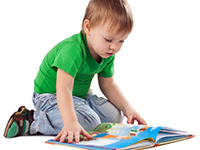
Story Time/Library Rules
| In the library center, we… | ||
 |
 |
 |
| Follow directions | Turn pages gently | Take care of books |
Art Center Rules
| In the art center, we… |  |
| Share materials with friends |  |
| Put on a smock before painting |  |
| Follow directions |  |
| Put artwork away when done |  |
Music and Movement Rules
|
Music and Movement Rules
|
|
| Use gentle touches |  |
| Dance on the carpet |  |
| If tired, take a break |  |

Activity
- Mrs. Rodriguez, the teacher in the Challenge, has eight classroom rules. Is this an acceptable number of rules? (Yes|No)
Now, read over the following list of Mrs. Rodriguez's rules and identify whether they follow the guidelines for developing classroom rules in early childhood. Mrs. Rodriguez’s rules are:
- Be ready to learn.
- Don’t talk loudly in the classroom.
- Think before acting.
- Sit on the carpet and don't touch other friends.
- Follow directions.
- Be respectful.
- Wheel or walk safely.
- Work and play in a safe manner.
Displaying Rules
Did You Know?
Teachers should handwrite or print each rule next to the corresponding visual. This helps promote early literacy skills. Teachers can also include the home languages of children on the rules poster, something that demonstrates respect for the child’s home language and supports EBLLs.
Once the rules are developed, they need to be displayed so that teachers and children can refer to them throughout the day. There are two key guidelines for displaying rules in early childhood settings:
Post rules at children’s eye level: Posting rules at children’s eye level allows them to easily see and reference them when needed.
Include a visual to illustrate each rule: Young children, who typically are not yet reading, need to be able to quickly reference the rules without being expected to memorize them. Even older children, who can read, should be given illustrated rules to ensure that they can easily and efficiently reference them when needed. Children who are emergent bilingual learners (EBLLs)—those in the process of learning two languages—might benefit from visual supports in particular. Visual supports can take many forms (e.g., photographs, picture symbols, written words, clip art, line drawings, physical objects). There are also commercially available software programs and apps that can assist with illustrations. The type of visual support used should be based on the needs and abilities of the children in the class. Some children respond better to photographs of themselves and their peers engaging in the rules, while others prefer line drawings. Teachers can combine different types of visual supports (e.g., photographs and line drawings) to accommodate a variety of needs and abilities. For example:
emergent bilingual learner (EBLL)
glossary
- Some children with disabilities, such as those with autism, might respond better to simple illustrations (e.g., line drawings), which contain fewer visual distractions than photographs or complex illustrations.
- Children with low vision often benefit from the use of larger visuals or concrete objects that they can touch.
In these interviews, Amanda Higgins and Erica Roy discuss developing and displaying classroom rules.


Transcript: Amanda Higgins, MEd
There are a couple of really important things to make your rules meaningful for kids. One of the things that I think is top of my list about rules is to keep them positively stated. We always want to be telling kids what to do rather than what not to do. I also think that keeping them few in number so that kids can remember them, so that they’re meaningful throughout the day. My rule of thumb is to stay between three and five rules so that those are always things that can be in the front of their mind. They can remember them in lots of different centers throughout the day. I also think it’s really important to have them posted, to have visual representations of what those rules are so that kids don’t have to just remember them but that you can refer to them throughout the day. You can use your words to say, “Remember the posted rules over there.” You can just point to things. You can pull pictures off the walls and show kids. It’s really valuable to have that resource in the classroom to use with them. When you’re developing rules, making them really concrete for your kids to understand—whether you work in an environment where you have some broad expectations, things like be respectful, be responsible, be safe—you want to make sure that you have defined those in ways for kids that are really concrete. So what does it mean to be respectful? What does it mean to be safe? What does it look like with our hands and feet being safe in the classroom? So any way that you can make it concrete and really understandable for kids.
Transcript: Erica Roy
I start the process of developing rules in the summer before the school year begins, learning about the school-wide expectations. I start thinking about what I will expect from students when they come in.
I like to base my classroom rules on the school’s rules as a whole. At my school we have four main rules: We’re supposed to be kind, be safe, be respectful, and be responsible. At the start of the year and all throughout the year, we talk about what that looks like in each space that we visit. But of course, especially with kindergarten, we also break it down to think about what exactly does this look like when you go to the bathroom or when you’re outside at recess versus sitting on the carpet?
We start every year with reading a book that talks about how our classroom is a family. I feel like that read-aloud at the beginning of the year is a start of our discussion on, like, values, what it means to be here together in a classroom and how we should treat one another. After going through that, I will invite students to share their own ideas about rules and what a safe classroom looks like, how we can all work together, how we can learn from one another, how we can show respect. What does it mean to be kind? What does that mean at our table spots? What does that mean on the carpet? What does that mean in different settings? We have big discussions about this, and it’s not just one discussion. We might have one discussion about one type of rule or expectation and really hit that one hard and then come back to it again. I also try to keep the number of rules manageable while also hearing out all ideas. We’ll do little bullet points so everyone has their voice heard, but I try to keep a condensed amount of rules so that we can focus on the most important things and it makes it a little easier to remember.
When developing rules, I think it’s really important to make sure that they’re inclusive, meaning that they apply to all children regardless of any different abilities or different language abilities. When creating rules, I try to make sure that they are clear, positive, understandable, and applicable to all students. To do this, I try to phrase rules in a way that emphasizes the intention behind the rule rather than a specific action. So instead of rules that I would typically say, like “Use walking feet in the hallway,” I need to reframe that to “Move safely around the classroom.” And I need to think about, What does that rule mean? Well, the intention behind the rule is I need all students to be safe. I think it’s important to take the time to do these things so that way you can create a space where all students feel accepted and confident and safe. We also include visuals to help represent each rule, and it’s also just a quick reminder for them. And then when working with bilingual learners, I want to make sure that they fully understand the rules and they also feel included and supported in the classroom. And so the use of visuals really helps these students as well. I also use simple language and repeat the key words and phrases. And then, of course, modeling the behaviors I expect for my bilingual learners, so demonstrating what the expectation looks like in different settings as well.
Revisit Mrs. Rodriguez's Classroom
Mrs. Rodriguez thinks she knows which rules are important for her classroom. However, she wants to involve her children in helping to generate them, so she begins the next school day with a large-group discussion about behavior expectations. She shows her children a poster of the school-wide expectations and reads them aloud.
She says, “We’re going to talk about what each of these expectations means for us, and then we are going to make our own classroom rules!”
 This begins a lively conversation about appropriate classroom behavior. Jerry is one of the first children to offer input for a new classroom rule. He says, “At school, you can’t hit people and push them and take their stuff.”
Mrs. Rodriguez responds, “That’s right! At school, you have to use gentle touches so people don’t get hurt.”
As the discussion continues, Mrs. Rodriguez uses easel paper to jot down the rules the children generate.
