How can teachers encourage and reinforce expected behaviors?
Page 6: Providing Positive Feedback
 Besides reminders, teachers should provide positive feedback—verbal or non-verbal (e.g., smile, thumbs-up) affirmations—to children when they follow the rules during classroom routines and activities and in other school locations (e.g., playground, cafeteria). In addition to teachers, other adults in a program should always be looking for opportunities to acknowledge children who are engaging in expected behaviors throughout the day. This includes food service staff, librarians, office staff, administrators, and custodial staff. The purpose of positive feedback is to increase the likelihood that children will engage in appropriate behavior. Children who struggle with the rules need this positive feedback the most. Educators should comment right away when these children follow the rules, no matter how simple it seems. This feedback is critical to their improvement and success. Furthermore, it should be:
Speak a word of affirmation at the right moment in a child’s life and it’s like lighting up a whole roomful of possibilities.
Gary Smalley
- Based on appropriate behavior or on the child’s effort to engage in the appropriate behavior
- Descriptive of the child’s desired behavior
- Sincere and conveyed with enthusiasm
- Provided frequently, especially for children who have trouble following the rules
- Individualized based on the child’s strengths and needs (e.g., visual supports, verbal statements, close proximity) and preferences (e.g., whether the child is comfortable being praised in front of others or prefers private recognition)
The most powerful positive feedback is behavior-specific praise, or descriptive praise—a positive declarative statement directed toward a child or group of children that describes a desirable behavior in specific, observable, and measurable terms. This involves saying the child’s name and specifying what was done correctly.
Examples:
“Wow! Bianca, you washed your hands all by yourself! You didn’t need any reminders!”
“Harper and Reagan, thank you for following directions and pushing in your chairs!”
Non-examples:
“Good job!”
“Thank you, friends!”
To learn more about this strategy, review the IRIS Fundamental Skill Sheet below.
Did You Know?
When a teacher provides behavior-specific praise to a child, often other children will hear and engage in that behavior as well. For example, the teacher directs the class to clean up for the transition and provides behavior-specific praise to a few children who immediately follow directions: “Micayla and Patrick, fantastic job cleaning up the art studio and throwing away your trash!” The teacher says this in a voice loud enough for the other children to hear. She gives all children who subsequently clean up a high five when they line up at the door for the transition outside.
Research Shows
- A review of characteristics indicates that clearly defined consequences linked to the rules positively impact their effectiveness.
(Alter & Haydon, 2017) - Decades of research have shown that praise is a low-intensity and effective strategy that teachers can use to decrease challenging behavior and increase positive behavior (e.g., time on task, student engagement).
(Ennis et al., 2020; Royer et al., 2019; Cavanaugh, 2013) - A general 4:1 ratio of praise to reprimand statements is desirable. Another recommendation is using about six praise statements every 15 minutes.
(Myers et al., 2011; Piscareta et al., 2011)
Sometimes teachers must intensify their efforts to offer positive feedback, particularly with children who struggle with the rules. Teachers can acknowledge individual or group progress and success in following classroom rules by:
 Sending a positive note home with the child
- Making a positive phone call home
- Photographing a child following a rule and putting the photo by the posted rule
- Writing the child’s name, their behavior, and the date on a handprint or classroom symbol, then posting it on a wall or bulletin board
- Giving a classroom cheer (e.g., “I saw D’Onte, April, and Charise waiting so safely for the slide. Let’s give a big cheer!”)
- Giving the child a stamp on the hand or a small sticker
- Letting the child be the line leader or teacher’s special helper for the day
In this interview, Erica Roy describes the importance of providing positive descriptive feedback to children when they follow the rules.

Erica Roy
Kindergarten teacher
Transcript: Erica Roy
I think providing positive feedback after children engage in the expected behavior is very important because it reinforces that behavior and helps students feel a little bit more confident and proud of their good choices. It encourages them to continue making those positive choices. I’ll do positive reinforcement individually and also in a bigger group. So in a more individual sense, if I notice a student is using their quiet voice, I might say, “I notice you’re being very respectful using your quiet voice when you’re working, that way we can all stay focused. That helps all of us. Thank you so much.” Little comments like that that I like to give them throughout the day when I notice them making good choices lets them know that I noticed their effort. And then it also gets other students to join along, too, when they notice that one friend is getting some reinforcement. It’s kind of a natural reminder for them as well. And then sometimes when they’re doing group work, I might say to the whole class, “I notice you all listening to your partner and waiting your turn. That’s how we make sure that everyone gets a chance to share. Great job.” And again, I’m explaining, like, why this is a good choice, which I think is really important for them to understand why they’re engaging in the right behavior and why they should continue doing that and how it impacts the friends around them as well.
I think to make praise authentic is to make sure that it’s genuine and specific for children. Instead of just a “good job,” I like to make sure it’s closely tied to exactly what I’ve seen the child doing so they know exactly what they’re being praised for and exactly what they are being encouraged to continue. I think that’s the main thing for me.
Revisit Mrs. Rodriguez's Classroom
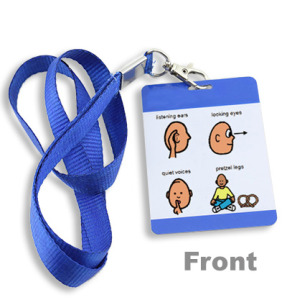
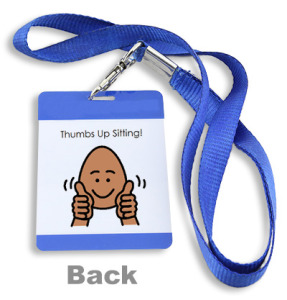
Mrs. Rodriguez decides to create a system for communicating with children during group time about whether they are following classroom rules. In the past, she had difficulty offering praise during group time without stopping the activity completely. To overcome this problem, Mrs. Rodriguez constructs a necklace that has the rules on one side and a thumbs-up picture on the other. By showing the appropriate side of the necklace, she can gently and silently remind her children about the desired behavior if they are not following the rules during an activity or can provide them with positive reinforcement if they are doing what they should.
Credit
The Picture Communications Symbols ⓒ1981–2014 by Mayer-Johnson LLC. All Rights Reserved Worldwide. Used with permission.
For Your Information
Educators must monitor their own behavior to ensure that they are providing more positive feedback than giving directions or correcting inappropriate behavior. To do this, they can use self-management strategies. There are different strategies teachers can use to monitor their own behavior, such as:
self-management strategy
glossary
- Putting rubber bands on a wrist and moving one to the other wrist every time they provide a positive descriptive comment to a child, with the goal of transferring all the rubber bands during each activity or routine of the day
- Tallying the number of times they use positive feedback during the day on a sticky note, board, or clipboard
- Using a timer as a cue to provide positive feedback at regular intervals
- Asking a coworker to count the number of times they use positive feedback
