How can teachers encourage and reinforce expected behaviors?
Page 8: Sharing Rules with Families
Once teachers have established classroom rules, they should communicate those rules to the families, which includes parents, caregivers, guardians, extended family members, and foster families. Educators often do this by sending home a letter, such as this sample letter regarding the classroom rules. By communicating and informing families of the rules, teachers can:
Sample Classroom Rules Letter
Date
Dear Families,
In our class, we have been working on learning the rules of our classroom! I want to share them with you so you know what we are working on and so you can talk with your child about the rules if you would like. Our rules are:
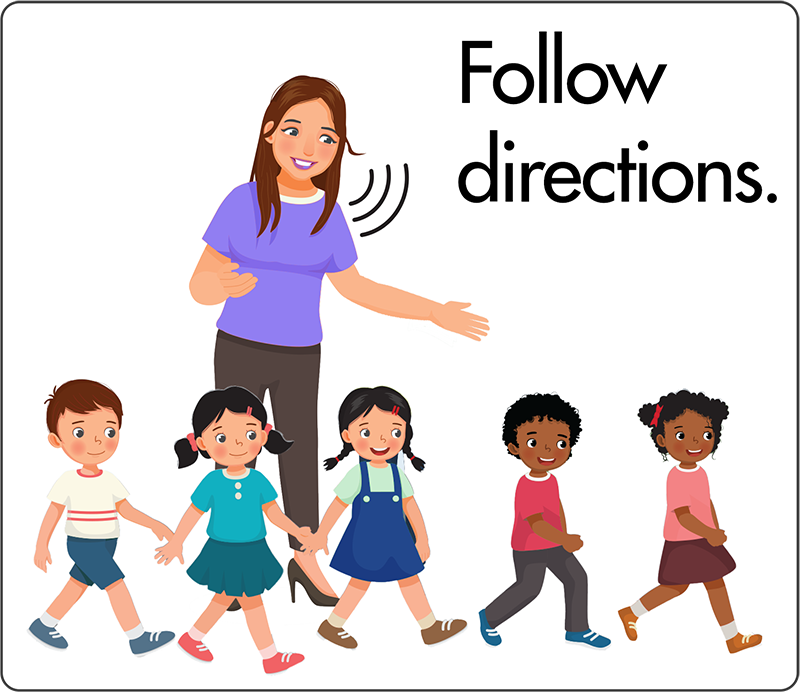


In our classroom, we focus on reinforcing children for following the rules and reminding them of the rules throughout the day and when they need extra help. We also encourage them to think about why the rules are important.
If you are interested in teaching household rules to your child, please let me know and I will be happy to give you some information and support.
Please contact me if you have any questions!
Thank you,
(Close this panel)
- Inform families of the expected school behaviors
- Promote consistency between home and school
- Lay the foundation to establish positive relationships
 Communicating and informing families about classroom rules can open an important dialogue about developmentally appropriate behavior expectations for young children and effective ways to encourage young children to follow the rules. This is an important step in establishing a mutual understanding between parents and teachers about the rules. Further, this dialogue allows opportunities to discuss similarities and differences between home and school rules. This allows educators and families to be as consistent as possible and to work together to help children navigate the expectations of the different environments.
Educators should communicate with families regularly throughout the year. To foster positive relationships with families, teachers can share information about children’s successes, including how they follow the rules. Teachers can also invite families to class celebrations when the class has earned a reward, or they can encourage family members to acknowledge the children’s successful school behavior. When teachers have positive relationships with families, it can be easier to engage in discussions when children are having difficulty following the rules.
Research Shows
Positive teacher-family relationships help create a supportive context, which allows teachers to address the challenging behaviors of children should they arise.
(Fettig & Ostrosky, 2011)
Mary Louise Hemmeter talks about the importance of communicating with families of young children about behavior expectations and classroom rules. Next, Erica Roy also discusses the importance of communicating rules with children’s families and shares how she does so.

Mary Louise Hemmeter, PhD
Nicholas Hobbs Chair
in Special Education and Human Development
Vanderbilt University
(time: 1:20)

Transcript: Mary Louise Hemmeter, PhD
It’s important to be proactive with families prior to there being a problem behavior. And when we begin to talk about rules and expectations and what our approach to discipline is in classrooms, it’s important that we talk to families about that as well. If an important expectation in the classroom is to be respectful, we want parents to talk to their children about what it means to be respectful at home. That way when there is a problem, we’ve established with parents what our expectations are and we can talk about the behavior as it relates to engaging or not engaging in that expectation. It’s also the case that we expect parents to just know these things, and we can’t expect them to just know what to do about them if we’re not proactive in helping them know what the expectations are and what some ways are that they can promote those expectations at home. Another thing that helps when we have expectations is to have families talk about what their expectations are for children at home and for us to talk about what expectations are at school and to help children understand that sometimes the expectations we have at school are different than the expectations that families have at home, to help them bridge the gap. Expectations are going to be different there.
Transcript: Erica Roy
I think sharing classroom rules with students’ families is extremely important because it helps extend the rules beyond the classroom. When families are aware of the expectations at school, they can help reinforce those expectations and those behaviors at home as well, which helps create consistency for children in their home environment and the school environment. And they also understand that the rules apply in both places, which makes it easier for them to remember those rules and follow those expectations. I also think it creates a strong partnership between families and teachers when you have that open communication. It helps hold students accountable when they know that their families are also aware and on board with the rules, which helps them take responsibility for their own actions and just overall understand the importance of that. Some strategies I use to share rules with families: At my current school, we do a curriculum night and open house before the kindergartners start school. During that time, it’s a chance for the parents to get to know me without any students there yet. And during that time, I give a presentation on what kindergarten looks like. And a big part of that presentation is our classroom rules and expectations and what their students will be expected to do in kindergarten and how they can help ensure that their student is ready for kindergarten as well in those last couple of weeks before school begins. I really like this time because it also gives them a chance to ask any questions they might have and it’s just an opportunity for us all to be on the same page and start the year off with clear communication. And then during our parent-teacher conferences, we might revisit the rules at some point. But I can check in with families about how things are going at home and if there’s anything specific that they’d like to address or anything that I can help support at school. I also do weekly newsletters. I will include different social-emotional things that we’re talking about in the classroom, so it might not be, like, directly a list of our expectations on our newsletter. But, for example, we did a social-emotional unit on growth mindset. I talk about that, and relating that to our expectations also is another way that I communicate with families. Of course, there’s always two-way communication. Families are always able to reach out to me at any point with any questions or concerns, and they’ve also been very open to me communicating with them to ask any questions just to keep that consistency.
For Your Information
Teachers can also encourage their children’s families to establish household rules. To help families establish rules, teachers can discuss guidelines for creating and teaching them (e.g., have no more than five rules, ensure rules are positively stated), the importance of reviewing and practicing them, and the value of positive feedback instead of criticism or punishment. Educators should keep in mind that families could have different priorities for household rules than those the educators might recommend. As such, it is important that educators have open and respectful communication with families and avoid judging families or discounting their perspectives.
Revisit Mrs. Rodriguez's Classroom
 Mrs. Rodriguez is so proud of the children’s progress in following the classroom rules. She sends a letter home detailing the rules and their new classroom reinforcement system. Subsequently, she begins to receive comments from families about the new classroom rules, their children’s enthusiasm for the new classroom reinforcement system, and how their children are excited to go to school every day.
