What evidence-based mathematics instructional practices can educators implement?
Page 6: Visual Representations
 Another evidence-based practice to help students learn abstract mathematics concepts and solve problems is the use of visual representations—accurate depictions of a problem’s mathematical quantities and relationships. Visual representations are flexible; they can be used across grade levels and types of math problems. Additionally, they can be used by educators to teach new concepts and by students to solve problems.
To help students understand mathematical ideas, educators must explicitly connect visual representations to abstract representations—mathematical notations, such as equations, numbers, and symbols. When educators skip this step, some students might not understand the purpose of the visual representation or how it helps them solve the abstract problem. Visual representations can take many forms, including concrete, semi-concrete, and virtual, all of which are discussed below.
Concrete Representations
concrete representation
glossary
manipulatives
glossary
Concrete representations, sometimes referred to as manipulatives, are three-dimensional objects that can be touched, moved, or “manipulated” to (1) help students develop a conceptual understanding of mathematical concepts and (2) represent the mathematical idea they are trying to learn or the problem they are attempting to solve. These types of visual representations can be used by students in kindergarten through high school and are especially beneficial for young children and students who struggle with mathematics. They can be used to represent numbers or to solve algorithms associated with the four operations: addition, subtraction, multiplication, and division. Additionally, they can help students better understand fractions, geometry, and measurement. For example, the student in the photo above is using fraction circles to determine how many parts are in a whole.
 Definition: Small items that can be easily manipulated (e.g., plastic bears, colored blocks).
Common Uses
- Counting with one-to-one correspondence
- Sorting and classifying
- Creating or completing patterns
- Modeling addition and subtraction basic facts
- Practicing fine motor skills
 Definition: Round chips that are red on one side and yellow on the other side.
Common Uses
- Counting item (review the above uses)
- Representing addition, subtraction, multiplication, and division facts
- Understanding integers (yellow usually represents positive and red negative)
- Understanding probability
- Representing fractions (e.g., 5 out of 12 = 5/12)
 Definition: Manipulatives that consist of ones, tens, hundreds, and thousands blocks.
Common Uses
- Understanding the base 10 number system (place value)
- Conceptually understanding what it means to regroup numbers
- Modeling addition and subtraction problems with two or more digits
- Modeling multidigit multiplication and division problems

Definition: Board with pegs—usually a square grid on one side and a circular model on the other—that students place rubber bands on to demonstrate and practice mathematical concepts.
Common Uses
- Showing geometric shapes (e.g., triangles, squares, hexagons)
- Showing symmetry, congruence, and angles
- Finding perimeter and area
- Showing multiplication arrays
 Definition: Bars—often made of plastic or wood—that are divided into equal sections. Sets usually consist of one bar representing a whole and those that illustrate the fractional parts for halves, thirds, fourths, fifths, sixths, eighths, 10ths, and 12ths.
Common Uses
- Showing equivalent fractions
- Comparing values of fractions
- Modeling addition and subtraction of fractions
 Definition: Consists of seven geometric shapes that form a perfect square when put together.
Common Uses
- Promoting visual-spatial awareness
- Building problem-solving skills
- Understanding rotating and sliding concepts in geometry
Semi-Concrete Representations
Semi-concrete representations are two-dimensional images or pictorial representations that can help students develop a conceptual understanding of mathematical concepts. They include images of concrete representations or those drawn by students. The links below include some of the most commonly used semi-concrete representations used by educators and students.
semi-concrete representation
glossary
Definition: A straight line that shows the order of and the relation between numbers.
Common Uses
- Early counting and cardinality
- Representing positive and negative integers, fractions and their equivalencies etc.
- Understanding concepts of addition, subtraction, multiplication, and division

Research Shows
- Number lines are beneficial for supporting students’ conceptual understanding of numerical magnitude and fractions.
(Fuchs et al., 2016; Fuchs, Wang et al., 2021; Jordan et al., 2023; Jordan et al., 2024)
numerical magnitude
glossary
Definition: A bar divided into rectangles that accurately represent quantities noted in the problem.
Common Uses
- Addition
- Fractions
- Proportions
- Ratios

Definition: Simple drawings of concrete or real items (e.g., marbles, trucks, paper clips).
Common Uses
- Counting
- Addition
- Subtraction
- Multiplication
- Division

Definition: Drawings that depict information using lines, shapes, and colors.
Common Uses
- Comparing numbers
- Statistics
- Ratios
- Algebra


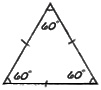
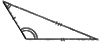
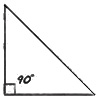
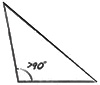
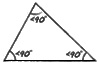
Definition: Visuals that assist students in remembering and organizing information, as well as depicting the relationships between ideas (e.g., word webs, tables, Venn diagrams).
Common Uses
- Algebra
- Geometry
| Triangles | ||
|---|---|---|
| equilateral |
|
 |
| isosceles |
|
 |
| scalene |
|
 |
| right |
|
 |
| obtuse |
|
 |
| acute |
|
 |
Before they can solve problems, however, students must first know what type of visual representation to create and use for a given mathematics problem. Some students—specifically, high-achieving students or gifted students—do this automatically, whereas others need to be explicitly taught which representations to use and how to use them. This is especially the case for students who struggle with mathematics and those with mathematics learning disabilities. Without explicit, systematic instruction on how to create and use visual representations, these students often create visual representations that are disorganized or contain incorrect or partial information. Consider the examples below.
Elementary Example
Mrs. Aldridge asks her first-grade students to add 2 + 4 by drawing dots.
Talia draws the following:
Colby draws the following: 
Notice that Talia gets the correct answer. However, because Colby draws his dots in haphazard fashion, he fails to count all of them and consequently arrives at the wrong solution.
High School Example
Mr. Huang asks his students to solve the following word problem:
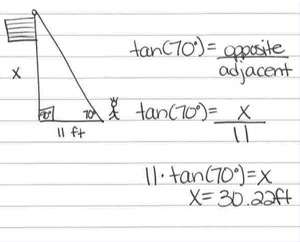
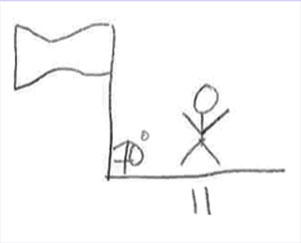
The flagpole needs to be replaced. The school would like to replace it with the same size pole. When Juan stands 11 feet from the base of the pole, the angle of elevation from Juan’s feet to the top of the pole is 70 degrees. How tall is the pole?
Compare the drawings below created by Brody and Zoe to represent this problem. Notice that Brody drew an accurate representation and applied the correct strategy. In contrast, Zoe drew a picture with partially correct information. The 11 is in the correct place, but the 70° is not. As a result of her inaccurate representation, Zoe is unable to move forward and solve the problem. However, given an accurate representation developed by someone else, Zoe is more likely to solve the problem correctly.
Brody
Zoe
Virtual Manipulatives
With the increasing use of technology, virtual manipulatives—visual representations that are viewed or manipulated on an electronic device—are being used by educators during instruction to model concepts. Virtual manipulatives offer educators an opportunity to illustrate mathematical concepts and relationships without relying on extra sets of materials. Additionally, virtual manipulatives are infused into computer-based math programs to aid in student learning.
virtual manipulative
glossary
Fading Visual Representations
High-Leverage Practices
The content on this page aligns with the following HLP.
HLP 15: Provide scaffolded supports.
The goal is for students to eventually understand concepts and procedures without relying on visual representations. Shifting students from concrete or semi-concrete representations to only using abstract representations can be difficult for some students, especially those with MLD. One strategy educators can use to help students systematically transition from visual representations to abstract representations is the Concrete–Semi-Concrete–Abstract (CSA) approach.
Concrete–Semi-Concrete–Abstract (CSA) approach
glossary
Concrete–Semi-Concrete–Abstract (CSA) Approach
 The Concrete–Semi-Concrete–Abstract (CSA) approach helps students gain a conceptual understanding of a mathematical process, rather than just completing the algorithm (e.g., 2 + 4, 2x + y = 27). Systematically connecting visual representations to the abstract notation or equation is a way to scaffold a student’s understanding. When teachers use concrete and semi-concrete representations to accurately demonstrate mathematical procedures, students are more likely to apply the procedure when solving abstract equations.
CSA is effective across all age levels and can assist students in learning math concepts, procedures, and applications. Educators should use explicit instruction and continually monitor student work to assess their understanding, asking them questions about their thinking and providing clarification as needed.
Another approach is the CSA-Integrated (CS-I) approach—a modified version of the CSA approach in which the educator presents concrete, semi-concrete, and abstract representations at the same time, allowing students to make direct connections among them. This approach is effective for teaching a range of math concepts (e.g., place value, algebra, fractions) to students with math difficulties or MLD.
CSA-Integrated (CS-I) approach
glossary
The examples below illustrate the concrete, semi-concrete, and abstract representations for elementary and secondary concepts.
Simple addition
- Concrete—Students use pencils to represent the quantities they are adding together. Then, the quantities are combined to represent the sum.
- Semi-concrete—Students use tally marks to represent the quantities they are adding together. Then, the quantities are combined to represent the sum.
- Abstract—Students write the equation and the answer.

Algebra
- Concrete—Students use colored tiles to represent the algebra problem.
- Semi-concrete—Students use two-dimensional drawings of tiles to represent the problem.
- Abstract—Students write the equation and the answer.
Simplify the expression: 4 + (-7)
Concrete Representation

Semi-Concrete Representation

Abstract
4+(-7)= -3
Research Shows
- Using visual representations to teach mathematics, and teaching students to use visual representations, helps students understand abstract mathematical concepts. Further, teaching students to use visual representations helps them draw connections among variables, quantities, and relational terms in word problems.
(Boonen et al., 2014; Jitendra & Woodward, 2019; Fuchs, Newman-Gonchar et al., 2021) - Although concrete and semi-concrete representations are included in core instructional programs, students who struggle with mathematics need explicit instruction on how to use representations to model mathematical ideas.
(Jitendra et al., 2016) - Explicitly connecting concrete, semi-concrete, and abstract representations during instruction helps students transfer their understanding of mathematics from the visual representation to the abstract representation.
(Fuchs, Newman-Gonchar et al., 2021) - Students who use accurate visual representations are six times more likely to correctly solve mathematics problems than students who do not use them. However, students who use inaccurate visual representations are less likely to correctly solve mathematics problems than those who do not use visual representations.
(Boonen et al., 2014) - Students who use visual representations to solve word problems are more likely to solve the problems accurately. This was equally true for students who had a learning disability (LD), were low achieving, or were average achieving.
(Krawec, 2014) - Students who have LD often do not create accurate visual representations or use them strategically to solve problems. Teaching these students to systematically use visual representations to solve word problems has led to substantial improvements in their math achievement.
(van Garderen et al., 2012; van Garderen et al., 2014)
Kim Paulsen discusses the benefits of manipulatives and a number of things to keep in mind when using them (time: 2:35).
Kim Paulsen, EdD
Professor, Special Education
Associate Director, IRIS Center
Vanderbilt University

Transcript: Kim Paulsen, EdD
Manipulatives are a great way of helping kids understand conceptually. The use of manipulatives really helps students see that conceptually, and it clicks a little more with them. Some of the things, though, that we need to remember when we’re using manipulatives is that it is important to give students a little bit of free time when you’re using a new manipulative so that they can just explore with them. We need to have specific rules for how to use manipulatives, that they aren’t toys, that they really are learning materials, and how students pick them up, how they put them away, the right time to use them, and making sure that they’re not distracters while we’re actually doing the presentation part of the lesson. One of the important things is that we don’t want students to memorize the algorithm or the procedures while they’re using the manipulatives. It really is just to help them understand conceptually. That doesn’t mean that kids are automatically going to understand conceptually or be able to make that bridge between using the concrete manipulatives into them being able to solve the problems. For some kids, it is difficult to use the manipulatives. That’s not how they learn, and so we don’t want to force kids to have to use manipulatives if it’s not something that is helpful for them. So we have to remember that manipulatives are one way to think about teaching math.
I think part of the reason that some teachers don’t use them is because it takes a lot of time, it takes a lot of organization, and they also feel that students get too reliant on using manipulatives. One way to think about using manipulatives is that you do it a couple of lessons when you’re teaching a new concept, and then take those away so that students are able to do just the computation part of it. It is true we can’t walk around life with manipulatives in our hands. And I think one of the other reasons that a lot of schools or teachers don’t use manipulatives is because they’re very expensive. And so it’s very helpful if all of the teachers in the school can pool resources and have a manipulative room where teachers can go check out manipulatives so that it’s not so expensive. Teachers have to know how to use them, and that takes a lot of practice.
